If you are asking how much does humidifier cost, budget about £25–£80 for a useful bedroom model or £100–£180 for a capable evaporative machine. Electricity can be surprisingly cheap for cool-mist units—often pennies per day—but warm-mist models, replacement filters and distilled water can change the total far more than the purchase price suggests.
In This Article
- How Much Does Humidifier Cost? The Short Answer
- What You Pay for Each Type of Humidifier
- How Much Electricity Does a Humidifier Use?
- Humidifier Running Cost Examples
- Filters, Water and Cleaning Costs
- What Makes One Humidifier More Expensive?
- How to Spend Less Without Buying Twice
- Is a Humidifier Worth the Cost in a UK Home?
- Frequently Asked Questions
How Much Does Humidifier Cost? The Short Answer
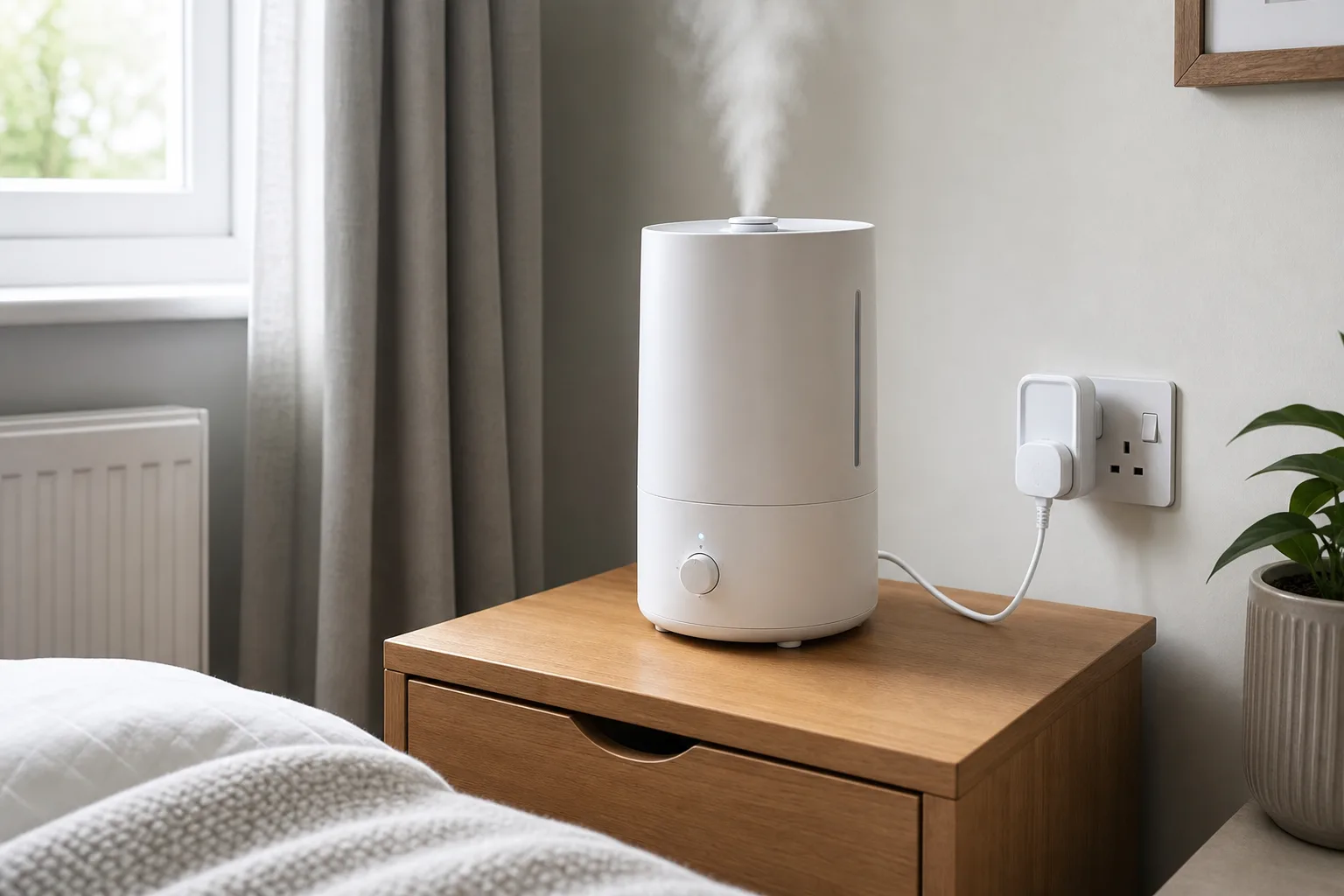
For most UK bedrooms, £40–£70 is the sensible buying range. That gets you a proper 3–5 litre ultrasonic humidifier with variable output, automatic shut-off and enough capacity to run overnight. Tiny USB models below £20 are closer to personal desk misters: they may make the air immediately around you feel less dry, but they are rarely a good answer for a whole room.
The full cost breaks down into four parts:
- Purchase price: roughly £20 for a mini unit, £35–£80 for mainstream ultrasonic models, and £100–£180 for a larger evaporative machine.
- Electricity: usually under £2 per month for an efficient cool-mist unit used eight hours a day, but potentially £15 or more for a heated warm-mist model.
- Consumables: £0 for a filter-free design, or perhaps £20–£60 a year for replacement wick filters depending on the model and your water hardness.
- Water and cleaning: tap water costs very little; bottled distilled water can cost far more than the electricity if you use it every day.
My practical answer is to avoid choosing on purchase price alone. A £30 ultrasonic machine that needs bottled water and frequent descaling may cost more to live with than a £100 evaporative model running on low power. Equally, buying a £600 purifier-humidifier combination makes little financial sense if all you need is comfortable humidity in one bedroom.
Before spending anything, check that the room is actually dry. Our guide to measuring humidity at home explains how to get a useful reading. A £10–£20 hygrometer can prevent a much more expensive wrong purchase.
What You Pay for Each Type of Humidifier
The technology matters because it changes the purchase price, power draw and ongoing maintenance. Two white boxes that look almost identical on a retailer’s page can have very different costs over a winter.
Mini and USB humidifiers: about £12–£30
These small units suit a desk, hotel room or the area beside a bed. Most have tanks below one litre and limited moisture output. They are cheap to run, but low electricity use is not much of a victory if the unit cannot materially change the room’s relative humidity.
I would treat a mini humidifier as a personal comfort device, not the budget version of a full-room machine. Replacement cotton wicks can also be awkward to source once the original marketplace listing disappears.
Ultrasonic cool-mist models: about £30–£100
Ultrasonic humidifiers use a vibrating plate to create a fine mist. They dominate the affordable end of the UK market because they are quiet, compact and use relatively little electricity. Argos, Amazon UK, Boots and larger home-appliance retailers commonly stock this type.
The value point sits around £40–£70. Below that, you often lose a proper humidistat, a useful tank opening or dependable spares. Above £100, I would expect a larger tank, accurate humidity control, easier cleaning or meaningful smart controls—not just mood lighting.
Ultrasonic models can disperse minerals from hard tap water as white dust. That does not automatically make them a poor choice, but it can add the cost of filtered or demineralised water. Read our comparison of warm-mist and cool-mist humidifiers before assuming one technology suits every household.
Evaporative humidifiers: about £90–£200
An evaporative unit draws air through a wet wick or filter. The fan uses little power, while evaporation naturally slows as the room becomes more humid. That self-limiting behaviour is useful in a UK home where you do not want to turn dry winter air into condensation on cold windows.
These machines cost more upfront and are not silent. They also need replacement filters. In return, they do not normally throw mineral white dust into the room. Manufacturer specifications give a useful reality check: the Meaco Armin evaporative range, for example, lists low single-digit to 11W power consumption depending on size and fan setting.
Warm-mist humidifiers: about £40–£120
Warm-mist units heat water, so their electricity use is much higher. The warm vapour can feel comforting in winter, but you are paying to boil or heat water rather than merely move air or vibrate a membrane.
They also introduce a hot-water and steam risk. I would not choose one for a child’s room, and our humidifier safety guide for babies explains why cool mist is the safer default around young children.
Purifier and humidifier combinations: about £100–£700
Combination appliances save floor space and can coordinate air cleaning with humidity control. The price spread is enormous: modest evaporative purifier-humidifiers may sit near £100–£200, while premium multi-function machines can approach £700.
Only pay that premium if you need both functions. A combined machine also ties two jobs to one set of parts; if its humidifying system becomes hard to clean or filters are discontinued, you may be left with an expensive purifier doing half the work you bought it for.
How Much Electricity Does a Humidifier Use?
A humidifier’s maximum wattage tells you its upper-rate electricity use, not necessarily what it draws every minute. A humidistat may stop or reduce output once the target is reached, and fan speeds can have different power demands.
The calculation
Use this formula:
Watts ÷ 1,000 × hours used × electricity unit rate = running cost
From 1 July to 30 September 2026, Ofgem’s average Direct Debit electricity rate is 26.11p per kWh for England, Scotland and Wales. Your tariff and region may differ, so use the unit rate printed on your bill for a personal figure.
Do not add the daily standing charge to the humidifier calculation. You pay that charge for having an electricity supply whether the humidifier is on or not.
Wattage matters most with heated mist
Typical power bands look like this:
- Mini ultrasonic: about 5–15W.
- Room-size ultrasonic: commonly 20–40W.
- Evaporative: often around 3–15W for the fan and controls.
- Warm mist: commonly 200–300W because it heats the water.
- Purifier-humidifier: often 20–70W, though fan speed and added heating functions can raise this.
Always check the rating plate or manual for the exact model. Retail listings sometimes mix power figures between sizes or quote output in millilitres per hour beside wattage, which makes a quick scan surprisingly easy to misread.
Measure instead of guessing
If you already own the machine, a plug-in electricity monitor is better than a label-based estimate. Run the humidifier through a normal night, including any periods when its humidistat cycles down, then read the kWh total. Multiply that by your unit rate.
That measurement captures the way you actually use it. It also reveals expensive settings: a heated mode, high fan speed or always-on display may change the figure. Owners often focus on tank size, but the control mode can matter more to the bill.
Humidifier Running Cost Examples
The examples below use 26.11p per kWh and assume eight hours of operation every day for 30 days. They show an upper-bound calculation at the stated wattage; a humidistat-controlled machine may consume less once the room reaches its target.
| Humidifier type | Example power | Cost for 8 hours | Cost for 30 days |
|---|---|---|---|
| Mini ultrasonic | 10W | 2.1p | £0.63 |
| Room ultrasonic | 25W | 5.2p | £1.57 |
| Evaporative | 6W | 1.3p | £0.38 |
| Purifier-humidifier | 35W | 7.3p | £2.19 |
| Warm mist | 260W | 54.3p | £16.29 |
The striking result is not the difference between a 10W and 25W cool-mist unit. Both are cheap in electricity terms. The real dividing line is whether the appliance heats water.
What about all-day use?
Multiply the eight-hour figures by three for 24-hour maximum operation. A 25W ultrasonic model would then cost about 15.7p per day, or £4.70 over 30 days. A 260W warm-mist machine could reach about £48.87 over the same period if it drew full power continuously.
Real consumption should be lower when an effective humidistat cycles the machine. If it runs flat out all day without reaching the target, the likely problem is not your tariff: the unit may be undersized, the door may be open, or ventilation and air leakage may be removing moisture as fast as the machine adds it.
Filters, Water and Cleaning Costs
Electricity is only one part of humidifier ownership. For many cool-mist machines, maintenance costs more than power.
Replacement filters
Evaporative humidifiers depend on a wet wick or filter. Prices and replacement intervals vary, so check availability before buying the appliance. If a filter costs £15–£25 and lasts a season, that is manageable. If the model uses two filters and needs several changes a year in hard water, the annual bill can overtake the purchase price of a budget ultrasonic unit.
Do not stretch a filter indefinitely to save money. A scaled, discoloured or musty wick can reduce output and make the machine unpleasant to use. The correct comparison is the cost of keeping each option working properly, not the theoretical cost with neglected maintenance.
Tap, filtered or distilled water
Tap water itself is cheap enough to be negligible at household volumes. The complication is mineral content. Ultrasonic machines can leave white dust when used with hard tap water, while scale builds up inside heated and ultrasonic units.
Jug-filtered water may reduce some deposits but is not the same as distilled water. Buying several litres of distilled or demineralised water every week can easily cost more than the humidifier’s electricity. If your chosen model requires it and you plan to run the machine daily, price the water before checkout.
An evaporative machine can be the better-value choice in a hard-water area despite its filters, because minerals stay largely in the wick rather than being sprayed into the room. There is no universal winner: compare local water hardness, filter prices and your tolerance for cleaning.
Cleaning time and supplies
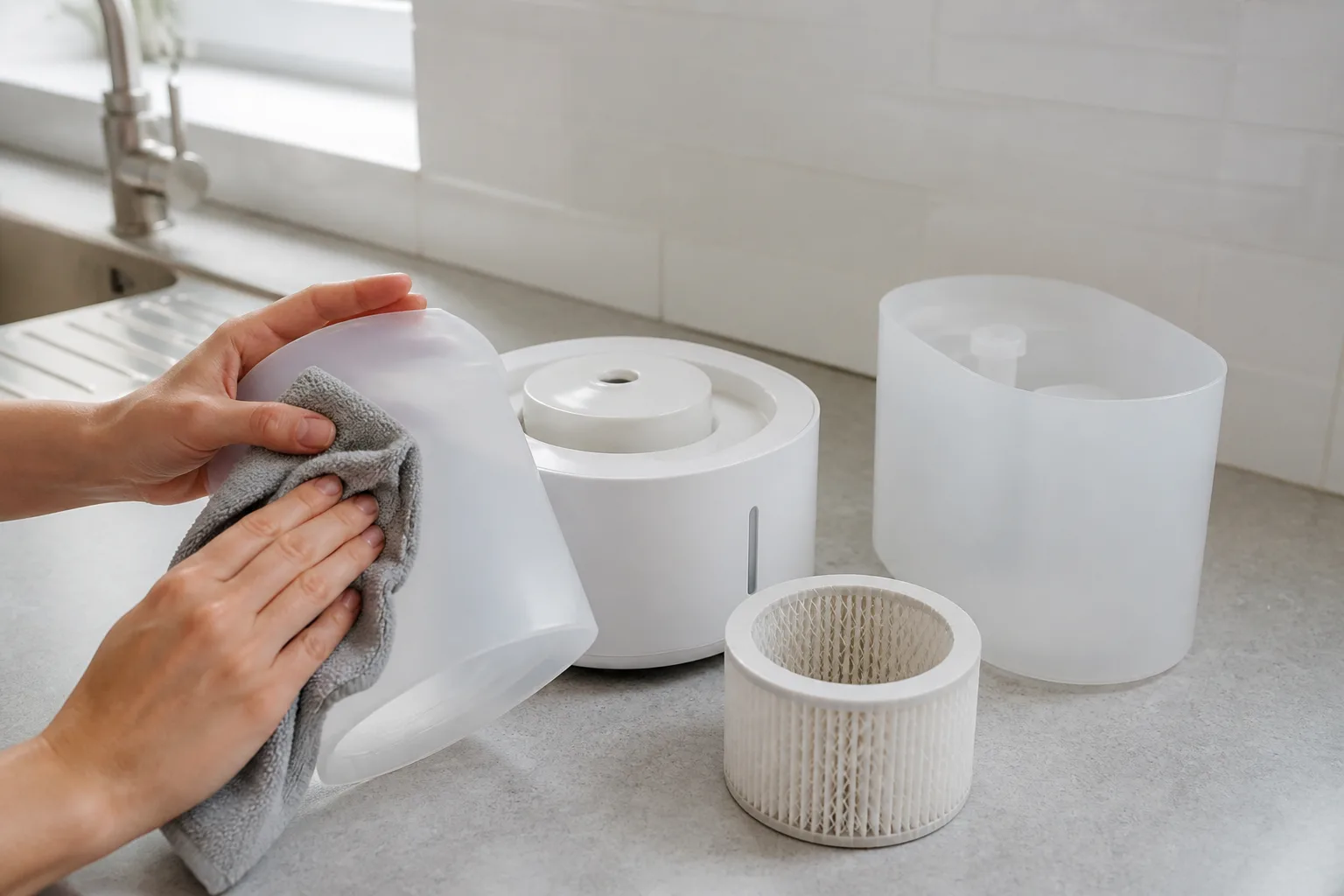
A reusable cloth, white vinegar where the manufacturer’s instructions permit it, and a small brush cost very little. Your time is the bigger issue. Tanks with narrow openings and hidden channels are fiddly, so they tend to be cleaned less often—the worst kind of false economy.
Our guide to preventing bacteria and scale in humidifiers covers the routine in detail. Based on reviewing appliance designs, I would pay a little more for a tank that opens fully and has accessible corners. That feature delivers more value than app control you stop using after the first week.
What Makes One Humidifier More Expensive?
A higher price can buy better control and easier ownership, but it can also buy decorative features with little effect on humidity.
Capacity and moisture output
Tank capacity tells you how long the unit may run between refills. Moisture output—usually quoted in millilitres per hour—tells you how quickly it can add water to the air. They are related but not interchangeable.
A large tank with weak output merely runs weakly for longer. Match the manufacturer’s room-size guidance to the closed room where you will use it. Our guide to choosing the right humidifier size explains the measurements that matter.
A proper humidistat
This is the feature worth paying for. A humidistat lets the machine reduce or stop output near a target humidity, saving water and power while limiting over-humidification.
Basic models may display a humidity reading without controlling to it accurately. Because the sensor sits close to the mist outlet, its reading can differ from the far side of the room. Check it against a separate hygrometer and aim for a sensible range rather than chasing an exact percentage.
Noise, construction and cleaning access
Bedroom models command more when they combine low noise with a large opening, leak-resistant tank and controls that dim at night. Those are useful upgrades. A louder evaporative fan may still be preferable in a living room if it controls minerals better.
Pay less attention to coloured lights, aroma trays and dozens of mist levels. Essential oils should never go into a water tank unless the manufacturer explicitly designed the appliance for them. They can damage plastics and create a cleaning problem rather than improve value.
Warranty and available spares
A recognised UK retailer and a two-year warranty can justify a modest premium. Check whether filters, caps, tanks and cleaning accessories are sold separately. A cheap marketplace model with no replacement parts becomes expensive the moment a small seal fails.
How to Spend Less Without Buying Twice
The cheapest humidifier is the one that meets the measured need, fits the room and remains easy enough to maintain that you continue using it.
Start with a hygrometer
Measure for several days, including overnight with the heating on. If relative humidity is already around 40–50%, adding a humidifier may create condensation rather than comfort. If readings regularly fall below about 30–35%, especially during winter heating, there is a clearer case for one.
Choose for one closed room
Portable humidifiers work best in a defined room with the door mostly closed. Trying to humidify an open-plan floor with a bedroom unit keeps it running at maximum output and still produces disappointing results.
Use this buying order:
- Measure the room: calculate its floor area and consider ceiling height.
- Choose the technology: ultrasonic for quiet, low-cost operation; evaporative for controlled output and less white dust; warm mist only when its specific benefits justify the power and heat.
- Check ongoing supplies: find the exact filter price and availability before buying.
- Inspect the tank design: wide openings and removable parts make regular cleaning realistic.
- Confirm the controls: prioritise a humidistat, timer and automatic shut-off over decorative extras.
Run it to a target, not forever
Set a reasonable humidity target and let the humidistat cycle. Keep doors and windows closed while it operates, then ventilate normally when needed. Placing the unit away from curtains, bedding, electronics and cold exterior walls also reduces damp patches.
Clean scale before it hardens, replace filters on condition and turn the machine off when the weather or heating pattern changes. These habits save more than obsessing over a few watts between two cool-mist models.
Is a Humidifier Worth the Cost in a UK Home?
It is worth the cost when you have measured dry indoor air and can target one room. A £40–£70 ultrasonic model may cost only £1–£3 a month in electricity, making it a modest winter comfort expense. A well-sized evaporative model costs more upfront but can be a better long-term fit where hard water and white dust are concerns.
It is poor value when humidity is already normal, the home has condensation or mould, or the machine is being bought as a medical cure. Humidifiers can make dry air feel more comfortable, but they do not replace diagnosis or treatment. If symptoms persist or you have a respiratory condition, seek appropriate medical advice rather than pushing indoor humidity higher.
The UK climate also changes the calculation. Many homes need moisture control in opposite directions at different times. If you are unsure which problem you have, compare the signs in our humidifier versus dehumidifier guide before buying either appliance.
My verdict: spend £10–£20 on a hygrometer first, then around £50 on a cleanable ultrasonic model for a genuinely dry bedroom. Move up to an evaporative unit when you need larger-room output or want to avoid mineral mist. Do not pay premium-combination prices unless air purification is independently useful to you.
Frequently Asked Questions
How much does a humidifier cost in the UK? A useful room humidifier generally costs £35–£100. Mini units can cost under £25, evaporative models are often £90–£200, and premium purifier-humidifier combinations can reach £700.
How much does a humidifier cost to run overnight? At 26.11p per kWh, a 25W cool-mist humidifier costs about 5.2p for eight hours at full rated power. A 260W warm-mist model costs about 54.3p for the same time.
Do humidifiers use a lot of electricity? Cool-mist ultrasonic and evaporative humidifiers usually use little electricity. Heated warm-mist models draw much more because they heat water.
Is it cheaper to run a humidifier all night or use the timer? A timer costs less if the room remains comfortable after the machine stops. A humidistat is better because it responds to actual humidity rather than running for a fixed period regardless of conditions.
Are filter-free humidifiers cheaper? They avoid replacement-filter costs, but may need more descaling or filtered water. Compare the complete cost for your water hardness rather than assuming filter-free always means cheaper.
Should I buy distilled water for a humidifier? Follow the manufacturer’s instructions. Distilled or demineralised water can reduce mineral dust and scale in ultrasonic machines, but buying it for daily use may cost more than the electricity.