Cool mist is the safer default for most UK homes, especially bedrooms used by children, pets or anyone likely to knock a unit over. Warm mist can feel comforting when the room is cold and some models are easier to keep hygienic, but the hot water and steam risk changes where I would use one. If you are choosing between warm mist vs cool mist humidifier options, I would buy cool mist for family bedrooms and only consider warm mist for a supervised adult room.
In This Article
- Warm Mist vs Cool Mist Humidifier Safety: The Short Answer
- What Warm Mist and Cool Mist Actually Do Differently
- Child, Pet and Bedroom Safety
- Hygiene, Minerals and Mould Risk
- Running Costs, Noise and Daily Convenience
- Which Type I Would Buy in the UK
- Frequently Asked Questions
Warm Mist vs Cool Mist Humidifier Safety: The Short Answer
Cool mist wins on physical safety because it does not boil water. That matters more than any small comfort advantage from warm vapour. A humidifier usually sits on a bedside table, chest of drawers, shelf or floor corner, and real homes have trailing cables, half-asleep adults, children, pets and laundry baskets in the way.
Warm mist models heat water before releasing vapour. That can reduce some contamination risk inside the unit, but it also means the appliance contains hot water and may release hot steam around the outlet. RoSPA’s burns and scalds advice is not written for humidifiers specifically, but it is relevant because it treats hot liquid and scald prevention as a household safety issue, particularly around children. If the unit can be reached, pulled, tipped or touched, the safer choice is cool mist.
My practical rule
For a child’s bedroom, nursery, pet area or overnight use, choose cool mist. For an adult bedroom where the unit is placed high, stable and away from the bed edge, warm mist is possible, but it still needs more thought.
The difference is not that cool mist is risk-free. It still uses water, it can leak, and it can spread minerals or microbes if you ignore cleaning. The point is simpler: cool mist removes the burn and scald risk from the decision. In a busy house, removing one serious failure mode is worth more than a slightly warmer plume of vapour.
Where warm mist still makes sense
Warm mist can suit an adult who wants a small amount of winter humidity in a cold bedroom, does not have children or pets wandering in, and is prepared to place the unit properly. Some people also prefer it because there is no visible white dust from ultrasonic mist, though that depends on the model and water hardness.
I would not use warm mist as a set-and-forget appliance. It belongs on a solid surface, away from fabric, away from the mattress, and somewhere you will not brush past it in the dark. If that sounds like a faff, that is the answer: buy cool mist.
What Warm Mist and Cool Mist Actually Do Differently
Both types add moisture to dry indoor air. The safety question comes from how they make that moisture.
Warm mist humidifiers heat water, then release warm vapour. Many UK shoppers will see models such as the Vicks VH845 Warm Mist Humidifier, which is about £58 at Argos and about £44-£58 on Amazon UK depending on stock and seller. These units are often marketed for cold-season comfort, coughs and congestion, though a humidifier is not a medical treatment.
Cool mist humidifiers do not boil the water. Ultrasonic models use vibration to create a visible mist. Evaporative models pass air through a wet wick or filter. In UK shops, common cool mist options include the Vicks VUL525 Mini Cool Mist Ultrasonic Humidifier at about £55 from Argos, the Babymoov Wave 2-in-1 at £39.99 from John Lewis, and larger Levoit 6L smart humidifiers at about £99.99 on Amazon UK.
Warm mist in normal use
Warm mist tends to feel better in a cold room because the plume is not chilly. It can also avoid the fine mineral dust that cheap ultrasonic units sometimes leave on nearby furniture. The downside is obvious once you have used one: the water chamber and outlet deserve respect. You would not put a kettle on a child’s bedside table. A warm mist humidifier is not a kettle, but it sits in the same risk family.
Warm mist can also use more electricity. A small ultrasonic cool mist unit may use roughly 20-30W, while a warm mist unit can draw far more because it heats water. Exact figures vary by model, but that difference can matter if you run it for several winter nights a week.
Cool mist in normal use
Cool mist is usually quieter, cheaper to run and safer near people. The trade-off is hygiene discipline. If you let water sit in the tank, skip cleaning, or use hard tap water in an ultrasonic model, you can get stale smells, scale build-up or fine mineral residue around the unit.
That is why the answer is not “cool mist is always better”. It is “cool mist is safer if you clean it properly”. Our guide to humidifier hygiene and scale build-up is worth reading before you buy, because maintenance is not a side issue with these appliances. It is part of ownership.
Child, Pet and Bedroom Safety
This is where the warm mist vs cool mist humidifier decision becomes easy. If a child can reach the unit, cool mist is the sensible answer.
Children’s Hospital of Philadelphia explains the difference plainly: cool mist humidifiers use cool water to make mist, while vaporizers boil water first, and the hot steam or tipped hot water can burn a child. That matches the practical advice I would give in a UK home: do not put a hot-water appliance where a child may grab, climb, trip or pull a cable.
Bedrooms and overnight use
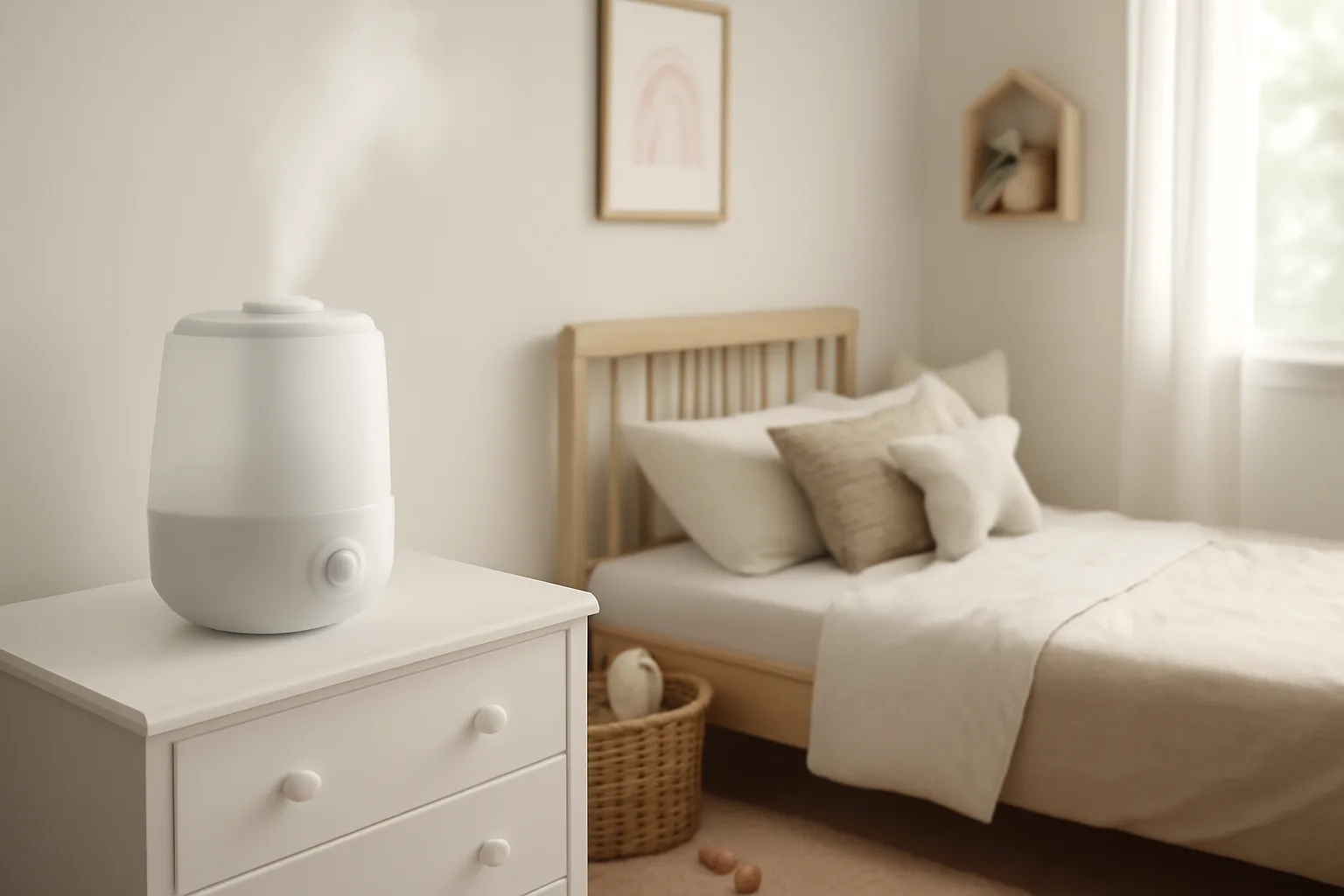
Bedrooms are awkward places for warm mist because people are tired, rooms are dark, and bedside surfaces are often crowded. Books, chargers, glasses of water, tissues and lamps leave less stable space than you think. If the humidifier has to live on a small bedside table, pick cool mist.
Place any humidifier:
- On a flat, stable surface where it cannot rock or slide.
- At least 30cm from walls, curtains and bedding so mist does not soak fabric or plaster.
- Away from plug sockets and extension leads because leaks and electrics are a poor mix.
- Out of reach of children and pets, including the cable.
- Facing into open air, not straight at a mattress, cot, wardrobe or painted wall.
I prefer a chest of drawers to a bedside table. It gives the mist more space to disperse and keeps the cable less tempting. If the only available spot is the floor, I would use a cool mist model and put it on a waterproof tray, not directly on carpet.
Pets and warm mist
Pets make warm mist less appealing. Cats jump. Dogs wag tails and nose at things. A warm mist unit tucked into a lounge corner may look safe until someone opens a door, shifts a blanket or charges across the room.
Cool mist still needs caution around pets. Do not add essential oils unless the manufacturer allows it and you know they are safe for the animals in your house. Many products blur the line between humidifier and aroma diffuser, but indoor air comfort and scent are different jobs. If you want more on that, the separate BreatheCleanUK piece on essential oil diffuser safety covers why I am cautious with scented mist indoors.
Hygiene, Minerals and Mould Risk
Burn risk is only half the safety picture. A neglected cool mist humidifier can become unpleasant quickly, and in a hard-water area it can leave white dust on nearby surfaces.
UK tap water varies a lot. If you live in London, Oxfordshire, Kent or much of the South East, you are probably dealing with hard water. Ultrasonic humidifiers can turn dissolved minerals into fine dust, which then settles on furniture. It is not a good look, and it makes the room feel less clean.
How warm mist compares on hygiene
Warm mist units heat the water, which can make the vapour itself cleaner at the point it leaves the appliance. That is a real advantage. It does not mean the tank can be ignored. Scale still builds up, water can still sit in corners, and the outlet still needs wiping.
The warm mist models I have used feel less fussy about mineral dust, but more fussy about safe placement. That trade-off is the whole comparison in miniature.
How cool mist compares on hygiene
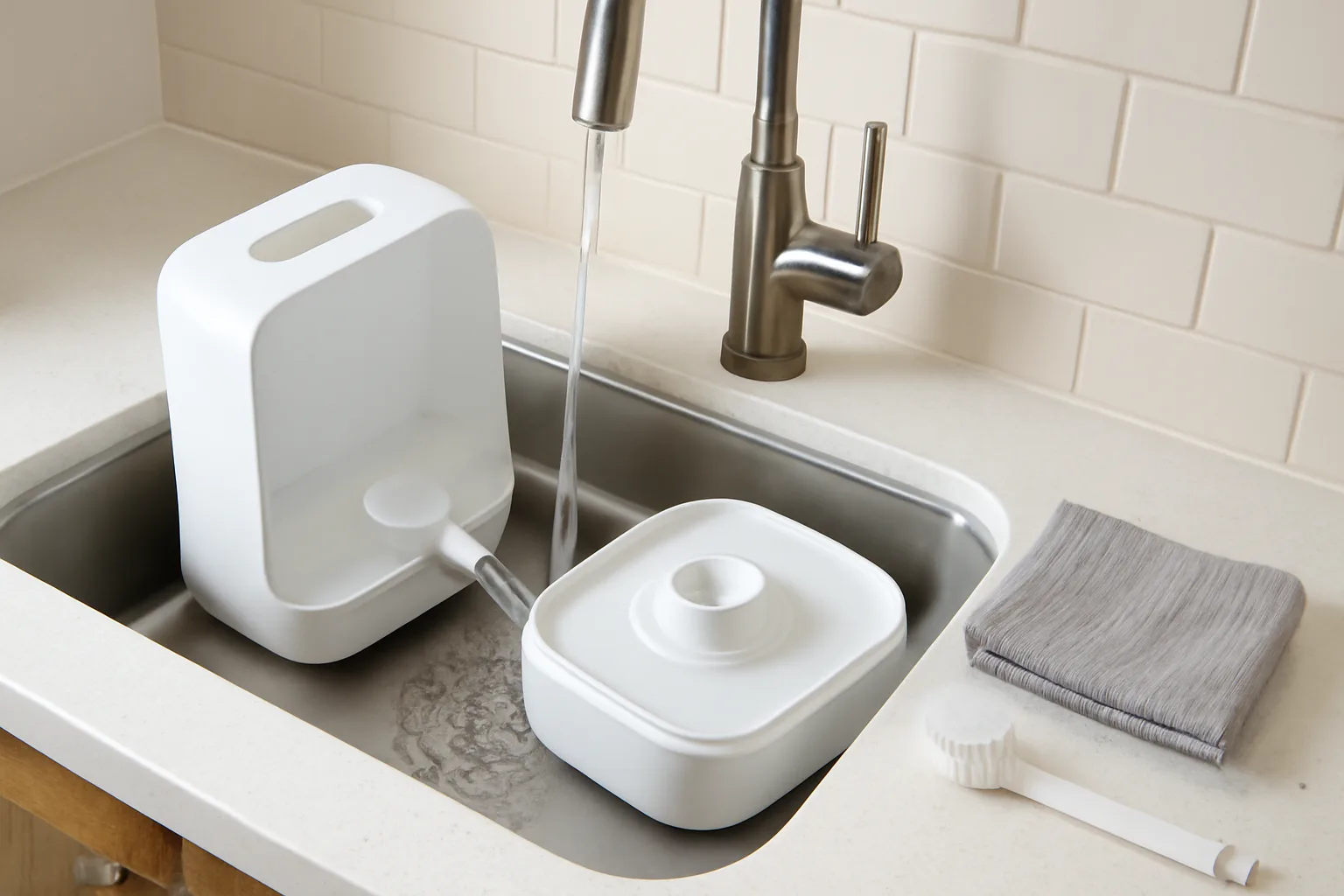
Cool mist asks more of the owner. You need to empty it daily, let parts dry, descale it when needed and avoid leaving old water sitting in the tank. If that sounds unrealistic, choose an evaporative model with a replaceable wick, or think twice about buying any humidifier at all.
For room humidity, aim for a comfortable middle ground rather than chasing mist output. Our guide to measuring humidity at home explains why a cheap £8-£15 hygrometer is often the most useful accessory. If a room is already around 40-60% relative humidity, adding more moisture can make condensation and mould worse.
Cleaning routine I would actually follow
Do this, or buy something else:
- Empty the tank each morning. Do not leave yesterday’s water sitting there until bedtime.
- Rinse and air-dry loose parts. Dry surfaces grow fewer smells than closed wet tanks.
- Descale weekly in hard-water areas. Follow the manual; white vinegar is common, but some brands specify their own method.
- Replace filters or wicks on schedule. A £6-£15 replacement part is cheaper than running a stale-smelling appliance.
- Stop if you see damp patches. Wet windows, walls or bedding mean the output is too high or the placement is wrong.
The maintenance burden is the reason I do not love tiny novelty humidifiers. They are cheap at £15-£25 on Amazon UK, but many have awkward tanks, vague cleaning instructions and no useful humidity control. A bad humidifier becomes another object to clean. Nobody needs that.
Running Costs, Noise and Daily Convenience
Safety is the main decision, but convenience decides whether you keep using the thing after week two.
Cool mist usually wins here. A small ultrasonic model is cheap to run, often quiet enough for a bedroom, and quick to refill. The Vicks VUL525 at about £55 is a simple example: compact tank, visible mist, low running fuss. For a spare bedroom or child’s room, that is usually enough.
Warm mist costs more to run because it heats water. Even if the nightly cost is not scary, it is still higher than a low-power cool mist unit. The other issue is noise. Some warm mist models make bubbling or heating sounds that are not loud, but can be noticeable in a quiet bedroom. If you already wake up at every radiator click, do not pretend you will ignore it.
Tank size and controls
Tank size matters more than most product pages admit. A 1.8-litre compact model can be fine for a small bedroom, but it may need frequent refilling if run high. A 4-6 litre model suits larger rooms and longer runtimes, but it is heavier to carry to the sink.
Look for:
- Auto shut-off when the tank empties.
- A built-in humidistat or at least sensible output controls.
- Top-fill design if you hate turning tanks upside down.
- Easy access for cleaning, with no tiny hidden channels.
- Low light or sleep mode if it will run in a bedroom.
If you are comparing sizes, read how to choose the right humidifier size for your room before spending £100+ on a large model. Oversizing is not safer. It just makes it easier to push too much moisture into the room.
White dust, filters and water choice
Cool mist ultrasonic units are most likely to create white dust in hard-water homes. Using filtered or demineralised water helps, but that adds cost. Evaporative cool mist models avoid much of that visible dust because minerals tend to stay in the wick, though you then have filter replacements to budget for.
Warm mist avoids most white-dust annoyance but can scale internally. If you live in a hard-water area, any humidifier needs descaling. I would rather descale a wide, accessible tank than fight with a stylish narrow one that looks clever in photos and maddening at the sink.
Which Type I Would Buy in the UK
For most readers, I would buy a cool mist humidifier with auto shut-off, a wide tank opening and either a built-in humidistat or a separate hygrometer. It is the better safety default, cheaper to run, and easier to place in normal UK bedrooms.
Budget pick
The Babymoov Wave 2-in-1 Air Humidifier at £39.99 from John Lewis is the kind of budget cool mist option I would consider for a small room. It is not a powerhouse, but the price is sensible, the capacity is more useful than tiny desk units, and buying from John Lewis gives you easier returns than a mystery marketplace listing.
For a baby or child’s bedroom, I would still place it away from the cot or bed and avoid fragrance. The “diffuser” wording on some products tempts people to add scent. For air comfort, plain water is the cleaner starting point.
Mid-range pick
The Vicks VUL525 Mini Cool Mist Ultrasonic Humidifier at about £55 from Argos is the safer family-room choice over the Vicks warm mist model. It is compact, familiar, widely available and easy enough to understand. If I were buying for a child’s winter bedroom, this is closer to what I would choose than a steam unit.
The Vicks VH845 Warm Mist Humidifier at about £58 from Argos is the one I would only buy for an adult room. It makes sense if you want warm vapour, you have a secure high surface, and you do not have children or pets with access. It is not the model I would put in a child’s room, however careful the marketing copy sounds.
Premium pick
The Levoit 6L Smart Warm and Cool Mist Humidifier is about £99.99 on Amazon UK. It is more flexible because it gives both warm and cool modes, app control and a larger tank. I like the idea for an adult bedroom or open-plan room where you want more control, but I would still default to cool mode overnight if children or pets are around.
If you are already looking at higher-priced hybrid units, compare them with the broader best humidifiers UK guide. At £100+, the mistake is buying extra modes instead of buying easier cleaning, better control and the right room size.
Final verdict
Cool mist is safer for most homes. Warm mist can be useful, but it asks for adult-only placement and more caution than many bedrooms can offer. If the humidifier is going anywhere near children, pets, a narrow bedside table or overnight unsupervised use, choose cool mist and clean it properly.
Frequently Asked Questions
Is warm mist or cool mist safer for a child’s bedroom? Cool mist is safer for a child’s bedroom because it does not use boiling water or release hot steam. Keep the unit out of reach, avoid fragrance, and clean it daily.
Does warm mist kill bacteria? Heating water can reduce some contamination in the vapour, but it does not remove the need to clean and descale the tank. Stale water and scale can still build up inside the appliance.
Can cool mist humidifiers cause mould? Yes, if you run them too high or point mist at walls, windows or fabric. Use a hygrometer and stop if you see damp patches, condensation or musty smells.
What humidity should a UK bedroom be? Around 40-60% relative humidity is a sensible target for comfort. If the room is already in that range, more mist is unlikely to help and may increase condensation.
Are warm and cool mist humidifiers good for coughs? Moist air can feel soothing when indoor air is dry, but humidifiers are not a treatment for illness. Speak to a pharmacist, GP or NHS 111 if symptoms are severe, persistent or worrying.
Which humidifier type is cheapest to run? Cool mist is usually cheaper to run because it does not heat water. Ultrasonic models are often the lowest-power option, while warm mist units use more electricity.