If a humidifier is going into a baby’s room, safety matters more than mist output, smart features or how calming the marketing photos look. The right choice is usually a cool-mist machine, placed well away from the cot, cleaned more often than feels convenient, and used with a separate hygrometer so you are not guessing. This humidifier baby safety guide is about using one without creating burn, mould, mineral dust or overheating problems.
In This Article
- Humidifier Baby Safety Guide: The Short Answer
- When a Humidifier Actually Helps a Baby
- The Safest Type for a Nursery
- Where to Put a Humidifier in a Baby’s Room
- Humidity, Temperature and Safer Sleep
- Cleaning Routine for Baby-Room Use
- What to Buy and What to Avoid
- Frequently Asked Questions
Humidifier Baby Safety Guide: The Short Answer
The safest nursery humidifier setup is boring: cool mist, clean water, no oils, no hot steam, no cable near the cot, and no running it just because the room “feels dry”. Use a separate humidity meter and aim for a sensible middle ground rather than a misty nursery.
My practical rule
For a baby room, I would buy a simple cool-mist or evaporative humidifier before a warm-mist vaporiser. Warm mist can be hygienic inside the machine because it boils water, but that advantage is not worth a hot tank, hot spout or scald risk in a child’s bedroom. A cool-mist unit still needs proper cleaning, but at least it is not adding a boiling-water appliance to the sleep space.
The nursery setup I would actually trust looks like this:
- Machine: cool mist or evaporative, with a tank you can properly get your hand or brush into.
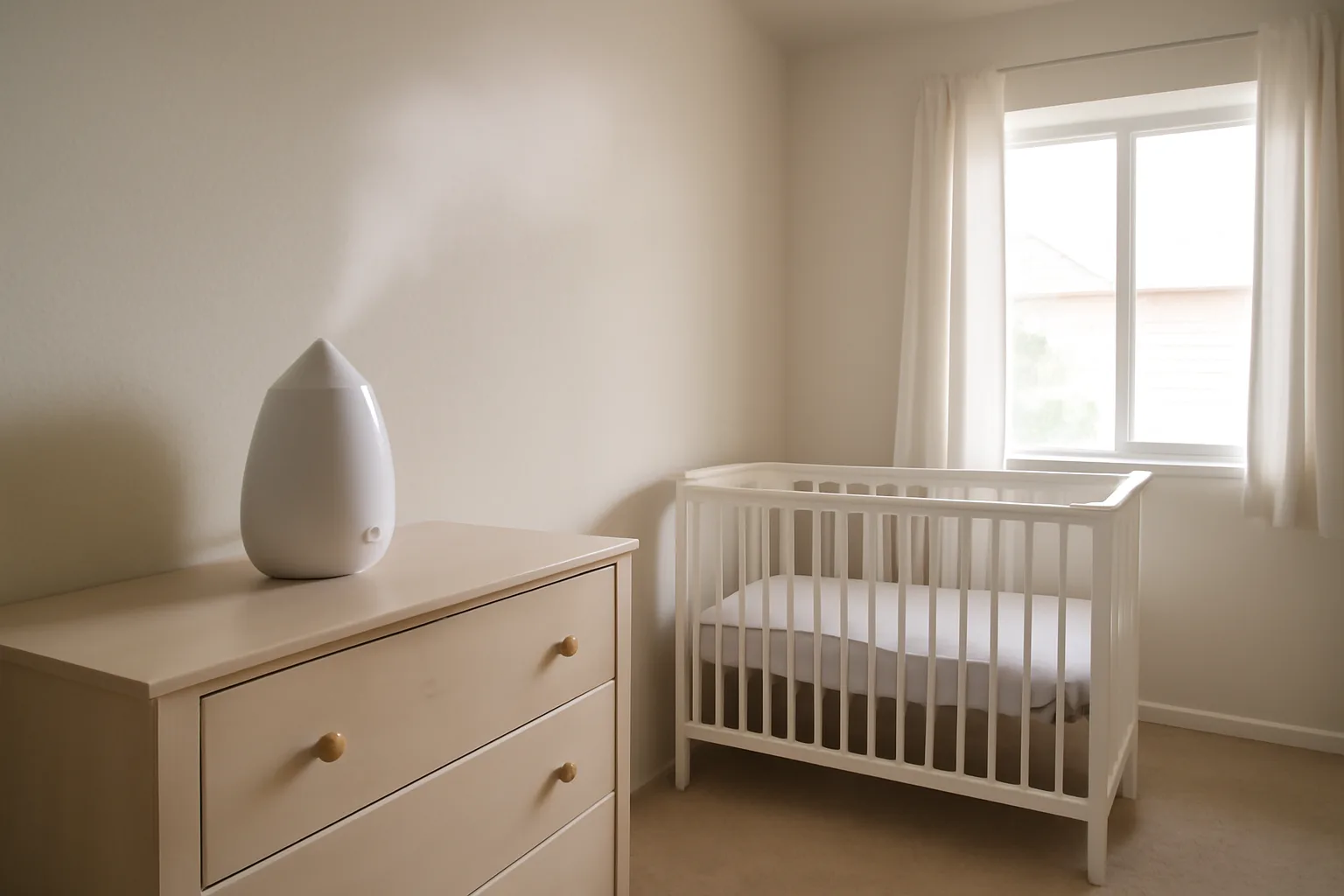
- Position: on a stable chest of drawers or shelf, at least 1m from the cot and never pointing mist at bedding.
- Target humidity: roughly 40-50% relative humidity for normal UK winter use, not 60%+.
- Water: fresh water daily; filtered or distilled water if your area leaves white dust.
- Cleaning: empty every morning, dry open, descale weekly, disinfect only as the manual allows.
That is less glamorous than a glowing cloud machine next to a cot. It is also how you keep the useful bit and avoid most of the daft bits.
What this guide is not
This is not another ranking of every humidifier sold in the UK. BreatheCleanUK already has a broader best humidifiers UK guide and a separate guide to warm mist vs cool mist humidifiers. Here, the question is narrower: should you use one around a baby, and what would make that setup sensible?
When a Humidifier Actually Helps a Baby
A humidifier can help when central heating leaves the nursery air dry for days at a time. It is not a cure for coughs, blocked noses, reflux, allergies or poor sleep, and it should not be used as a substitute for medical advice.
Dry winter rooms are the real use case
UK homes can feel damp overall and still have dry upstairs bedrooms in winter. Heating raises air temperature and lowers relative humidity, especially in newer insulated rooms with radiators on before bedtime. If a nursery repeatedly sits around 30-35% relative humidity, a small humidifier can make the air feel less scratchy.
You do not need one because it is November. You need evidence. A cheap digital hygrometer costs about £8-£15 from Amazon UK, Argos or B&Q, and it tells you more than your nose will. Put it near the cot but out of reach, then check it at bedtime and first thing in the morning for a week.
Symptoms are not proof on their own
Dry lips, stuffy breathing and waking are easy to blame on dry air, but babies are noisy sleepers and small colds are common. If your baby is under three months and has a temperature over 38°C, or you are worried about their breathing, use NHS advice on taking a baby’s temperature and get medical advice rather than turning up a humidifier and hoping for the best.
The humidifier earns its place when all three things line up:
- The room is genuinely dry: repeated readings below about 40% relative humidity.
- There is no condensation problem: windows, walls and wardrobes are not already damp.
- You can clean it properly: daily emptying and weekly cleaning are realistic, not wishful thinking.
If one of those fails, fix the room first. Opening trickle vents, avoiding wet laundry in the nursery, and checking for mould are more useful than adding another appliance.
Congestion: keep expectations sensible
Cool mist can make a dry room more comfortable during a cold, but it will not clear a blocked nose on command. The benefit is usually modest. I would treat it like a comfort measure, not a treatment.
If you already have a child’s bedroom air-quality problem, the humidifier may not be the first purchase. Dust, mould, poor ventilation and VOCs from new furniture can matter more than moisture.
The Safest Type for a Nursery
Cool-mist humidifiers are the safer default for baby rooms because they avoid hot water and steam. Within cool mist, the choice is usually ultrasonic versus evaporative.
Cool mist versus warm mist
Warm-mist humidifiers and steam vaporisers heat water. That can reduce microbes inside the boiling chamber, but it creates an obvious nursery problem: heat. Hot water, hot surfaces and trailing cables are a bad mix once a baby becomes mobile, and the risk starts before they can walk if an older sibling can reach it.
Cool-mist models avoid scald risk, but they can spread minerals or microbes if they are dirty. That is the trade-off. If you choose cool mist, you are taking on cleaning discipline rather than burn risk.
Ultrasonic versus evaporative
Ultrasonic models are common because they are quiet and cheap. The Babymoov Hygro Plus is about £69.99 direct from Babymoov, the Vicks VUL525 Mini Cool Mist is about £40 at Argos, and Levoit small-room models start around £39.99 from Levoit UK. They suit nurseries because they run quietly, but hard-water homes may see white dust unless you use filtered or distilled water.
Evaporative models use a wick or filter and are less likely to push mineral dust into the room. The downside is filter cost, fan noise and fewer nursery-looking designs. Replacement filters often cost around £10-£25 depending on brand, so the cheapest-looking machine is not always cheapest over a winter.
Features that matter
Ignore most of the nursery fluff. The useful features are practical:
- Easy tank access: if you cannot scrub it, you probably will not clean it well.
- Auto shut-off: the unit should stop when the tank is empty.
- Adjustable mist: fixed-output machines can overdo small UK box rooms.
- Quiet night mode: useful, but not if it hides all warning lights and controls.
- No compulsory app: nursery kit should still work at 2am when the Wi-Fi is sulking.
I would not pay extra for aroma trays in a baby room. Essential oils are not needed for safer sleep, and they add another variable around small lungs, pets and residue inside the machine.
Where to Put a Humidifier in a Baby’s Room
Placement is where good humidifiers become bad nursery appliances. The machine should improve room air, not wet bedding, walls, plugs or the floor.
Keep it away from the cot
Do not put a humidifier on the cot, under the cot, clipped to the cot, or on a low table next to tiny hands. Put it on a stable surface at adult waist height if possible, with the mist angled into open room air. Keep the cable routed behind furniture and out of reach.
The simple test is this: if the unit leaked half a tank, would the water go near the cot, a plug socket or an extension lead? If yes, move it.
Avoid cold outside walls
Mist directed at a cold external wall can condense quickly, especially in older UK houses. That is how you end up using a humidifier to create the mould problem you were trying to avoid. Leave space around wardrobes and curtains, and check the wall behind the unit with your hand in the morning. If it feels damp, the output is too high or the position is wrong.
This matters more in small nurseries. A 5-litre humidifier designed for a 40m² living room can overpower a 9m² bedroom. If you are unsure, read the room-size guide on choosing the right humidifier size before buying.
Do not mist bedding
Bedding, sleep bags and soft toys should not feel cool or damp. If they do, the humidifier is too close, too strong or running too long. Damp fabric is uncomfortable, and it gives dust mites and mould more of what they like.
For most nurseries, a few hours before bedtime is more sensible than running a high-output mist all night. If the humidity falls back into the 40s and stays there, job done. More mist is not better.
Humidity, Temperature and Safer Sleep
The humidity target has to sit alongside safer sleep guidance. A humidifier should not make the room warmer, damper or harder to monitor.
The room still needs to stay cool
The Lullaby Trust recommends a baby room temperature of 16-20°C. That matters because overheating is a safer-sleep risk, and a cosy-looking nursery can become too warm once heating, sleep bags and closed doors all stack up.
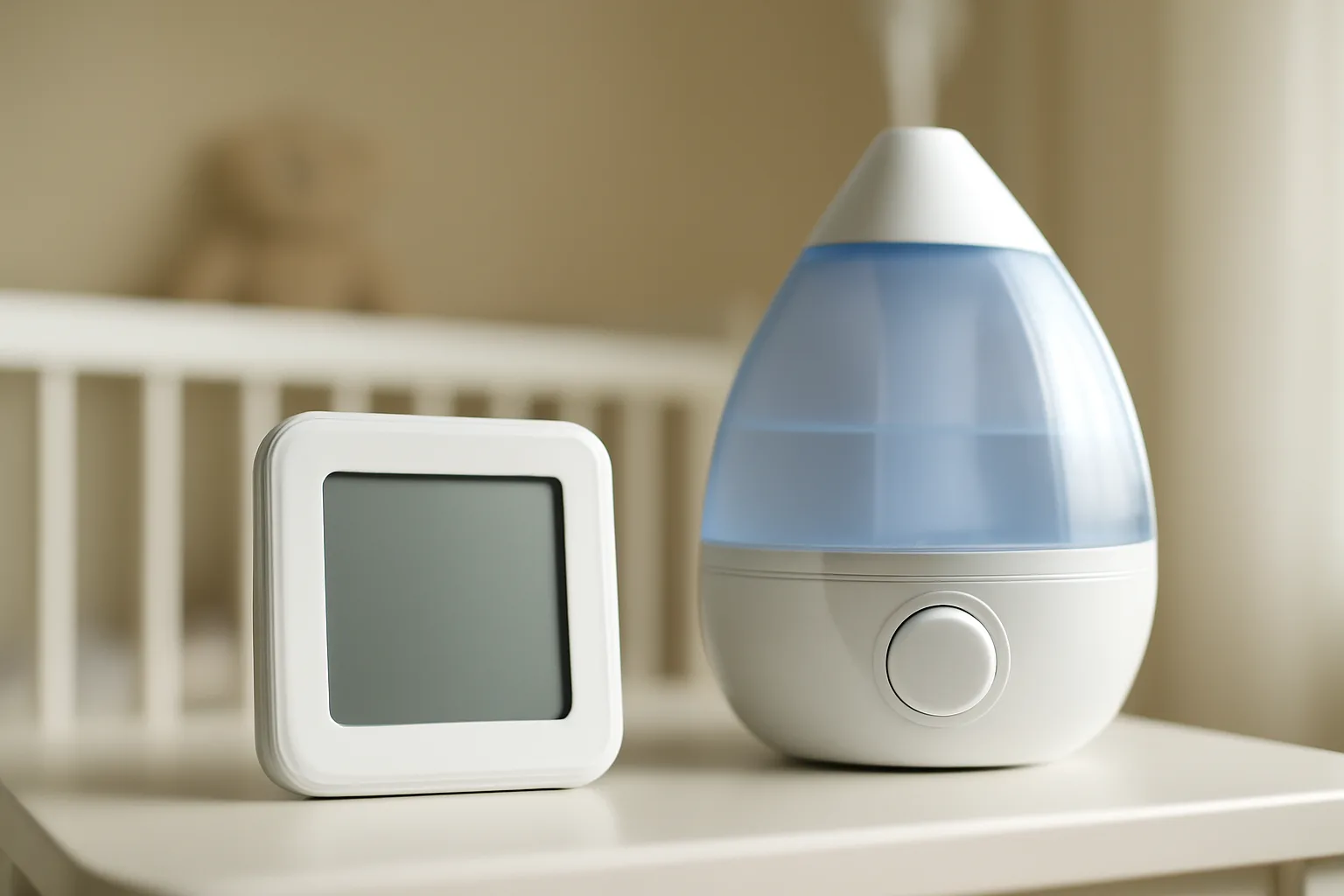
That is why I like pairing a humidifier with a separate room thermometer. The Tommee Tippee Groegg 2 is about £21.99 at John Lewis or Smyths, but a basic digital thermometer-hygrometer for £10-£15 is fine if you do not need a nightlight.
Use the humidifier to correct dry air, not to compensate for an overheated room. If the nursery is 22-23°C, turn down the heating before you add moisture.
The useful humidity range
For everyday baby-room use, I would aim around 40-50% relative humidity. Below that can feel dry. Above 55-60% starts to push many UK rooms towards condensation, especially if the window is cold or the door stays shut overnight.
If you are already seeing black mould, wet windows or a musty smell, pause the humidifier and sort ventilation first. The guides on measuring humidity at home and relative humidity levels are more useful starting points than buying a bigger tank.
Watch the room, not the mist
Visible mist is satisfying because you can see it doing something. It is not a measure of safety or usefulness. The hygrometer reading, window condition and bedding feel matter more.
I would avoid any unit that encourages you to run “max mist” overnight in a small nursery. The better habit is to set the output low, check the reading after 30-60 minutes, and stop when the room is in range.
Cleaning Routine for Baby-Room Use
A humidifier used around a baby has to be cleaned like feeding-adjacent kit, not like a random fan in the corner. Stale tank water is the enemy.
Daily routine
Every morning, unplug the unit, empty the tank and base, rinse with fresh water, then leave the parts open to air-dry. Do not keep topping up yesterday’s water. It takes two minutes, and it prevents the tank becoming a warm little pond.
If the tank smells sweet, earthy or plasticky after rinsing, stop using it until it has had a proper clean. Smell is not a lab test, but it is a useful early warning.
Weekly descaling
In hard-water areas, scale builds fast. A £3-£5 tub of citric acid or a bottle of white vinegar is usually enough for routine descaling, but follow the manufacturer’s instructions because some bases have electronics that should not be flooded.
The shape of the tank matters here. Narrow-neck tanks are a pain. I would rather buy a less pretty model with a wide top-fill opening than a sleek nursery model you can only rinse and hope.
What not to add
Do not add essential oils, vapour pads, disinfectant, bleach or fragrance to the tank unless the manual specifically says that exact product is allowed. Even then, I would skip oils in a baby’s bedroom. Clean mist is the point.
If your model uses cartridges or filters, price them before buying. A machine that costs £45 but needs £15 cartridges every month through winter is not cheaper than a £70 model with washable parts.
For a deeper cleaning schedule, use the separate humidifier hygiene guide, but be stricter in a nursery than you would be in a home office.
What to Buy and What to Avoid
You do not need a specialist “baby” humidifier, but nursery use changes the buying priorities. Safety, cleaning and controllability beat tank size.
My UK shortlist
For most baby rooms, I would start with one of these types rather than chasing the biggest output:
- Budget small-room option: Levoit Classic 160, about £39.99 from Levoit UK. Simple, cool mist and sensible for smaller bedrooms.
- Nursery-focused option: Babymoov Hygro Plus, about £69.99 direct from Babymoov. The controls and nightlight are nursery-friendly, but still skip oils.
- Compact pharmacy-style option: Vicks VUL525 Mini Cool Mist, about £40 at Argos. Good for occasional use, though the small tank needs more refilling.
- Higher-spec option: Meaco Deluxe 202, about £99.99 when in stock at Meaco or John Lewis. Better if you want filtration as well, but probably overkill for a tiny nursery.
My pick for most parents would be the Babymoov if you want nursery controls and a tidy bedside look, or the Levoit if you just want a cheaper cool-mist unit and already own a hygrometer. I would not buy a warm-mist vaporiser for overnight nursery use.
Running costs
Electricity is usually minor for small ultrasonic humidifiers. Many use roughly 20-30W, so a few hours a night is pennies. The real costs are filters, cartridges, cleaning supplies and, in hard-water areas, using filtered or distilled water.
Distilled water is often around £1-£2 per litre in UK shops, which gets silly if you run a large tank every night. A filter jug may reduce visible dust, but it will not remove all minerals. If white dust appears on furniture, lower the output, clean more often, or switch to an evaporative model.
Red flags
Avoid nursery humidifiers with:
- Poor tank access: narrow openings make proper cleaning harder.
- No humidity control: constant output can over-humidify a small bedroom.
- Very bright lights: cute in photos, annoying at 3am.
- Hot mist: not worth the scald risk in a baby’s room.
- Oil-first marketing: fragrance is not a baby-room air-quality feature.
The best humidifier is the one you will clean, place properly and stop using when the room no longer needs it. That is not exciting, but parenting kit does not need to be exciting. It needs to behave.
Frequently Asked Questions
Are humidifiers safe for babies? Yes, if you use a cool-mist or evaporative model, keep it away from the cot, clean it daily and monitor humidity. Avoid hot steam units in baby rooms.
What humidity level is best for a baby’s room? Around 40-50% relative humidity is a sensible target for most UK nurseries. If the room goes above about 55-60%, watch for condensation and reduce use.
Can I run a humidifier all night in a nursery? Sometimes, but it is better to use a hygrometer than a fixed overnight habit. If the room reaches a healthy range before bedtime, you may not need it running until morning.
Should I use warm mist or cool mist for a baby? Cool mist is the safer default because it avoids hot water and steam. Warm mist may reduce microbes inside the unit, but the scald risk makes it a poor nursery choice.
Can I put essential oils in a baby-room humidifier? I would not. Only use additives if the manual allows them, and essential oils are unnecessary around babies. Clean water is the safest approach.
How often should I clean a nursery humidifier? Empty and air-dry it every day, then descale and clean it weekly. In hard-water areas or during daily winter use, inspect the tank and base more often.