Choosing an air purifier for hay fever season is mostly about three things: a proper HEPA filter, enough airflow for the room, and using it before pollen gets into your bedding.
In This Article
- The Air Purifier Hay Fever UK Decision
- What an Air Purifier Can and Cannot Do
- Filter Type: HEPA First, Carbon Second
- Room Size, CADR and Where It Will Run
- Where to Put It During Pollen Season
- UK Models and Running Costs to Compare
- Mistakes That Make Hay Fever Worse Indoors
- Frequently Asked Questions
The Air Purifier Hay Fever UK Decision
Start with the room, not the brand
The right air purifier hay fever UK choice is the one that can clean the room you actually sleep or sit in. A small purifier beside a double bed can be useful. The same purifier in an open-plan kitchen diner may be decorative noise.
For hay fever, the bedroom is usually the first room to solve. You spend hours there, bedding holds pollen, and symptoms often feel worse at night or first thing in the morning. If your budget only covers one unit, put it where sleep is being disrupted.
The NHS hay fever advice covers the usual symptom pattern and practical pollen-reduction habits, including keeping windows and doors shut where possible and showering after being outside. An air purifier fits into that same indoor-control approach; it does not replace medicine, but it can reduce airborne particles in the room while it is running.
Choose for pollen season behaviour
A purifier bought for hay fever has a different job from one bought for cooking smells, damp rooms or general dust. Pollen particles are the priority, so HEPA-style particle filtration matters more than app features, fragrance modes or heating and cooling extras.
Use this order:
- Filter quality: HEPA or a clearly specified high-efficiency particle filter.
- Room coverage: enough CADR or room rating for the bedroom or living room.
- Noise: quiet enough to run at night, ideally under about 30 dB on sleep mode.
- Filter cost: affordable replacements, not just a cheap machine.
- Placement: space around the intake and outlet so it can move air properly.
The best result usually comes from a boring routine: windows closed on high-pollen evenings, purifier running before bed, bedding kept away from open windows, and filters changed on time. Not glamorous. Useful.
What an Air Purifier Can and Cannot Do
What it can do
A good air purifier can pull airborne pollen, dust and fine particles through a filter while the room air circulates. In a bedroom, that can mean less pollen moving around while you sleep, especially if you run the unit before getting into bed.
It can also help with mixed allergy triggers. If you already react to dust or pets, read BreatheCleanUK’s guide to whether air purifiers help with pet allergies, because the same filter logic applies: capture particles, keep airflow moving, and do not expect miracles from a tiny unit in a large room.
Based on owner reviews across common UK models, people are happiest when they buy for one room and one clear problem. They are less happy when they expect a purifier to fix the whole house from a hallway socket.
What it cannot do
An air purifier cannot stop pollen entering when windows are wide open. It cannot remove pollen stuck to hair, clothes, pets, curtains or bedding. It also cannot diagnose whether symptoms are hay fever, dust mite allergy, mould sensitivity or something else.
That distinction matters. If the room smells musty, has condensation or visible mould, do not treat an air purifier as the main fix. The UK government’s guidance on damp and mould health risks is a reminder that moisture problems need source control, ventilation and repair, not just a filter in the corner.
For hay fever, think of the purifier as one part of a system. Medication, pollen timing, laundry habits, window discipline and cleaning all matter.
Filter Type: HEPA First, Carbon Second
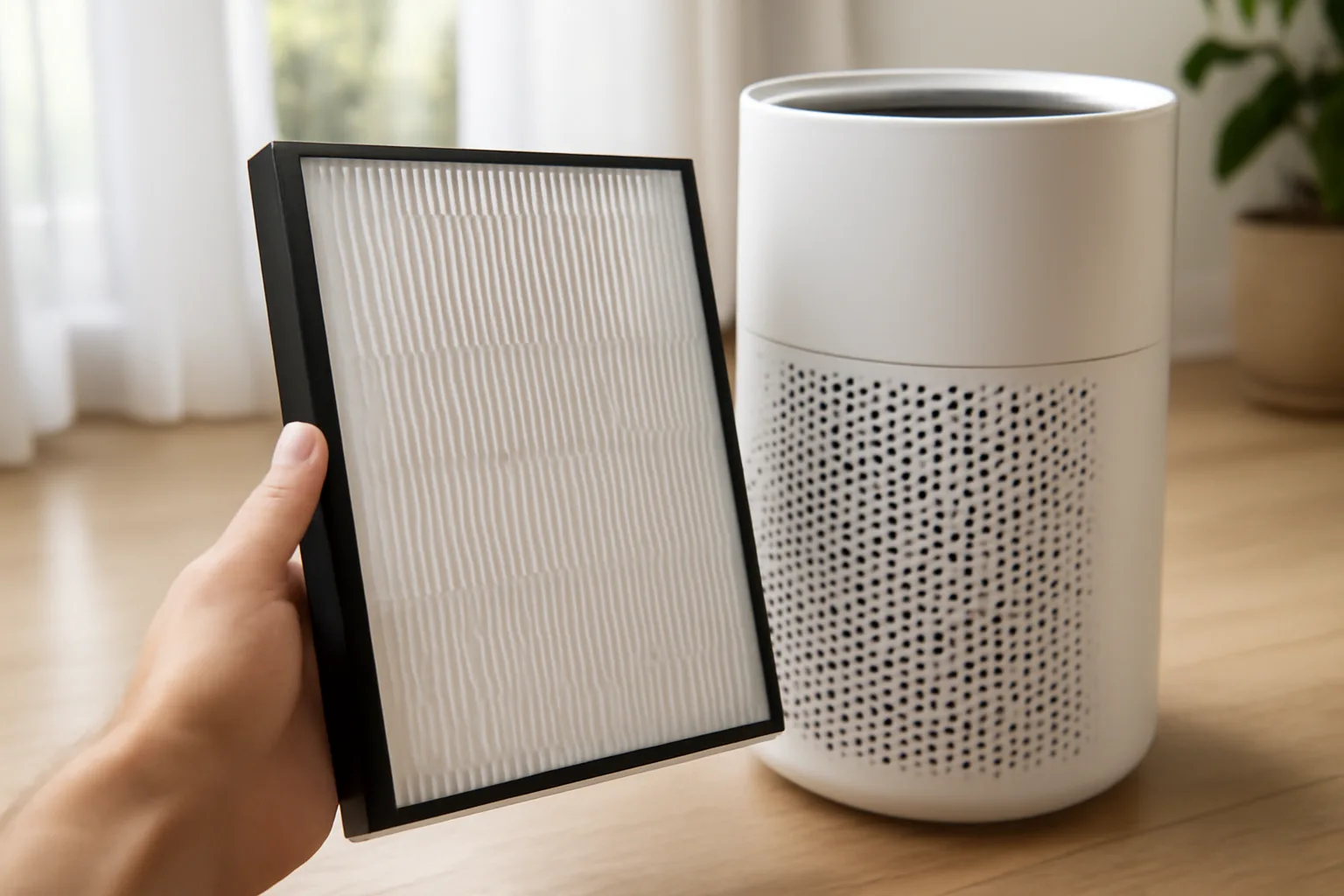
HEPA is the main feature for pollen
For pollen season, start with HEPA. You want a particle filter, not just a fan with a nice grille. Many brands use terms such as True HEPA, HEPA 13, NanoProtect HEPA or H13-style filtration. The wording varies, but the principle is the same: the filter needs to capture fine airborne particles rather than just trap fluff on a mesh screen.
BreatheCleanUK has a deeper explainer on how HEPA filters work. For this article, the practical point is simple: if a machine does not clearly say what particle filter it uses, skip it for hay fever.
I would rather buy a plain-looking purifier with a good HEPA filter than a flashy bladeless fan that talks more about airflow modes than filtration. Pollen does not care how stylish the tower looks.
Carbon helps smells, not the main pollen problem
Activated carbon is useful for odours and some gases. It is not the main pollen feature. If a purifier has both HEPA and carbon, fine. If it only talks about carbon or “freshening” air, that is not the right tool for hay fever.
The common setup is:
- Pre-filter: catches larger dust and hair before they clog the main filter.
- HEPA-style particle filter: does the pollen, dust and fine-particle work.
- Carbon layer: helps with smells from cooking, pets or traffic.
For homes near busy roads, carbon is a useful extra. For a pollen-focused bedroom, do not pay a premium for carbon if the HEPA performance and room size rating are weak.
Avoid ioniser-only units
Ionisers are not my first choice for hay fever bedrooms. Some machines combine ionisation with filters, but I would not buy an ioniser-only purifier for pollen. If you are comparing technologies, BreatheCleanUK’s ionic vs HEPA air purifier guide covers the safety and practical trade-offs in more detail.
For a child’s bedroom, a guest room or a room used by someone with asthma symptoms, keep it simple: mechanical filtration, low noise, no fragrance pods, no gimmicks.
Room Size, CADR and Where It Will Run
CADR is more useful than vague room claims
CADR stands for Clean Air Delivery Rate. It tells you how much clean air the purifier can deliver, usually in m³/h. Higher CADR means faster air cleaning, though brands do not always quote it in the same way.
As a rough UK home guide:
- Small bedroom around 10-12 m²: look for roughly 100-200 m³/h.
- Typical double bedroom around 12-18 m²: 200-300 m³/h is a safer range.
- Larger living room around 20-30 m²: look closer to 300-500 m³/h.
- Open-plan rooms: buy bigger than you think or accept slower results.
BreatheCleanUK has a dedicated guide to CADR ratings if you want the detail. For hay fever, I would not obsess over perfect maths. Just avoid tiny desktop purifiers for full bedrooms.
Measure the room properly
Measure the floor area, then look at ceiling height if your room is unusual. Most UK bedrooms have ordinary ceiling heights, so floor area is usually enough for choosing. A loft room, large bay-window bedroom or open-plan downstairs space needs more airflow.
Do not assume “up to 50 m²” means it will clean a 50 m² room quickly and quietly. Those claims often rely on high fan speeds you will not use while sleeping. If a purifier only works for your room on turbo mode, it is too small.
Noise decides if it stays on
Noise is not a minor detail. A purifier that annoys you will be switched off, and a switched-off purifier is expensive furniture.
Look for sleep mode around 20-30 dB if it will run beside a bed. Many units are quiet on low but loud on auto when pollen or dust readings rise. Based on using similar units at home, I prefer setting a bedroom purifier to a steady low or medium speed before bed rather than letting auto mode ramp up and down in the dark.
If sleep is the main issue, BreatheCleanUK’s guide to air purifier noise levels is worth reading before buying.
Where to Put It During Pollen Season
Bedroom placement
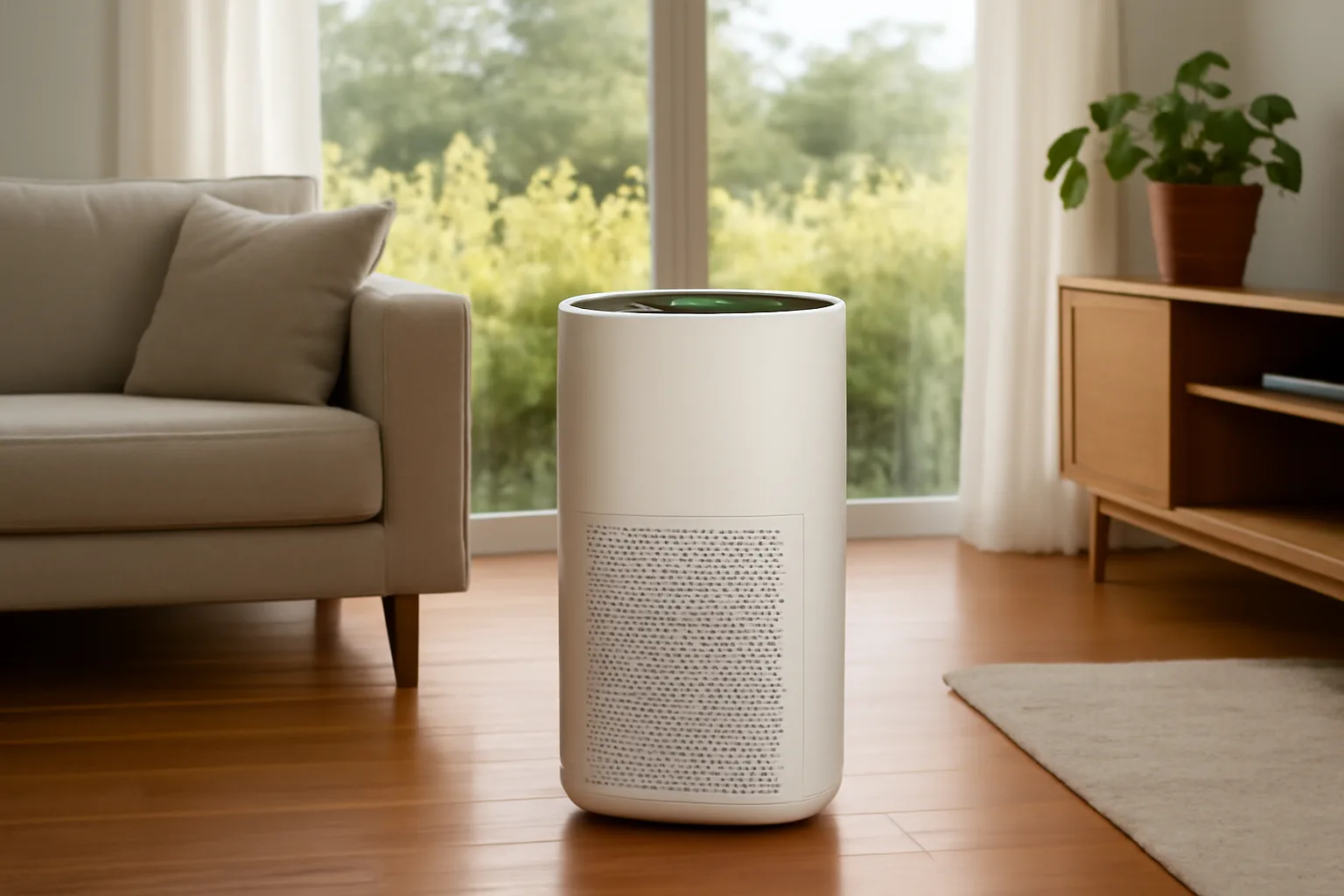
Put the purifier in the room where you need cleaner air, with clear space around it. Do not wedge it behind a curtain, under a desk, or tight against the bed. Most units need at least 20-30cm around the intake and outlet.
For hay fever bedrooms, I would place it near the bed but not blowing straight at your face. Run it with the bedroom door mostly closed for an hour before sleep, then keep it on low overnight if the noise does not bother you.
The simplest routine:
- Late afternoon: close bedroom windows before pollen-heavy evening periods.
- Early evening: run the purifier on medium while the room is empty.
- Bedtime: switch to sleep mode or low speed.
- Morning: ventilate briefly if pollen is low, then close windows again.
Living room placement
Living rooms are harder because people open doors, cook, move around and bring pollen in on clothes. Put the purifier where air can circulate, not hidden beside the sofa. If it has an air-quality sensor, avoid placing it directly beside candles, log burners, kitchen doors or plug-in fragrances because it may chase the wrong problem.
For more detail, BreatheCleanUK has a guide to air purifier placement. During hay fever season, the key is consistency. Running the unit for 20 minutes once symptoms start is less useful than keeping the room cleaner over several hours.
Window rules
This is where people sabotage themselves. They buy a purifier, then leave the window open all evening because the room feels stuffy. The purifier keeps filtering, but pollen keeps entering.
You do not have to live in a sealed box. Use pollen forecasts and common sense. On bad days, keep bedroom windows shut during peak pollen periods and ventilate briefly when counts are lower. If you dry washing outside, avoid putting pollen-covered bedding straight back on the bed.
UK Models and Running Costs to Compare
Sensible models to benchmark
This is not a full buying guide, but prices help. For a hay fever bedroom, these are realistic UK benchmarks:
- Levoit Core 300S: often around £120-£150, with app control and a compact round design.
- Philips 800i Series: often around £150-£230 depending on retailer and exact model.
- Blueair Blue 3210 or newer 3250i-style models: commonly around £130-£180.
- Winix Zero: often around £150-£200, usually a strong value pick for larger rooms.
- Dyson purifier models: commonly £350-£600, better if you want fan features as well as filtration.
For most hay fever bedrooms, I would start around the Levoit, Philips, Blueair or Winix level before paying Dyson money. Dyson makes sense if you actively want the fan, app ecosystem or year-round cooling. If all you want is pollen filtration in one bedroom, it is rarely the value pick.
Also check filter availability before buying. A cheap purifier with £60 filters is not cheap after two seasons.
Filter replacement costs
Replacement filters often cost £20-£60 depending on the brand. Some need changing every 6 months, others every 12 months, depending on use and air quality. Hay fever season use may be heavy from March to September, but lighter in winter unless you also use it for dust, pets or traffic pollution.
BreatheCleanUK’s guide to when to change air purifier filters covers the signs. For buying, the important bit is to price one year of filters before you click checkout.
Electricity use
Most compact purifiers use modest power on low or sleep settings, but costs rise if you run a large unit hard all day. A small bedroom unit might use around 5-25W on lower modes; larger units can use much more on high speed.
BreatheCleanUK has a fuller breakdown of air purifier running costs in the UK. In practice, filter replacement is often the bigger cost than electricity.
Mistakes That Make Hay Fever Worse Indoors
Buying too small
The most common mistake is buying a tiny purifier because it looks neat on a bedside table. If the CADR is weak, it will struggle to turn over the room air. Small units are fine for box rooms and desks, not full bedrooms with wardrobes, curtains and bedding holding pollen.
If you are torn between two sizes, I would usually buy the larger one and run it on a quieter lower setting.
Putting it in the wrong room
Hallway placement sounds efficient but rarely works for hay fever. You need cleaner air where symptoms matter: usually the bedroom, sometimes a home office, sometimes the living room. Air does not politely move through doorways just because the product box says whole-home freshness.
Use one purifier well before trying to cover every room badly.
Ignoring bedding and clothes
Pollen rides in on hair, clothes, pets and laundry. If you sit on the bed in outdoor clothes, dry pillowcases outside on high-pollen days, or let pets sleep on the duvet after rolling around in grass, the purifier has extra work before it even starts.
A better routine:
- Change clothes: keep outdoor layers away from the bed.
- Shower or rinse hair: useful after gardening, sport or evening walks.
- Keep bedding indoors: avoid outdoor drying on high-pollen days.
- Vacuum slowly: use a HEPA-filter vacuum if pollen and dust are both triggers.
Confusing hay fever with damp or mould
If symptoms flare in one damp room all year, pollen may not be the only issue. Mould, dust mites and humidity can irritate airways too. In that case, a purifier may help particles in the air, but it will not fix the source.
Read BreatheCleanUK’s guide to reducing damp and mould in UK homes if you see condensation, black mould or a musty smell. For hay fever season, your aim is pollen control. For damp, your aim is moisture control. Different problem.
Final buying advice
For most UK hay fever bedrooms, buy a HEPA purifier with enough CADR for the room, a sleep mode you can tolerate, and replacement filters you can afford. Run it before symptoms peak, keep windows controlled, and do not expect it to undo pollen-covered bedding.
The best air purifier hay fever UK setup is not the most expensive machine. It is the one that fits the room and gets used every day through pollen season.
Frequently Asked Questions
Do air purifiers help with hay fever? They can help reduce airborne pollen indoors while running, especially in bedrooms. They do not cure hay fever or remove pollen already stuck to bedding, clothes, hair or pets.
What type of air purifier is best for hay fever? Choose a purifier with a proper HEPA or high-efficiency particle filter, enough CADR for the room, and a quiet sleep mode. Carbon is useful for smells but is not the main pollen feature.
Should I keep windows closed when using an air purifier for hay fever? On high-pollen days, yes, especially in the bedroom during evening periods. If windows stay open, the purifier has to keep dealing with fresh pollen entering the room.
Where should I put an air purifier during hay fever season? Put it in the room where symptoms matter most, usually the bedroom. Leave clear space around the intake and outlet, and run it before bed rather than only after symptoms start.
How much should I spend on an air purifier for hay fever? For a typical UK bedroom, expect useful models around £120-£230. Larger rooms and premium fan-purifier designs can cost £300-£600, but they are not always better value for pollen alone.
How often should I replace air purifier filters in pollen season? Follow the brand’s guidance, but many filters need replacing every 6-12 months. Heavy pollen use, pets, dust or smoke can shorten that interval.