If safety is the deciding factor, choose a HEPA air purifier over an ionic one for most UK homes. Ionic vs HEPA air purifiers is not just a performance debate; the real issue is whether the cleaner removes particles without adding ozone or charged by-products to the room. That matters most in bedrooms, nurseries, asthma households and smaller flats where stale air hangs around.
In This Article
- Ionic vs HEPA Air Purifiers: HEPA Is the Safer Default
- What Ionic Air Purifiers Actually Do
- What HEPA Air Purifiers Do Differently
- Ozone, Asthma and Children: The Safety Difference
- Running Costs, Filters and Real UK Prices
- Which Type Should You Buy for Each Room?
- Frequently Asked Questions
Ionic vs HEPA Air Purifiers: HEPA Is the Safer Default
HEPA is the safer default because it is mechanical. Air passes through a dense filter, particles are trapped, and cleaner air comes out. There is no need to electrically charge the air in the room, and there is no marketing fog around “fresh” or “active” purification.
My practical verdict
For a normal UK home, I would buy a HEPA-based purifier with a decent CADR rating, a sealed filter, a quiet night mode and clear replacement-filter pricing. I would avoid standalone ionisers and ozone-generating air cleaners, especially in occupied bedrooms.
That does not mean every product with an ioniser button is dangerous. Some mainstream purifiers include a switchable ioniser as an extra feature. The point is simpler: you do not need that feature to clean household air. If a cleaner works well with the ioniser off, leave it off.
Where the comparison gets muddled
People often compare these machines as if they do the same job in different ways. They do not. A proper HEPA purifier captures particles inside the machine. An ioniser charges particles so they stick to surfaces, plates inside the device, or each other. That may reduce what floats in the air, but it can leave dust on walls, furniture and floors.
If your goal is pollen, pet dander, smoke particles, fine dust or mould spores, start with the basics:
- Filtration: use a HEPA or HEPA-type particle filter matched to the room size.
- Airflow: choose enough clean-air delivery for the room, not just a pretty shell.
- Maintenance: replace filters on time, because a clogged purifier is just a noisy box.
- Source control: remove the problem where possible, especially smoke, damp and scented sprays.
Our guide to HEPA filters explained goes deeper on filter grades and particle capture. This article stays on the safer-choice question.
The one-line buying rule
If the product advertises ozone, “activated oxygen”, “plasma” cleaning, or ionisation as the main reason to buy it, be cautious. If it advertises HEPA filtration, CADR, room size and filter replacement cost, you have more useful information to judge.
What Ionic Air Purifiers Actually Do
Ionic air purifiers use electrical charge. They release negative ions or use charged plates to make airborne particles clump together or stick to surfaces. The pitch sounds neat: no big fan, fewer filter changes, quieter running. The trade-off is that the cleaning process happens partly in your room, not only inside the machine.
Why ionisers can look attractive
The appeal is obvious in small bedrooms and rented flats. A £35 to £80 ioniser on Amazon UK or eBay can be compact, quiet and cheap to run. Some models have no consumable filter, so the running cost looks lower than a HEPA purifier.
That is why they keep appearing under different names:
- Air ioniser: a device that releases charged ions into the air.
- Plasma air cleaner: often a variation of ionisation or electrical air treatment.
- Electrostatic purifier: uses electrical charge and a collection plate or filter.
- Ozone generator: a different and more worrying category, because ozone is the product rather than a side effect.
For a shed, empty garage, or specialist use with proper airing afterwards, some people still buy these devices. For a child’s bedroom or a room used all evening, I would not choose one as the main cleaner.
The dust does not vanish
One weak point with ionisers is where the particles go. If the device has collection plates, you need to clean them. If it mainly charges particles in the room, some of that dust can settle on shelves, curtains, walls and screens. I have seen ioniser users mistake that for “the air being cleaned” when it is really a cleaning chore moved from lungs to surfaces.
That is not useless, but it is not the same as trapping particles in a replaceable filter. If you use an ioniser, wipe surfaces often and vacuum with a decent filter. Otherwise you can stir the settled dust back up the next time someone opens curtains or makes the bed.
The ozone question
Some ionisers produce tiny amounts of ozone as a by-product. Ozone is not something you want to breathe indoors. The US Environmental Protection Agency explains that ion generators and ozone-producing air cleaners can create ozone, and that ozone is a lung irritant: EPA guidance on ionizers and ozone-generating air cleaners.
For UK homes, the safest consumer rule is blunt: if a purifier needs you to accept any ozone risk to get its claimed cleaning benefit, choose a HEPA model instead.
What HEPA Air Purifiers Do Differently
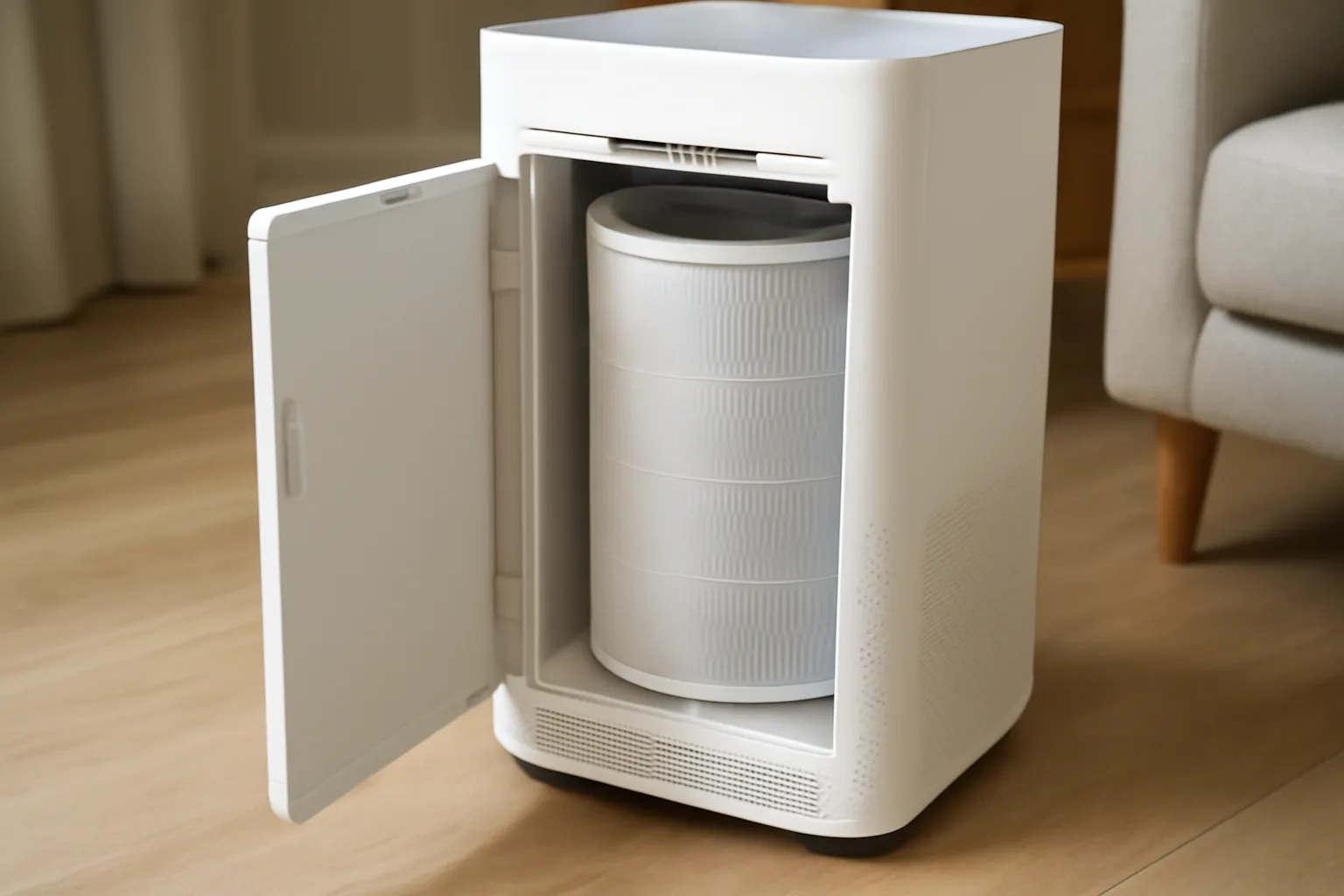
HEPA purifiers pull air through a filter and capture particles inside the machine. Most UK household models combine a pre-filter, a particle filter and an activated-carbon layer for smells. The better ones also publish CADR figures or recommended room sizes that are at least plausible.
What HEPA is good at
A good HEPA-based purifier is useful for airborne particles:
- Pollen: helpful during spring and summer if windows are open during the day.
- Pet dander: useful in bedrooms and living rooms, though it will not replace cleaning sofas and carpets.
- Fine dust and PM2.5: useful near busy roads, during wildfire-smoke events, or after cooking.
- Mould spores: can capture airborne spores, but it will not fix damp walls or condensation.
- Smoke particles: can reduce particles, though smoke smell needs carbon and source control too.
If you are choosing by numbers, our guide to CADR ratings is the one to read next. CADR is more useful than vague “up to 50m²” claims because it tells you how quickly the unit moves cleaned air.
The HEPA downsides
HEPA is safer, but it is not perfect. Filters cost money. Fans make noise. Cheap units can be underpowered for open-plan rooms. Some “HEPA-type” filters are vague, and some tiny desktop purifiers are little more than USB fans with a filter pad.
For a bedroom, I would look for a proper purifier around £90 to £180 rather than a £25 mini unit. The small cheap ones can be fine beside a desk, but they rarely shift enough air to matter in a 12m² bedroom with the door closed.
What HEPA does not solve
A HEPA air purifier does not remove the cause of damp, stop mould growing on cold walls, or make smoking indoors harmless. It also will not fix poor ventilation. Asthma + Lung UK gives practical indoor-air advice around ventilation, smoke-free homes, aerosols and damp control, which is the right mindset: filtration helps, but it does not replace source control.
That is the grown-up answer: use filtration as one part of the room, not as permission to ignore the source.
Ozone, Asthma and Children: The Safety Difference
The safety gap is sharpest for people with asthma, COPD, allergies, young children, older relatives, or anyone using the purifier while sleeping. Those are exactly the homes most likely to buy an air purifier in the first place, so the cautious choice matters.
Why ozone is the red flag
Ozone can irritate airways. That is why “fresh outdoor smell” claims around ozone cleaners should make you suspicious rather than reassured. Clean indoor air should not smell sharp, bleachy, metallic or storm-like.
The UK Department for Education guidance on ventilation and air quality in education and childcare settings recommends HEPA filtration units and says it does not recommend air ionisers, ozone generators or unenclosed UV-field units in that setting: GOV.UK ventilation and air quality guidance. A school is not the same as your spare room, but the caution is useful. If a device is not the preferred approach around children in a managed setting, I would not make it the first choice for a nursery at home.
Bedrooms are the wrong place to take chances
People often run purifiers overnight because the bedroom is where symptoms show up: blocked nose, coughing, itchy eyes, dusty carpets, pets sleeping nearby. That makes low-risk operation more important than clever-sounding cleaning technology.
For bedrooms, I would choose:
- HEPA-based filtration: no required ioniser mode.
- Quiet night setting: under about 25 dB if you are noise-sensitive.
- No bright display: or a display-off mode, because blue LEDs at 2am are not a lifestyle upgrade.
- Clear filter schedule: a filter reminder is useful, but only if replacements are easy to buy.
If you already own a purifier with an ioniser button, check whether the main filtration still runs with that button off. If yes, turn it off and use the filter. If no, I would move it out of bedrooms and replace it when budget allows.
What about asthma?
For asthma households, the safest advice is to focus on proven, boring measures: reduce triggers, vacuum, manage damp, keep bedrooms clean, wash bedding, ventilate sensibly and use a HEPA purifier sized to the room. An ioniser is not where I would spend the money.
If symptoms are changing, the purifier is not the treatment plan. Use NHS or clinician advice for asthma management, and treat the purifier as background support.
Running Costs, Filters and Real UK Prices
The cheapest purifier is not the one with the lowest sticker price. It is the one that cleans the room safely without awkward filter costs, high electricity use, or a feature set you end up switching off.
Typical UK purifier prices
These are realistic UK street-price bands as of mid-2026, before short sales and voucher codes:
- Basic ioniser: about £25 to £80 from Amazon UK or marketplace sellers. Often small, quiet and light on specifications.
- Hybrid purifier with ioniser mode: about £90 to £250 from brands such as Pro Breeze, Shark, Winix or Philips, depending on room size.
- Small HEPA bedroom purifier: about £80 to £150. Examples include Levoit Core Mini at around £50 to £70 and Levoit Core 300S around £130 to £160.
- Mid-range HEPA purifier: about £150 to £300. Blueair Blue Max 3250i is often around £169, while Philips 800 or 1000-series units often sit around £120 to £230.
- Premium purifier: about £350 to £650. Dyson purifier-only or fan-purifier models usually live here, with replacement filters often about £65 to £80.
Those prices make the ioniser look tempting, but check what you are giving up: published CADR, replacement parts, room-size honesty and low-risk overnight use.
Filter costs matter
HEPA filters usually need replacing every six to twelve months depending on dust, smoke, pets and usage. Typical UK filter prices:
- Levoit Core 300/300S filter: about £25 to £35 for official replacements, less for third-party filters.
- Blueair small-room filters: about £30 to £45 depending on model.
- Philips filters: often about £35 to £60.
- Dyson combined filters: usually about £65 to £80.
I prefer official filters for bedrooms and allergy households. Third-party filters can be fine in a study or utility room, but the fit and carbon quality vary.
Electricity cost
Most household purifiers use roughly 5 to 50 watts depending on fan speed. A small HEPA purifier running at 20 watts for eight hours uses 0.16 kWh. At an electricity price around 25p per kWh, that is about 4p a night. Run it every night and you are looking at roughly £14 to £16 a year for that usage pattern.
Large purifiers on high speed cost more, but filter replacement is usually the bigger annual bill. Our guide to air purifier running costs in the UK breaks that down by room size.
What I would buy
For a bedroom or small living room, I would rather buy a £130 to £180 HEPA purifier from Levoit, Blueair, Philips or Shark than a £45 ioniser with grand claims. If the budget is tight, buy a smaller HEPA unit for the bedroom first and use cleaning plus ventilation elsewhere.
For a larger open-plan kitchen-living room, spend closer to £220 to £350 on higher CADR rather than buying two weak desktop units. If cooking particles are the issue, use the extractor too. A purifier should help the room recover; it should not be your only line of defence.
Which Type Should You Buy for Each Room?
The safest choice depends on where the machine will run and who uses the room. A home office with the window open at lunchtime is a different risk from a toddler’s bedroom with the door closed all night.
Bedrooms and nurseries
Choose HEPA. Avoid ioniser-first products and turn off optional ioniser modes. Look for quiet operation, a display-off mode and a filter that is easy to buy from UK retailers. Place the purifier away from curtains and walls so it can draw air properly.
If the room is dusty, also read our guide on where to place your air purifier. Placement can make a good unit feel average if you trap it behind furniture.
Living rooms with pets
Choose HEPA with a washable pre-filter if possible. Pet homes load filters quickly with hair and dander. Expect to vacuum the pre-filter every couple of weeks and replace the main filter sooner than the app predicts.
An ioniser may make dust settle, but pet dander is better dealt with by filtration, vacuuming, washable throws and keeping pets out of bedrooms if symptoms are bad. No judgement if the dog wins that argument, but the purifier has to work harder.
Kitchens and smoke-prone rooms
Choose a HEPA purifier with activated carbon, but control the source first. Use the cooker hood, open a window when outdoor air is reasonable, and avoid indoor smoking. For smoke, read our guide to air purifiers for smokers; the short version is that particles and smell need different layers of control.
I would not use an ozone cleaner in an occupied room to deal with smoke smell. It may sound like a shortcut, but it is the wrong trade-off.
Home offices
HEPA still wins, but this is where a smaller unit can make sense. If you sit in a box room all day with a printer, dusty carpet or road-facing window, a £90 to £150 purifier near the desk can be worthwhile. Check noise at medium speed, not just sleep mode, because medium is where many units do useful work.
If you already have a combined purifier with an optional ioniser, run it with the ioniser off unless the manual gives clear, trustworthy safety information and you are not using it around children or anyone with lung symptoms.
The bottom line
For the question “Which is safer?”, HEPA wins. Ionic purifiers can be cheap and quiet, but the ozone question and particle-settling issue make them hard to recommend as the main cleaner in a lived-in room. Buy HEPA first, size it properly, change the filter, and fix the indoor-air source where you can.
Frequently Asked Questions
Are ionic air purifiers safe to use at home? Some may meet safety limits, but I would not choose an ioniser as the main cleaner for bedrooms, nurseries or asthma households. A HEPA purifier is the safer default because it filters particles mechanically.
Do HEPA air purifiers produce ozone? A standard HEPA purifier does not need to produce ozone to work. Be more cautious with products that add ioniser, plasma, UV or ozone features, especially if those features cannot be switched off.
Is an ioniser better than a HEPA filter for smells? No. Smells are better handled by source control, ventilation and activated carbon. HEPA captures particles; carbon helps with odours. Ionisation is not the fix I would rely on for cooking smells, smoke or damp.
Should I turn off the ioniser on my air purifier? Yes, unless you have a clear reason to use it and the manufacturer gives credible safety data. Most homes can run the purifier in normal HEPA filtration mode and leave the ioniser off.
What is the safest air purifier for a child’s bedroom? Choose a HEPA-based purifier with no required ioniser mode, quiet night running, a display-off option and replacement filters you can buy easily in the UK. Expect to spend about £90 to £180 for a sensible bedroom unit.
Are cheap £30 ionisers worth buying? I would usually skip them. Put the money towards a small HEPA purifier, better vacuuming, bedding washing, damp control or a replacement filter for a purifier you already own.