For a first answer to “does this home have a radon problem?”, start with a three-month lab test in the rooms you use. The UKradon home measurement pack is my first choice for that job. A digital monitor earns its place if you need to follow a basement room, watch seasonal changes or check how remedial work performs. It does not turn a high reading from one afternoon into a diagnosis.
If you want a digital device, the Airthings Corentium Home 2 is the most balanced radon-focused pick here. The EcoBlu is simpler if a fixed plug-in screen suits you; View Plus adds wider air-quality sensors; Aranet Radon Plus offers a portable E-Ink display. All four are monitors, not substitutes for smoke or carbon monoxide alarms.
Digital radon monitors: our top picks

Airthings Corentium Home 2
Best radon-focused digital choice
Battery powered; screen and Bluetooth app; radon, temperature and humidity.

Ecosense EcoBlu
Best simple plug-in display
Mains-powered LED display with short- and long-term radon views.

Airthings View Plus
Best for wider air-quality monitoring
Radon plus PM2.5, CO₂, VOC, humidity, temperature and pressure.
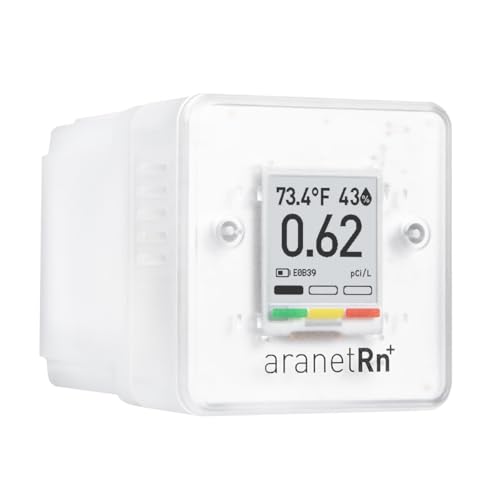
Aranet Radon Plus
Best portable E-Ink option
Battery-powered E-Ink display, Bluetooth app and radon trends.
In This Article
- Comparison at a glance
- Four digital radon monitors in detail
- Lab test or digital monitor?
- How to choose a monitor
- Where and how long to measure
- What a high result means
- The bottom line
- Frequently Asked Questions
Comparison at a glance
| Choice | Best for | Power and access | Main limitation |
|---|---|---|---|
| UKradon home measurement pack | First UK home assessment | Two passive detectors; lab analysis after three months | No live trend |
| Corentium Home 2 | Radon-focused digital monitoring | Battery; local display and Bluetooth | Remote access needs a compatible hub |
| EcoBlu | Simple fixed-room display | Plug-in; on-device LED display | No app or portable battery use |
| View Plus | Radon plus wider indoor air quality | Battery or USB-C; Wi-Fi and display | Extra sensors may be unnecessary |
| Aranet Radon Plus | Portable E-Ink trend display | Battery; Bluetooth app | Device colour bands differ from UK action guidance |
The lab pack and digital monitors answer different questions. The pack follows UKHSA’s three-month home-measurement approach. Digital devices help you see patterns as a room or season changes. Buying the fastest display is not the same as obtaining the most useful long-term home assessment.
Four digital radon monitors in detail
Airthings Corentium Home 2 — best radon-focused monitor
The Corentium Home 2 shows rolling radon averages on its own screen, alongside temperature and humidity. It runs on two AA batteries and connects to the Airthings app over Bluetooth. The maker’s specification confirms that it works without an app; set the units to Bq/m³ for UK use.
Check before buying: Bluetooth alone is not always-on remote Wi-Fi access. For remote viewing you need a compatible Airthings hub or View device. Give the long-term average time to develop before comparing it with UK guidance.
Ecosense EcoBlu — best simple plug-in screen
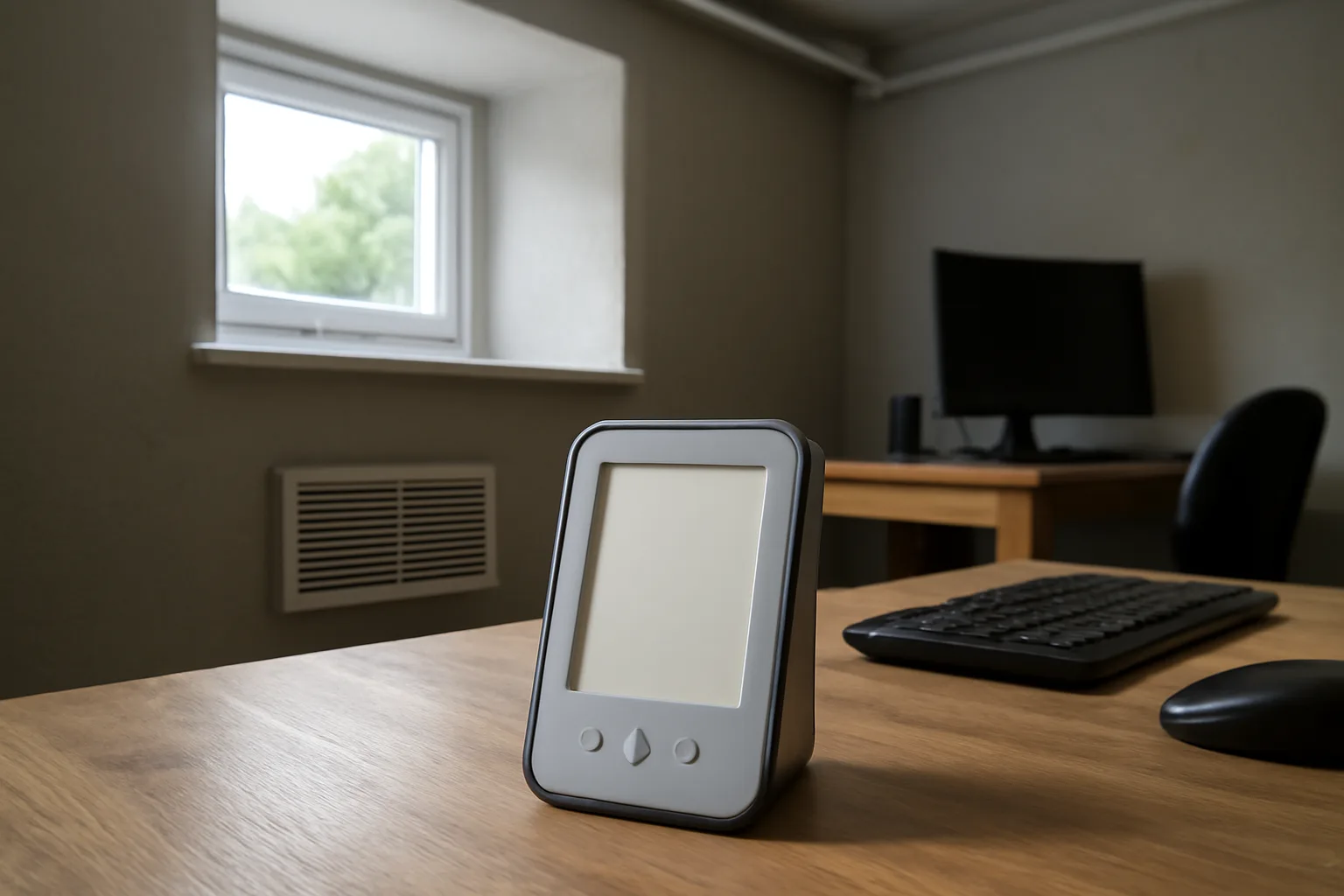
EcoBlu is for a room where you can leave a monitor in one place and want a readable number without opening an app. Its maker-listed plug-in design offers short- and long-term views on an LED display. That is useful in a regularly occupied basement office or ground-floor room.
Check before buying: It needs a socket and is not a portable battery monitor. Its fast updates are helpful for observing a pattern, but a day of readings should not decide whether major work is needed.
Airthings View Plus — best for wider air quality
View Plus combines radon with PM2.5, CO₂, VOC, temperature, humidity and air pressure, with Wi-Fi connectivity. Choose it if your question includes stale air or cooking particles as well as radon; see our air-quality monitor guide for what those other measurements mean.
Check before buying: Those extra sensors do not make its radon reading a substitute for a three-month assessment. If radon is your only concern, the Corentium Home 2 is the cleaner purchase.
Aranet Radon Plus — best portable E-Ink option
The Aranet Radon Plus uses an E-Ink display, battery power and a Bluetooth app for longer trends. The maker’s Home leaflet describes the temperature and humidity measurements too. It suits a buyer who wants a quiet screen and may later move the unit between rooms after each measurement period.
Check before buying: Aranet’s on-device colour bands are not the UKHSA decision rule: the UK Action Level is 200 Bq/m³ as a home annual average. Use the number and a longer test, not a green/yellow/red moment, to guide action.
Lab test or digital monitor?
Start with the question you need answered
Radon is a colourless radioactive gas from the ground. Its concentration can change with ventilation, weather and season. The UKHSA Action Level of 200 Bq/m³ refers to the annual average concentration in a home, not a brief peak. UKradon therefore uses two passive detectors, normally in a living room and bedroom, over three months for a domestic measurement. The home pack includes lab analysis; follow its instructions and check the current service terms directly.
When a digital monitor adds value
A digital monitor is useful after an initial result if you occupy a basement room, want to compare longer room trends or need to observe a change after remediation. It is also reasonable if you want an ongoing indicator while arranging a formal measurement. Leave it in one place long enough for a meaningful average. Do not treat an instant reading as a smoke-alarm event, or a low afternoon as an all-clear.
- One-off home decision: choose a three-month lab test first.
- Known radon concern: add a digital trend monitor if regular use of the room justifies it.
- After remedial work: use a monitor for trends, then confirm the outcome with an appropriate longer test.
How to choose a monitor
Compare the display and connection you will actually use
A local screen is easiest when everyone in the house wants to see the long-term number. Corentium Home 2 and Aranet offer battery-powered placement without a nearby plug; EcoBlu suits a fixed socket. View Plus makes sense only if you also want PM2.5 and CO₂. A Bluetooth app is not the same thing as built-in Wi-Fi: decide whether checking the device in the room is enough or whether remote access matters.
Check the UK measurement units
Look for Bq/m³ on the screen or in the app. Some devices ship with US pCi/L units or US-style alert bands; the Corentium Home 2 manual explains how to change units. Aranet’s coloured bands should likewise be read alongside UKradon’s Action and Target Levels, rather than used as a UK threshold. Check whether the product includes the power adapter or batteries described for the exact variant.
Skip a device that cannot explain its reading
A generic “gas detector” is not necessarily a radon monitor. Look for a named radon sensor, clear averaging periods, instructions for placement and a way to obtain support if results look odd. Extra sensor count, alarms and flashy app graphics do not make the long-term radon result more meaningful. Our home air-quality testing guide covers other indoor pollutants separately.
Where and how long to measure
Put it where people spend time
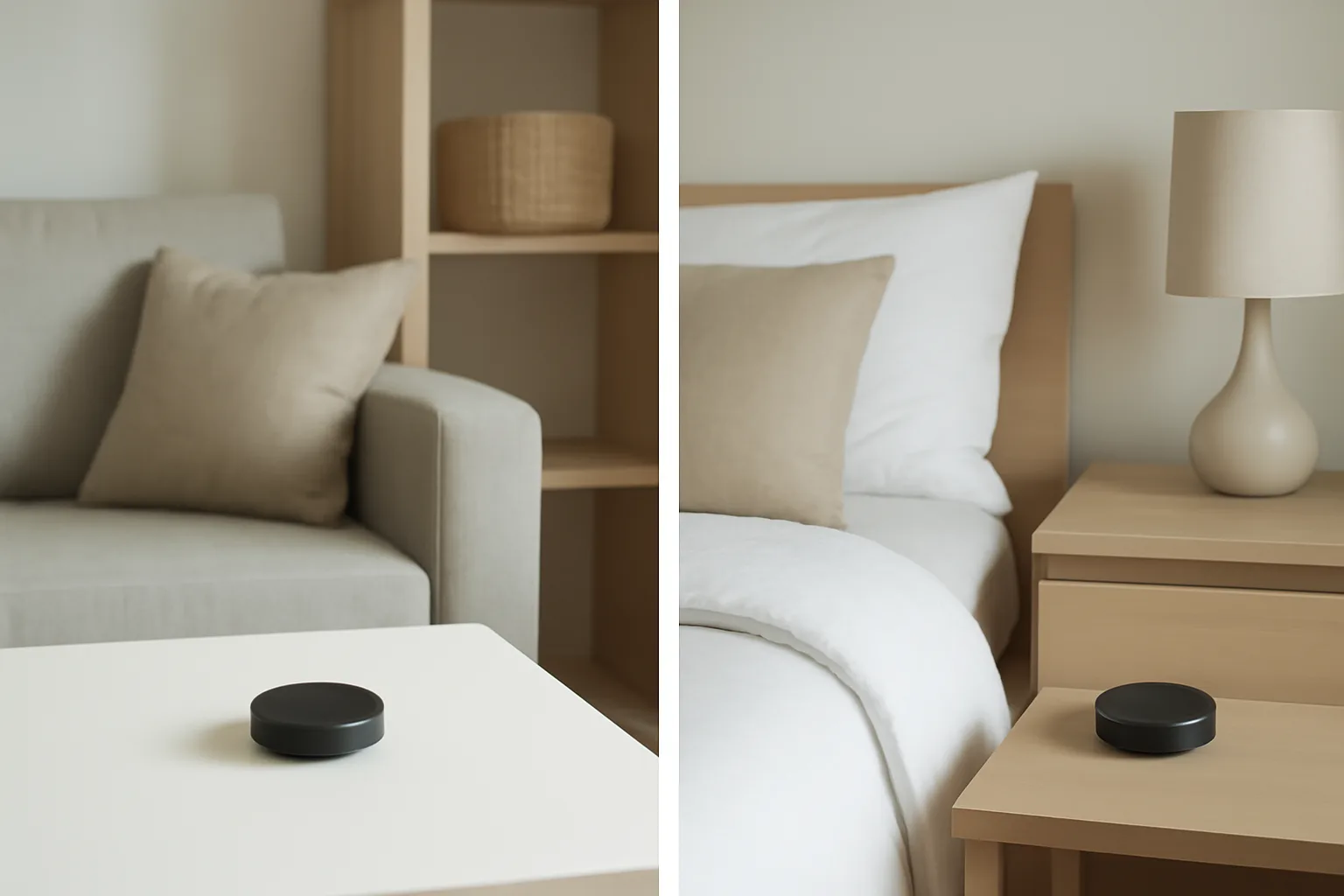
For the UKradon pack, follow the supplied placement instructions: one detector in a living area and one in a bedroom. For a digital device, choose the occupied room you care about, often a basement office or ground-floor living room. Avoid a bathroom, kitchen, direct sun, a draughty window or an air vent unless the manufacturer specifically instructs otherwise. If you move a digital unit between rooms, note the date and begin a fresh measurement period.
Give the average time to settle
A short spike can prompt a closer look, but a longer average is the better basis for a home decision. Do not switch windows or ventilation habits purely to improve the number during a test; measure the home as it is normally used. UKradon’s address search indicates area risk, not your home’s actual level. It recommends testing occupied below-ground rooms even outside an affected area.
Radon is a separate hazard from carbon monoxide. A radon device cannot replace a CO alarm; our carbon monoxide alarm placement guide covers that immediate safety device. Damp and ventilation questions are covered in our indoor air-quality guide and damp and mould guide.
What a high result means
Use a measured average to plan the next step
If a three-month result exceeds 200 Bq/m³, follow the advice with the report and seek an appropriate reduction plan. UKradon’s remediation guidance describes options such as improving subfloor ventilation and an active radon sump. Which method suits a house depends on its floor and existing ventilation; sealing visible gaps alone is rarely a whole-house plan. The ideal target after remediation is below 100 Bq/m³.
Treat a digital spike as a prompt, not a verdict
Check the device placement, the longer average and whether the room is normally occupied. If the trend remains high, arrange a longer measurement or specialist advice rather than buying another gadget to settle an argument between screens. After mitigation, retest to establish whether the work has reduced exposure. An air purifier is not a substitute for radon reduction: filtration aimed at particles does not stop radon gas entering from the ground.
The bottom line
For most first-time UK home checks, order the UKradon three-month pack. If ongoing digital monitoring is justified, the Corentium Home 2 is the most sensible radon-focused choice here. Choose EcoBlu for a fixed plug-in display, View Plus when wider air quality matters, or Aranet Radon Plus for a portable E-Ink screen. The buying mistake is paying for faster readings while overlooking the longer measurement needed to judge the home.
Frequently Asked Questions
What is the best first radon test for a UK home? A three-month home measurement in the living area and bedroom is the sound first step. UKradon supplies a two-detector pack with lab analysis and advice; a digital monitor can add longer-term trends afterwards.
Which digital radon detector suits most households? The Airthings Corentium Home 2 is the balanced radon-focused choice here. It shows rolling averages on its own screen and runs on batteries, with Bluetooth app access if wanted.
How should I interpret a reading above 200 Bq/m³? The UK Action Level of 200 Bq/m³ is based on an annual average home concentration, not a single hour. Look at a longer measurement and follow UKradon advice if the result is above that level.
Where should I put a home radon detector? Follow the maker’s instructions and measure a regularly occupied room. UKradon’s domestic pack uses a living area and a bedroom; avoid draughts, direct sun and rooms such as kitchens or bathrooms unless instructed otherwise.
How long should I measure radon? UKradon’s domestic measurement runs for three months to account for fluctuations. A digital monitor can show early trends, but its brief readings should not replace a longer home assessment.
Will an air purifier or carbon monoxide alarm deal with radon? Neither is a radon remedy. A carbon monoxide alarm detects a different gas, while ordinary particle filtration does not stop radon entering a home. Seek radon-specific advice if a longer test shows a high level.