This humidifier tank size and runtime guide starts with the part manufacturers’ headline figures often hide: tank capacity does not tell you exactly how many hours an appliance will run. Runtime depends on usable water volume, the selected output in millilitres per hour, room demand and whether a humidistat pauses the unit. A 4-litre model running gently can last longer than a 6-litre model working at maximum output, so litres alone are a poor buying shortcut.
This humidifier tank size and runtime guide gives you a practical way to estimate refill frequency without treating a marketing claim as a promise. The useful calculation is simple: divide usable tank volume in millilitres by the output rate in millilitres per hour, then adjust for automatic cycling and the water left below the shut-off point.
In This Article
- Why tank size does not equal runtime
- How to calculate humidifier runtime
- Humidifier tank sizes compared
- How room demand changes refill frequency
- Ultrasonic vs evaporative runtime
- Tank design matters as much as capacity
- Night use, noise and automatic control
- Cleaning and safe humidity control
- Choosing the right tank size
- Frequently asked questions
Humidifier Tank Size and Runtime Guide: Why Litres Are Not Hours
Manufacturers usually state tank capacity in litres and runtime in hours, but those figures describe different things. Capacity is a physical volume. Runtime is the result of several operating conditions, and the advertised figure may use the quietest or lowest-output setting.
Nominal capacity is not always usable capacity
A tank described as 4 litres may not release every millilitre. The maximum fill line can sit below the top, while a small amount of water may remain when a float or sensor triggers automatic shut-off. Water can also sit in a base channel, wick tray or internal reservoir rather than in the removable tank.
That difference is normally small, but it matters when you calculate an exact-looking result. Treat the stated capacity as a ceiling unless the manual gives a usable volume.
Output is the main variable
Humidifier output is normally stated in millilitres per hour. A model capable of 300ml/h does not necessarily release 300ml every hour. Low, medium and high settings can use water at very different rates, and automatic mode may stop mist or fan operation when the chosen humidity is reached.
A simple comparison shows the problem. Two litres divided by a low 150ml/h setting is about 13.3 theoretical hours; the same two litres divided by a 220ml/h setting is only about 9.1 hours. The tank did not change. The assumed output did. Use figures from the current manual for the exact model rather than borrowing a rate from a similar-looking humidifier.
Automatic cycling can lengthen elapsed runtime
A humidistat measures relative humidity and pauses or reduces humidification when the target is reached. The tank may therefore last across a longer period than a simple continuous-output calculation suggests. That is elapsed time, not evidence that the appliance has produced more water.
This is why a quoted “up to 30 hours” can be plausible in one small, closed room yet impossible at maximum output in a dry, draughty space. Our guide to how to measure humidity at home explains how to check whether the room actually needs more moisture.
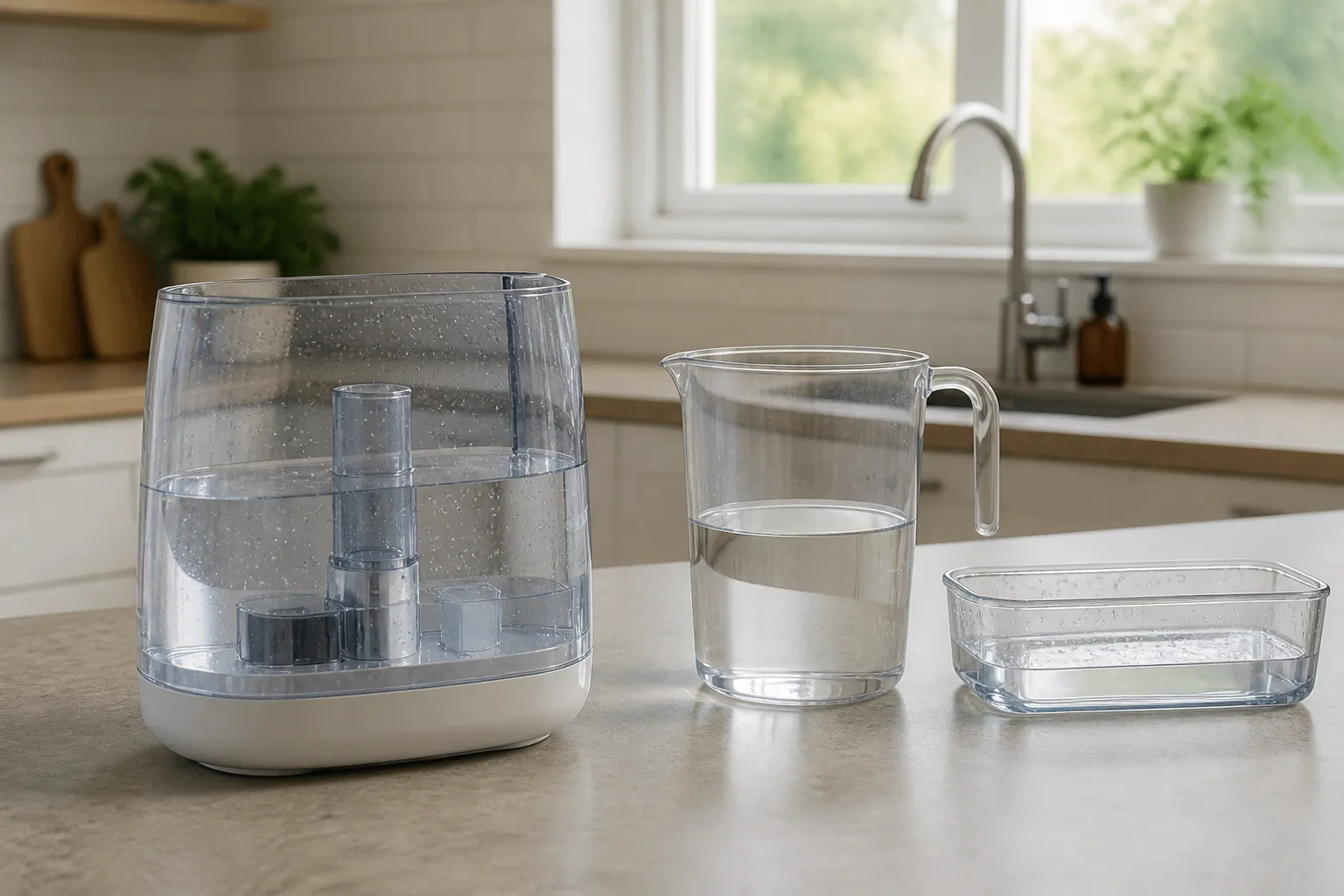
How to Calculate Humidifier Runtime
You need two figures: usable tank volume and the output at the setting you expect to use. Convert litres to millilitres by multiplying by 1,000.
The basic formula
Estimated continuous runtime = usable tank volume (ml) ÷ output (ml/h)
For a 3-litre tank running at 200ml/h:
3,000ml ÷ 200ml/h = 15 hours
That is a planning estimate for continuous operation at that output. It does not include automatic cycling, water retained below the shut-off level, a changing fan speed or the effect of mineral build-up on performance.
Use a range rather than one number
If the manual lists several outputs, calculate each one. A 4-litre usable tank gives these theoretical results:
- At 150ml/h: about 26.7 hours;
- At 250ml/h: 16 hours;
- At 350ml/h: about 11.4 hours.
That range is more useful than repeating the longest figure on the box. It shows whether the appliance can cover a workday, an evening or an overnight period at the output your room is likely to demand.
Make the estimate more realistic
If you cannot find usable capacity, start with 90% of the nominal volume as a cautious planning allowance. This is not a universal engineering rule; it simply avoids assuming that every drop reaches the emitter or wick. For a 5-litre tank, use 4,500ml in the first calculation, then compare the result with the manufacturer’s own tested runtime.
Do not multiply the result by an invented “humidistat bonus”. Cycling depends on starting humidity, ventilation, temperature, room size and the target setting. Instead, record how much water remains after one typical day and refine your estimate from your own room.
Humidifier Tank Sizes Compared
Tank bands are not formal standards, but compact, medium and large ranges provide a useful way to think about carrying, cleaning and refill routines.
| Nominal tank size | Typical use pattern | Example at 200ml/h | Main advantage | Main compromise |
|---|---|---|---|---|
| Under 2 litres | Short sessions or small spaces | Under 10 theoretical hours | Light and easy to wash | Frequent refilling |
| 2–4 litres | Evening, overnight or daily room use | 10–20 theoretical hours | Good balance of capacity and handling | May not cover a full day at high output |
| Over 4 litres | Long sessions or higher-output units | Over 20 theoretical hours | Fewer refill interruptions | Heavier and more awkward to clean |
Compact tanks under 2 litres
A small tank suits occasional desk use, a compact room or someone who prefers to empty and refill the unit frequently. One litre of water weighs roughly 1kg, so a compact removable tank is easier to carry to the sink and manoeuvre under a tap.
The limitation is obvious: even a modest 150ml/h output empties a 1.5-litre tank in roughly ten theoretical hours. At 250ml/h, the same volume lasts about six hours. A tiny unit may be quiet and convenient, but it is not automatically an all-night machine at a useful output.
Medium tanks from 2 to 4 litres
This is the practical middle ground for many bedrooms and living rooms. A 3-litre tank offers about 15 theoretical hours at 200ml/h, yet remains manageable when full. It also leaves enough capacity for a humidistat-controlled unit to operate across an evening and night without demanding an enormous appliance.
Capacity still needs to match room demand. Read how to choose the right humidifier size for your room before choosing a larger tank merely to avoid refills. Output and room suitability come first; tank volume supports that performance.
Large tanks over 4 litres
Large tanks reduce refill frequency, which is useful when a unit actually needs a higher output. They also become heavy. Five litres of water adds about 5kg before the tank itself is counted. A tall, slippery tank carried from an upstairs bedroom to a kitchen sink can be less convenient than filling a smaller vessel twice.
Check whether the tank has a secure handle, a flat base and an opening wide enough for your hand or cleaning brush. A large tank that is difficult to clean is not a sensible upgrade.
How Room Demand Changes Refill Frequency
The same humidifier can use water quickly in one room and slowly in another. The machine is replacing moisture lost through ventilation, air leakage and absorption by dry materials, not simply adding a fixed quantity to a sealed box.
Starting humidity and target humidity
A room starting at 30% relative humidity needs more water to reach 45% than a room already at 42%. After the target is reached, a humidistat may cycle the unit rather than running continuously. Raising the target makes cycling less likely and increases water use.
Our explanation of relative humidity and sensible indoor levels gives the context. The goal is controlled humidity, not the longest possible runtime or the highest number on the display.
Ventilation and draughts
An open door, trickle vents, extractor use and a draughty window allow humidified air to mix with drier air. That can keep the appliance working for longer. Closing every vent is not the answer: UK homes still need appropriate ventilation. Instead, recognise that a quoted runtime from a controlled test may not match a ventilated bedroom.
Temperature and room contents
Relative humidity changes with temperature. Heating a room can lower the relative-humidity reading even when the amount of moisture in the air has not changed. Dry timber, plaster, furniture and textiles can also absorb moisture when conditions first change, increasing early demand.
This is why the first tank after switching on in winter may disappear faster than later tanks. Watch the hygrometer and room surfaces rather than assuming faster water use means a fault.
Ultrasonic vs Evaporative Runtime
Technology changes how water reaches the air and how output is controlled. It does not create water, so the same volume-versus-output formula remains the starting point.
Ultrasonic humidifiers
An ultrasonic unit uses a vibrating element to produce a visible cool mist. Many models offer several mist levels, making output relatively easy to understand when the manufacturer publishes ml/h figures. At a fixed high setting, water consumption can be steady and the tank estimate reasonably close.
Minerals in water can leave scale in the appliance and may appear as white dust around some ultrasonic units. Follow the exact water and cleaning instructions for the model. Do not add essential oils to the tank unless the manufacturer provides a separate approved tray or explicitly permits tank use.
Evaporative humidifiers
An evaporative model draws air through a wet wick or filter. Output changes with fan speed and room conditions: drier air can accept more moisture, while evaporation slows as humidity rises. A rated maximum therefore describes capability rather than constant consumption.
Filters add another variable. Scale or dust on a wick can reduce airflow and effective output, while replacement intervals create an ongoing cost. Our guide to humidifier hygiene and scale build-up covers the cleaning routine in more detail.
Warm-mist units
Warm-mist humidifiers heat water and have their own electricity and burn-risk considerations. Tank calculations still apply, but a high stated output can empty the reservoir quickly. Keep hot-water and steam units away from children and follow the placement instructions. The article on warm mist versus cool mist humidifiers handles that safety decision separately.
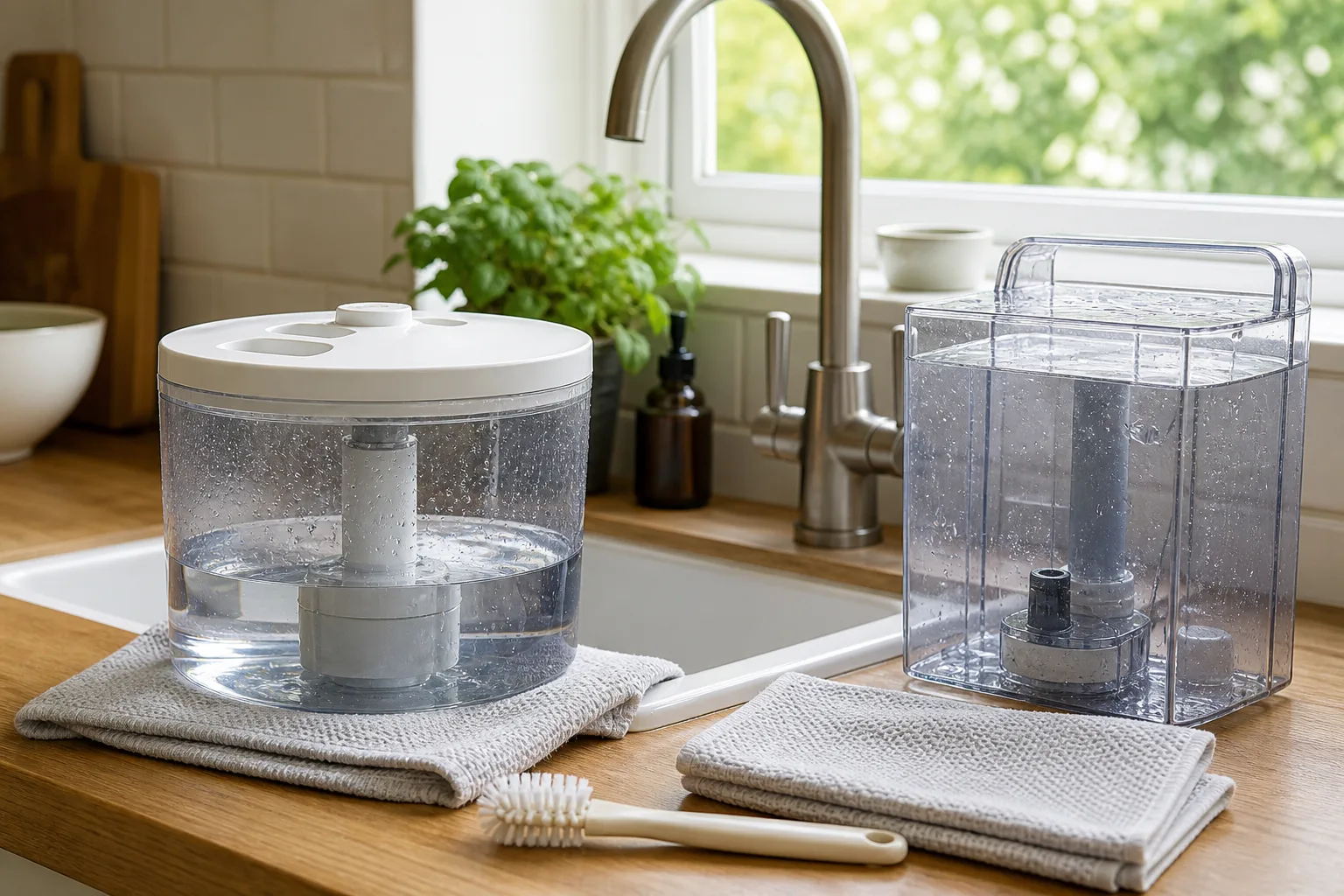
Tank Design Matters as Much as Capacity
Capacity looks impressive in a comparison chart, but the refill and cleaning design determines whether you will maintain the appliance properly.
Top-fill designs
A top-fill tank can be replenished with a jug without turning it upside down. That is convenient when the unit sits near a safe water source, but you still need to remove or access the tank for cleaning. A narrow decorative opening may be easy to fill and miserable to scrub.
Lift-out and inverted tanks
A removable tank can be carried to the sink and emptied completely. Look for a secure handle, stable base and cap that is easy to grip when wet. Check the filled weight before choosing a 6-litre model for an upstairs room.
Fill lines and residual water
Do not exceed the maximum line. Overfilling can wet electrical areas or prevent the base from seating correctly. A little residual water near the valve or shut-off sensor can be normal, but standing water should not be left indefinitely. Empty and dry the parts according to the manual when the humidifier is not in regular use.
Openings and internal corners
The best tank is one you can clean without improvising. Wide openings, smooth internal surfaces and removable parts reduce the places where film and scale can collect. Inspect product diagrams for inaccessible tubes, tight corners and fixed channels rather than judging only the litre figure.
Night Use, Noise and Automatic Control
An overnight runtime claim is useful only if the humidifier is quiet, dim and able to control humidity without soaking the room.
Low mode may explain the headline runtime
Night or sleep mode often reduces fan speed or mist output. That saves water and can make a tank last longer, but it also lowers humidification capacity. If the room remains dry on low, the long runtime has little value.
Check the output attached to sleep mode rather than relying on a general noise figure. A product may quote its lowest decibel level and its highest output in separate tests; those two best-case figures do not necessarily occur together.
A humidistat matters more than an oversized tank
A built-in humidistat can stop or reduce output after the target is reached. That helps prevent unnecessary operation and makes elapsed runtime more meaningful. An external hygrometer is still useful for checking the reading away from the immediate mist plume.
Position the sensor and appliance as the manufacturer directs. If the humidifier measures its own damp microclimate, it may cycle too early; if it sits in a draught, it may work harder than the rest of the room requires.
Lights, alarms and refill timing
Look for controls that can dim fully, a low-water indicator that is not startling and automatic shut-off when the tank empties. If a calculation predicts the tank will run dry at 4am, a slightly larger unit or lower sensible output is more useful than gambling on an optimistic “up to” claim.
Cleaning and Safe Humidity Control
A large tank is not permission to leave the same water standing for days. Runtime convenience has to fit a proper emptying and cleaning routine.
The US Environmental Protection Agency’s humidifier care guidance recommends emptying, drying and refilling portable units daily, cleaning them every third day, following manufacturer instructions and avoiding indoor relative humidity above 50%. It also advises reducing output if surrounding materials become damp. Those are cautious public-health recommendations rather than a substitute for the manual supplied with a UK appliance.
A practical routine
- Check humidity first: use the humidifier only when conditions require it and monitor a representative part of the room.
- Unplug before handling: switch off and disconnect the appliance before removing water parts.
- Discard stale water: do not keep topping up old water indefinitely.
- Clean to the manual: use the stated method and rinse away any approved cleaning product thoroughly.
- Dry before storage: empty tanks, channels and removable parts when the unit will be unused.
Condensation on windows or dampness around the unit means output is too high, placement is poor or the room does not need continuous humidification. Lower the setting, use automatic control or stop the unit while conditions stabilise. A longer tank runtime is not a benefit if it encourages over-humidification.
Choosing the Right Tank Size
Start with the output needed for the room, then choose enough water capacity for your preferred refill routine. Reversing that order can leave you with a huge tank attached to an underpowered unit.
Choose compact when handling matters most
A tank below 2 litres makes sense for short sessions, a small space or anyone who would struggle to lift a larger filled reservoir. Expect more frequent refills and calculate whether the selected output covers the intended session.
Choose medium for the best everyday balance
A 2–4 litre tank is the sensible default for many room humidifiers. It offers enough water for an evening or night at moderate output without becoming difficult to carry and clean. It is also the range where a good top-fill design can be practical.
Choose large only for a clear reason
Go above 4 litres when room demand, output and usage pattern justify it. Check filled weight, sink clearance, handle strength and cleaning access before celebrating the longer theoretical runtime.
The final decision should answer three questions:
- Performance: can the humidifier provide the output the room needs?
- Routine: will the usable capacity cover the period between sensible refills?
- Maintenance: can you carry, empty, clean and dry the tank without avoiding the job?
Tank size is a convenience feature after those checks, not a measure of humidifier quality.
Frequently Asked Questions
How long will a 2-litre humidifier last? Divide usable volume by the selected output. Two litres gives about 10 theoretical hours at 200ml/h, 13.3 hours at 150ml/h or 8 hours at 250ml/h. Automatic cycling may extend elapsed time, while residual water can shorten continuous runtime.
Is a bigger humidifier tank always better? No. A larger tank reduces refills but adds weight, bulk and cleaning effort. Output, room suitability, humidistat control and access for cleaning matter more than capacity alone.
Why did my humidifier run out sooner than advertised? The quoted figure may use low mode, a controlled room or automatic cycling. High output, low starting humidity, ventilation and a smaller usable volume can all shorten runtime.
Can I leave water in a humidifier for several days? Follow the manufacturer’s care instructions. Cautious EPA guidance recommends emptying, drying and refilling portable humidifiers daily rather than repeatedly topping up standing water.
Does auto mode use less water? It can. A humidistat may pause or reduce output after the target humidity is reached. Savings depend on room conditions and the chosen target, so there is no fixed percentage.
What tank size is best for overnight use? Calculate the water needed at the quiet setting you will actually use. For eight hours at 200ml/h, the theoretical requirement is 1.6 litres, plus a sensible allowance for unusable water. Check noise, display lights and automatic humidity control too.