The Philips 600 Series is the best quiet bedroom air purifier for most UK rooms. Its published 170m³/h CADR is enough for a typical double bedroom, sleep mode is rated at 19dB, the display dims at night and maximum power draw is only 12W. It is compact without relying on the very low air-cleaning rate of a tiny desktop model.
Choose differently when your priority changes. The Coway Airmega 50 is quieter on paper and adds automatic air-quality control; the Levoit Core 200S is better for app scheduling; the Blueair Blue Pure 511 gives simple physical controls; and the Levoit Core Mini makes sense for a small single bedroom. The older Philips 800 remains a capable choice, but scarce stock makes it harder to recommend over the newer 600 Series.
In This Article
- Our direct answer
- Purifiers at a glance
- Six recommendations
- How to choose
- Noise, room size and clean-air delivery
- Filters, running costs and maintenance
- Placement
- Final verdict
- Frequently asked questions
Best Bedroom Air Purifier: Our Direct Answer
Buy the Philips 600 Series if you want a quiet, sensibly sized purifier that can stay beside the bed without dominating the room. Philips quotes 19dB in sleep mode, dims the display and gives a 170m³/h CADR. Those specifications create a better bedroom balance than choosing purely by the largest coverage number on the box.
The Coway Airmega 50 is the stronger alternative for a light sleeper who wants automatic control without Wi-Fi. Its listing gives an 18.4dB sleep mode, a 120m³/h CADR, a particle sensor and a colour air-quality indicator. It trades some cleaning speed for quieter, set-and-forget use.
Do not buy a purifier because it promises to cure poor sleep, asthma or allergies. It can reduce airborne particles that pass through its filter, but it cannot remove dust mites living in bedding, solve damp or replace ventilation. Think of it as one part of bedroom air management, not treatment.
The Best Quiet Bedroom Air Purifiers at a Glance
| Air purifier | Best for | Quoted low noise | Published capacity | Main compromise |
|---|---|---|---|---|
| Philips 600 Series | Best overall | 19dB | 170m³/h CADR | App adds complexity some buyers will not use |
| Coway Airmega 50 | Light sleepers | 18.4dB | 120m³/h CADR | Slower cleaning than Philips |
| Levoit Core 200S | Smart scheduling | 24dB | Up to 64m² listing claim | Night light needs managing |
| Blueair Blue Pure 511 | Simple controls | 24dB | 16m² in 12.5 minutes | No sensor or app |
| Levoit Core Mini | Small single rooms | Not published on the current listing | 34m² once per hour | Low air-change rate |
| Philips Series 800 | Air-quality feedback | Near-silent claim | Up to 49m² listing claim | Stock is scarce |
Coverage claims are not directly comparable because brands use different air-change assumptions. CADR is the more useful starting point. Noise figures are manufacturer or listing claims measured under particular conditions, not independent measurements in your bedroom.

Our Six Bedroom Air Purifier Recommendations
Philips 600 Series — Best Overall

The Philips 600 Series has the clearest specification balance here. Its 170m³/h CADR gives useful headroom in a normal UK double bedroom, while the 19dB sleep setting and dimmed display address the two things most likely to make a purifier annoying at night: fan noise and unwanted light.
Maximum consumption is listed at 12W, so the machine does not need a high-power motor to deliver its quoted airflow. The Air+ app can change speed, switch the unit on or off and monitor filter status, although the purifier remains usable without turning bedtime into another phone-admin job.
Philips describes its NanoProtect system as HEPA filtration assisted by electrostatic charge. That is not the same wording as a conventional H13 claim, so buy it for the published performance and bedroom usability rather than for a familiar filter label.
- Buy it if: you want strong airflow with a very quiet published sleep mode.
- Skip it if: you specifically want a purifier with no connected features.
- Main compromise: excellent bedroom balance, but replacement-filter availability should be checked before purchase.
Coway Airmega 50 — Best for Light Sleepers

Coway quotes 18.4dB in sleep mode, the lowest explicit figure in this group. The 120m³/h CADR is lower than the Philips 600, but still sensible for a modest bedroom when the unit can run continuously rather than being switched off because it is intrusive.
Its particle sensor drives an automatic mode and a colour-coded indicator. That is more useful than an app for someone who wants the purifier to respond without pairing an account or reaching for a phone. The listing also states ECARF certification and a combined particle and activated-carbon filter.
The trade-off is cleaning speed. In a larger room, or after opening windows during a high-pollen period, the Philips or a larger purifier can clear the air faster. The Airmega 50 earns its place because it focuses on quiet overnight use rather than headline room coverage.
- Buy it if: low noise and automatic response matter most.
- Skip it if: your bedroom is large or you want faster high-speed clearing.
- Main compromise: quieter operation paired with a modest 120m³/h CADR.
Levoit Core 200S — Best for Smart Scheduling
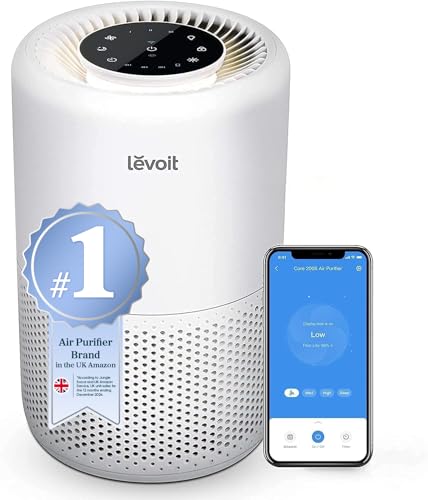
The Core 200S is the practical choice for scheduling around a routine. The VeSync app supports remote speed changes, timers and filter-status checks, while Alexa and Google Assistant compatibility offers voice control. Its sleep mode is listed at 24dB and the display can be dimmed.
Levoit describes three-stage filtration for pollen, dust, pet dander and some odours. The listing claims coverage up to 64m², but that figure should not be read as proof of several air changes per hour in a 64m² room. It is better treated as a bedroom-sized purifier with useful controls.
There is a night light, which some households may like and others will immediately disable. Check that the light and display remain off after your chosen schedule starts; a quiet fan is little comfort if the room glows blue.
- Buy it if: schedules and remote control will help you run it consistently.
- Skip it if: you want no account, app or illuminated features.
- Main compromise: useful automation with extra setup and screen-light management.
Blueair Blue Pure 511 — Best for Simple Controls

The Blue Pure 511 keeps operation deliberately simple: a single-button control interface with three fan speeds. Blueair quotes 24dB on low and says the unit cleans a 16m² room in about 12.5 minutes under its stated test basis. That makes it a good fit for buyers who value airflow but do not want an app.
Its HEPASilent system combines mechanical and electrostatic filtration, and the filter includes carbon for light household odours. Blueair states removal of 99.97% of particles down to 0.1 microns under its test conditions. As with every purifier, that describes air passing through the unit, not instant removal of every particle in the room.
There is no automatic particle sensor in this model. You choose the speed yourself, which is either pleasingly uncomplicated or a missing feature depending on how much attention you want to give it.
- Buy it if: you want capable filtration and physical controls.
- Skip it if: you expect automatic fan changes or air-quality data.
- Main compromise: simplicity means fewer feedback and automation features.
Levoit Core Mini — Best for a Small Single Bedroom

The Core Mini is the smallest-space option rather than a cheaper substitute for a full bedroom purifier. Its listing says it can treat 34m² once per hour. For a 7–9m² single bedroom, that can be workable; for a larger double room, the air-change rate is too modest to be the main reason to buy it.
It uses a three-layer filter and a 360-degree intake, with no UV-C lamp or negative-ion generator. The compact footprint helps on a crowded bedside cabinet or desk, although it still needs clear space around the intake and outlet.
The current product listing does not give a reliable numerical sleep-noise figure, so it would be wrong to place it above products with explicit low-mode data. Choose it for size and basic filtration, then judge the sound during the return period.
- Buy it if: the room and available surface are genuinely small.
- Skip it if: you need several air changes per hour in a double bedroom.
- Main compromise: tiny footprint, but a low published hourly cleaning rate.
Philips Series 800 AC0820/30 — Best Older Model

The Series 800 is familiar, compact and includes a four-colour air-quality display. Philips says its automatic sensor monitors particles, adjusts purification and dims the lights in sleep mode. The listing gives room coverage up to 49m² and 99.5% removal of ultrafine particles under its test conditions.
It remains a credible bedroom purifier, but stock was scarce when checked. That matters because an ageing model can also become less attractive if official replacement filters are harder or more expensive to find. Check both the purifier and genuine FY0194 filter before committing.
The newer Philips 600 is our default because its current listing provides clearer CADR, noise and energy figures. Choose the 800 only if its air-quality display or a good current price makes it more useful to you.
- Buy it if: you value automatic sensing and find reliable filter supply.
- Skip it if: the price is close to the newer 600 Series.
- Main compromise: sound bedroom features, but scarce current stock.
How to Choose a Quiet Bedroom Air Purifier
Start with the room, not the maximum coverage claim
Measure length and width to get floor area, then note ceiling height if it is unusual. A typical UK double bedroom might be 12–16m², while a small single can be below 9m². The purifier needs enough airflow at the speed you can tolerate overnight, not merely enough on its loudest setting.
Our guide to choosing an air purifier for room size explains why coverage labels can mislead. A large quoted area may assume only one air change per hour. For pollen, dust or smoke, buyers often want faster recirculation than that.
Decide which controls help at night
- Display-off control: essential if small LEDs disturb you.
- Manual low mode: predictable and easy to check before sleep.
- Auto mode: useful when the sensor is responsive, but sudden fan changes may wake a light sleeper.
- Schedule: helpful for running the purifier at a higher speed before bed and reducing it later.
- Filter indicator: a prompt, not a substitute for checking the filter and manufacturer guidance.
Noise, Room Size and Clean-Air Delivery
A decibel figure needs context
Decibels use a logarithmic scale, so a small numerical change is not a simple percentage change in perceived loudness. Tone matters too: a smooth fan rush can be easier to ignore than bearing noise or an electronic whine at the same measured level. Our air-purifier noise guide covers that distinction in more detail.
Published minimum noise normally applies to the lowest speed. That setting may move far less air than the quoted maximum CADR. A useful bedroom strategy is to run medium or high speed for an hour before bed, then use sleep mode overnight with the door and windows managed appropriately.
Air cleaning is not ventilation
A particle filter does not remove the carbon dioxide produced by sleeping occupants. The UK government’s existing-home ventilation guide explains that ventilation exchanges stale indoor air for fresh outdoor air. Ventilate when conditions allow, then use filtration to reduce particles; do not treat the two as interchangeable.

Filters, Running Costs and Maintenance
Check replacement filters before the purifier
A cheap machine becomes poor value if its filter is unavailable six months later. Search for the exact official filter code, check current UK stock and compare the replacement interval in the manual. Our air-purifier filter guide explains the signs that a filter needs attention.
Do not vacuum or wash a HEPA filter unless the manufacturer explicitly permits it. Many washable claims refer only to a mesh pre-filter. Moisture, compressed air and aggressive cleaning can damage the fine filter medium.
Carbon has limits
Thin carbon sheets can reduce light odours, but they are not equivalent to a deep bed of activated carbon for sustained gas removal. Read our carbon-filter explainer if fumes or VOCs are the primary concern. Strong or persistent chemical smells need source control and ventilation, not a small bedroom purifier.
Electricity cost depends on actual wattage, speed, hours and tariff. Avoid annual figures based on a temporary energy price. Multiply power in kilowatts by hours used and your current price per kWh; add genuine replacement-filter cost for a realistic annual total.
Where to Place an Air Purifier in a Bedroom
Give the intake and outlet clear space according to the manual. A bedside table can work for a compact model, but not if curtains, bedding or the wall obstruct its 360-degree intake. Floor placement is fine when the design permits it and the unit is not buried in deep carpet.
- Keep airflow clear: follow the maker’s minimum clearance rather than assuming 30cm suits every design.
- Avoid a direct draught: clean air does not need to blow across your face all night.
- Move it away from fabric: curtains and duvets can block vents.
- Keep it dry: do not place it beside a humidifier where mist can enter the purifier.
- Shut the bedroom door when practical: an open-plan area is much larger than the measured bedroom.
For allergies, filtration works best alongside source control. The NHS guidance on managing allergies recommends avoiding known triggers where possible and seeking medical advice for persistent symptoms. An air purifier may reduce airborne exposure, but it is not a diagnosis or medicine.
Which Bedroom Air Purifier Should You Buy?
The Philips 600 Series is the best overall choice because 170m³/h CADR, 19dB sleep mode, a dimmed display and 12W maximum power make sense together. The Coway Airmega 50 is our pick for the most noise-sensitive sleeper, while the Levoit Core 200S is better if scheduling and remote control will keep the purifier running consistently.
Choose the Blueair Blue Pure 511 for simple one-button control and no app. Choose the Levoit Core Mini only when the room really is small. Buy the Philips 800 if genuine replacement filters and a worthwhile price are both available. Whichever model you choose, fit the purifier to the bedroom and the quiet speed you will use—not to the largest number in the product title.
Frequently Asked Questions
Should I run an air purifier all night in the bedroom? You can run a suitable purifier continuously if the manufacturer permits it. Use a speed that is quiet enough to sleep through and keep the intake and outlet clear.
How quiet should a bedroom air purifier be? Published sleep modes around 18–24dB are a useful shortlist, but fan tone and distance matter. Test it in your room during the retailer’s return period.
Will an air purifier help with dust mites? It can capture some airborne dust-mite allergen, but it does not remove mites living in mattresses or bedding. Combine filtration with appropriate bedding and cleaning measures.
Can I sleep with the window open and an air purifier running? Yes, but incoming outdoor air increases the workload and may bring in pollen or pollution. Ventilation and filtration do different jobs, so balance them around outdoor conditions.
Is a HEPA filter enough for bedroom odours? HEPA targets particles. Activated carbon can reduce some gases and light odours, but thin carbon layers have limited capacity and cannot replace removing the source.
Where should a bedroom air purifier go? Put it where air can reach every intake and leave every outlet freely. Avoid curtains, bedding, enclosed corners and direct humidifier mist.