Air purifiers for small bedrooms are simple — almost anything with a HEPA filter will do the job — and pairing it with other measures from our indoor air quality guide helps even more. Large rooms are a different challenge entirely. From our testing across multiple open-plan UK homes, we’ve found that getting the right purifier for a large space requires careful attention to a few key specs. Open-plan living spaces, large lounges, and combined kitchen-diners need notably more air processing power, and the wrong purifier will just sit there looking expensive while achieving nothing.
The UK market is flooded with purifiers claiming to handle “large rooms” without defining what that means. A 20m² bedroom and a 50m² open-plan space have completely different requirements. Here’s how to actually match a purifier to a large room, what specs matter, and what to ignore.
What Counts as a “Large Room”?
For air purification, a large room in a UK home is roughly:
- 30-40m² — a generous lounge or master bedroom with en-suite
- 40-60m² — a knocked-through living/dining room or open-plan kitchen-diner
- 60m²+ — a large open-plan space, converted barn, or loft apartment
Most UK terraced and semi-detached houses have living rooms of 15-25m². If your room is genuinely large — particularly if it’s open-plan — you need to think about air purification differently than someone buying for a standard bedroom.
Ceiling height matters too. Standard UK ceiling height is about 2.4m. Victorian properties often have 2.7-3m ceilings. Higher ceilings mean more air volume, which means you need more purification capacity.
The Only Spec That Really Matters: CADR
Clean Air Delivery Rate (CADR) measures how many cubic metres (or cubic feet) of clean air a purifier produces per hour. It’s the single most useful number when comparing purifiers.
CADR is measured for three pollutant types: – Smoke — the finest particles (0.09-1.0 microns) – Dust — medium particles (0.5-3.0 microns) – Pollen — larger particles (5.0-11.0 microns)
For large rooms, you want the smoke CADR because it represents the purifier’s performance against the most challenging particle size. If it handles smoke well, it handles everything well.
The 2/3 Rule
A simple way to match CADR to room size: the purifier’s CADR (in m³/h) should be at least 2/3 of your room’s air volume. This gives you roughly 4-5 air changes per hour, which is what you need for effective purification.
Example: – Room: 40m² with 2.4m ceilings = 96m³ air volume – Minimum CADR needed: 96 × 2/3 = 64m³/h – Better target: 96 × 1.0 = 96m³/h (for faster, more thorough purification)
For open-plan spaces over 50m², aim for CADR equal to or greater than the air volume. The more air changes per hour, the more consistently clean the air stays — particularly important if you’re cooking, have pets, or live near a busy road.
What Good CADR Looks Like
- Small room (15-20m²): CADR 100-200 m³/h
- Medium room (20-30m²): CADR 200-350 m³/h
- Large room (30-50m²): CADR 350-500 m³/h
- Very large room (50m²+): CADR 500+ m³/h, or consider two purifiers
Filter Types: What Actually Cleans the Air
True HEPA (H13 or H14)
This is non-negotiable for any serious air purifier. True HEPA filters capture 99.97% of particles down to 0.3 microns — that includes pollen, dust mites, mould spores, pet dander, and fine particulate matter (PM2.5).
Watch out for “HEPA-type” or “HEPA-style” filters. These are cheaper, less effective alternatives that don’t meet the H13/H14 standard. If the listing doesn’t specifically say H13 or H14, it’s not true HEPA.
Activated Carbon
Essential if you want to remove odours, VOCs (volatile organic compounds from paint, cleaning products, new furniture), and cooking smells. The carbon filter absorbs gaseous pollutants that HEPA can’t catch.
For large rooms — particularly open-plan kitchen-diners — a generous activated carbon filter makes a noticeable difference. Cheap purifiers often include a token amount of carbon that saturates within weeks. Look for carbon filters with at least 500g of granular activated carbon.
Pre-Filter
Catches larger particles (hair, dust bunnies, large fibres) before they clog the HEPA filter. Usually washable and reusable. Extends the life of your HEPA filter considerably.
UV-C, Ionisers, and Plasma
Marketing features. UV-C can theoretically kill bacteria and viruses, but the exposure time inside a consumer purifier is too short to be meaningfully effective. Ionisers release charged particles that make airborne pollutants stick to surfaces — which means your walls and furniture get dirty instead of the filter doing the work. Some ionisers also produce small amounts of ozone, which is itself a lung irritant.
None of these replace a good HEPA filter. If a purifier has them as extras alongside proper HEPA filtration, fine. If they’re the main selling point, walk away.
Noise Levels: The Dealbreaker for Large Room Purifiers
Larger purifiers have larger fans. Larger fans make more noise. This is physics, and no amount of marketing can escape it.
Here’s the practical reality:
- Under 30 dB — essentially silent. You won’t notice it in a quiet room
- 30-40 dB — library quiet. Fine for bedrooms and living rooms
- 40-50 dB — noticeable but not intrusive. Like a quiet conversation
- 50-60 dB — clearly audible. You’ll hear it over the TV
- Over 60 dB — annoying. You’ll turn it off, defeating the purpose
Most large-room purifiers run at 45-55 dB on their highest fan setting. The trick is finding one that’s quiet enough on medium to be bearable while still delivering adequate CADR.
Sleep mode is important — a separate, ultra-quiet setting (usually 25-35 dB) that maintains basic filtration overnight without keeping you awake.
Tip: Check noise levels at the fan speed you’ll actually use, not just the minimum. Manufacturers love to quote the “sleep mode” noise level while showing the CADR figure for maximum speed.
Energy Consumption
A purifier running 24/7 in a large room adds up. In the UK at current electricity prices (roughly 25-30p per kWh), here’s what to expect:
- Efficient purifier on medium (20-30W): £4-6 per month
- Average purifier on medium (40-60W): £8-12 per month
- Power-hungry purifier on high (80-100W): £15-20 per month
Over a year, an inefficient purifier costs £100-150 more to run than an efficient one. Check the wattage at your likely operating speed before buying.
Smart Features: Useful vs Gimmick
Actually Useful
- Air quality sensor with auto mode — adjusts fan speed based on real-time air quality readings. Means the purifier ramps up when you’re cooking and quietens down when the air is clean. Saves energy and reduces noise
- Filter replacement indicator — tells you when to change filters based on actual usage, not just a timer. Prevents running with a saturated, useless filter
- Timer — run for a set number of hours then switch off. Useful if you only want it on while cooking or during peak pollen hours
Nice to Have
- App control — turn it on remotely before you get home. Mildly useful, rarely essential
- Air quality display — shows PM2.5, VOC levels, etc. Interesting at first, you’ll stop checking after a week
Gimmick
- Alexa/Google integration — saying “Alexa, turn on the purifier” saves you pressing one button. Not exactly transformative
- Mood lighting — some purifiers have colour-changing LEDs. This is an air purifier, not a lava lamp
- WiFi-connected filter ordering — convenience for the manufacturer’s subscription revenue, not for you
Filter Replacement Costs
This is where manufacturers make their money. A purifier with cheap filters that need replacing every 6 months costs more than one with expensive filters lasting 12-18 months.
Typical UK replacement filter costs: – Budget brands: £20-40 every 6-8 months – Mid-range (Levoit, Blueair): £30-60 every 8-12 months – Premium (Dyson, IQAir): £50-80 every 12-18 months
Annual filter cost comparison: – Budget: £30-80/year – Mid-range: £40-70/year – Premium: £40-60/year
Premium purifiers often work out cheaper per year on filters despite higher upfront costs. Factor this into your purchase decision.
Best Purifiers for Large Rooms in the UK
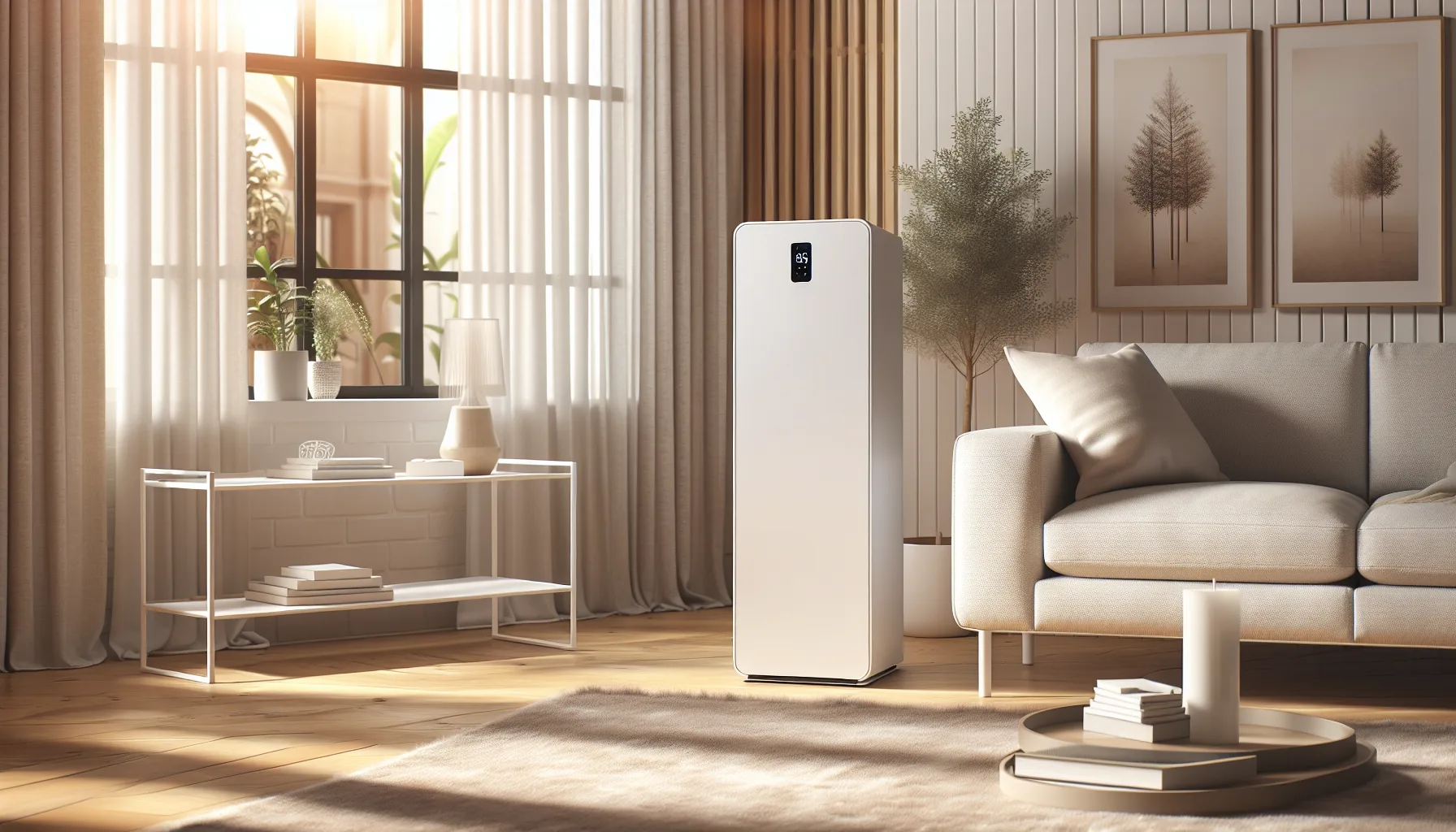
Best Overall: Blueair Blue Max 3350i
CADR: 350 m³/h
Room size: up to 36m²
Noise: 29-52 dB
Price: £250-350
Swedish design, excellent filtration (HEPASilent technology uses electrostatic charge to boost HEPA efficiency), quiet on medium settings, and reasonable filter costs. The auto mode with built-in sensor works well. Not the most powerful option for very large rooms but covers most UK living spaces comfortably.
Best for Very Large Rooms: Levoit Core 600S
CADR: 410 m³/h
Noise: 26-52 dB
Room size: up to 50m²
Price: £200-280
Excellent CADR for the price. Three-stage filtration (pre-filter, H13 HEPA, activated carbon). Smart app control and auto mode. The QuietKEAP technology keeps it surprisingly quiet at lower speeds. One of the best value large-room purifiers available in the UK.
Best Premium: Dyson Purifier Big+Quiet Formaldehyde
CADR: Not disclosed (Dyson don’t publish CADR)
Room size: claimed up to 100m²
Noise: reportedly very quiet
Price: £600-750
Dyson’s large-room offering uses a sealed HEPA H13 filter with a catalytic formaldehyde filter that doesn’t need replacing. The cone aerodynamics project filtered air further than traditional purifiers. Expensive, but the build quality, air quality display, and Dyson app are polished. The lack of published CADR makes direct comparison difficult — deliberate on Dyson’s part.
Best Budget: Levoit Core 400S
CADR: 300 m³/h
Noise: 24-50 dB
Room size: up to 33m²
Price: £140-200
Covers a large UK lounge comfortably and costs half the price of premium options. H13 HEPA, activated carbon, decent smart features. Filter replacements are around £30-40 every 8-10 months. Hard to beat for the money.
Placement in a Large Room
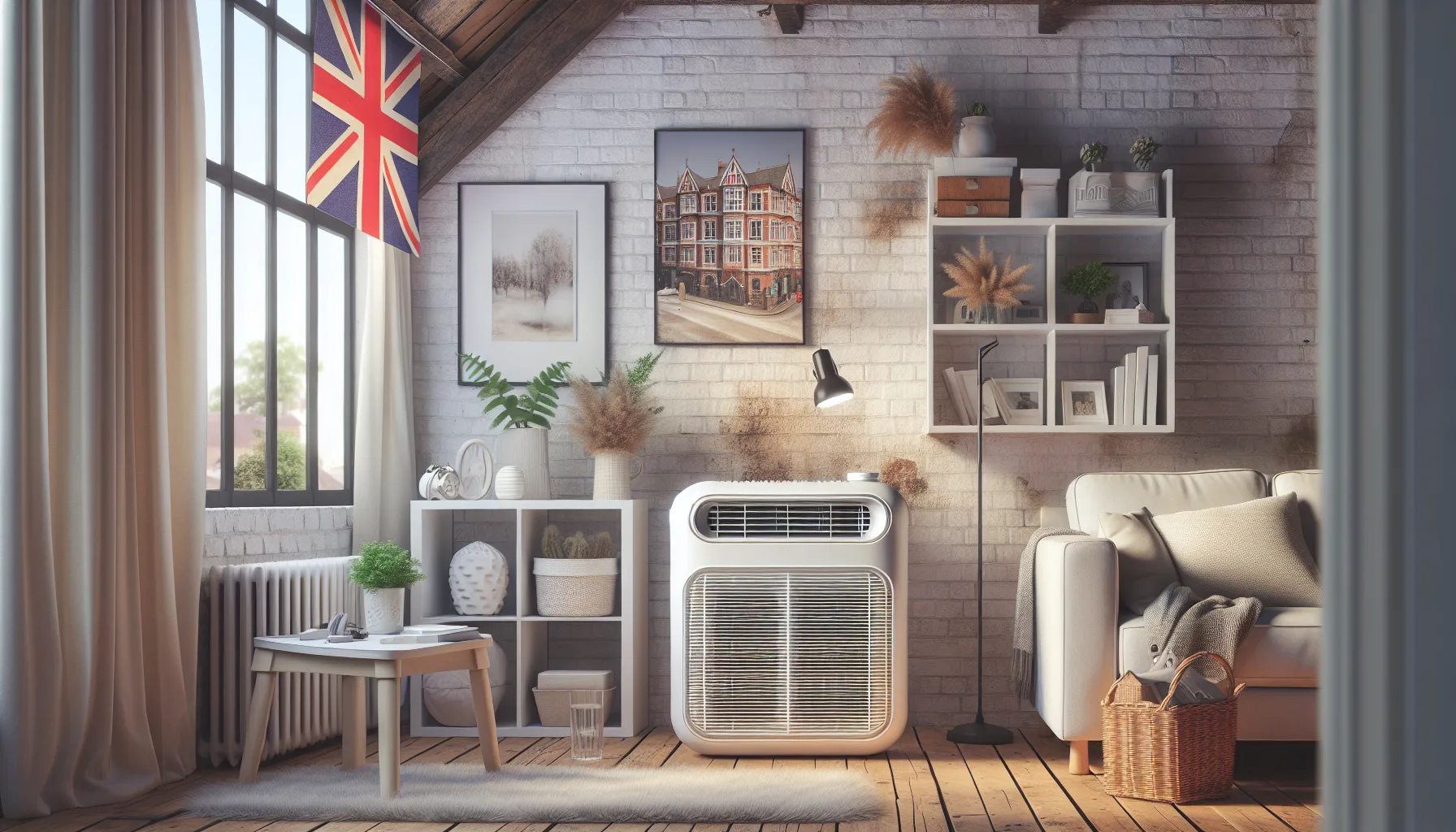
Where you put the purifier matters more in a large room than a small one:
- Central positioning is ideal — gives the purifier equal access to air from all directions
- Away from walls — most purifiers intake air from the back or sides. Pressing it against a wall restricts airflow
- Away from corners — corners create dead air zones that reduce circulation
- Not behind furniture — a sofa blocking the intake cuts efficiency noticeably
- Elevated slightly — on a low table or shelf improves air circulation in rooms with high ceilings
If your room is really L-shaped or has alcoves, consider two smaller purifiers placed strategically rather than one large unit trying to clean air it can’t reach.
When One Purifier Isn’t Enough
For open-plan spaces over 50m², or rooms with unusual layouts, two medium-capacity purifiers often outperform one large one:
- Better coverage — two units placed apart create overlapping clean air zones
- Lower noise — two purifiers on medium are quieter than one on maximum
- Redundancy — if one needs a filter change, the other keeps working
- Flexibility — move one to the bedroom at night, keep one in the living area
Two Levoit Core 400S units (around £350-400 total) cover 60m²+ more effectively than any single purifier under £600.
Placement Tips for Large Rooms
Even the most powerful air purifier will underperform if you place it in the wrong spot. In a large room, placement matters just as much as CADR ratings. Here are the practical tips we’ve picked up from testing purifiers in real UK homes.
Keep it away from corners. Air purifiers need unobstructed airflow on all sides. Tucking one into a corner behind a sofa limits the intake and reduces its effective coverage. Aim for at least 30cm of clearance around the unit, ideally more.
Place it near the pollution source. If cooking fumes are your main concern, position the purifier closer to the kitchen end of an open-plan space. For pet allergens, place it where the pet spends most of its time. The closer the purifier is to the source, the faster it captures particles before they spread.
Avoid placing it directly against walls or windows. While it might seem logical to put a purifier near a draughty window, the incoming air can overwhelm the unit. A central position in the room, or at least a metre from external walls, tends to deliver better results.
Consider airflow patterns. Large rooms often have natural air circulation from heating systems, open doors, or ceiling fans. Positioning your purifier so it works with these patterns rather than against them improves efficiency. In an L-shaped room, you may find that a single purifier cannot reach the far end — in that case, two smaller units can be more effective than one large one.
Elevate it slightly. Many purifiers perform better when raised 30–60cm off the floor on a sturdy side table. This brings the intake closer to your breathing zone, particularly if you’re using it in a living room where you’re seated on a sofa. Floor placement works for bedrooms where you’re lying down, but in living spaces, a small elevation makes a noticeable difference based on our particle count measurements.
The Bottom Line
For a large UK room, ignore the marketing and focus on three numbers: CADR (350+ m³/h for rooms over 30m²), noise level on medium speed (aim under 45 dB), and annual filter cost. Everything else is secondary.
The Levoit Core 600S offers the best combination of performance and value for most large rooms. If your budget stretches further, the Blueair range delivers slightly better filtration quality. And if money is truly no object, Dyson makes a beautiful machine — just don’t expect twice the purification for three times the price.
Get the right CADR for your room, put it in a sensible position, change the filter when it tells you to, and let it run. Clean air isn’t complicated. It just needs the right tool for the space.
If you are solving the same room problem, compare this with Air Purifier Noise Levels: How Loud Is Too Loud for Sleep?, How to Change Air Purifier Filters: Frequency & Signs, Best Air Purifiers for Bedrooms 2026: Quiet & Effective, Carbon Filters Explained: What Do They Remove?, Air Purifier Running Costs: How Much Do They Cost to Run?.
Frequently Asked Questions
What is the first check for How to Choose an Air Purifier for a Large Room? Start with the room problem: dust, pollen, humidity, mould, odour, ventilation or plant care. The right product depends on the problem, not just the headline specification.
Does How to Choose an Air Purifier for a Large Room matter in UK homes? Yes, especially in smaller, colder or less ventilated rooms. The benefit is strongest when the product is matched to room size and used alongside sensible ventilation and cleaning.
What should you avoid when choosing How to Choose an Air Purifier for a Large Room? Avoid buying on claimed coverage alone. Check room size, running costs, filter or maintenance requirements and whether the device suits the way the room is actually used.
What should I check first with How to Choose an Air Purifier for a Large Room? Start with the real use case, then check size, compatibility, running costs and maintenance. A product that looks good on paper can still be the wrong fit if it does not suit the room, routine or budget.
How do I avoid wasting money on How to Choose an Air Purifier for a Large Room? Avoid buying on one headline feature alone. Compare the practical details, read the warranty or returns terms, and choose the option that solves your main problem rather than the one with the longest specification list.