The Philips 2200 Series is the best air purifier for most UK homes because its 420m³/h stated CADR gives it useful airflow headroom without pushing into oversized premium pricing. The Winix Zero-S is the stronger value choice for a large bedroom or living room, while the Blueair 3250i is easier to live with beside a bed. Allergies and asthma make sizing and honest claims more important: a purifier can reduce airborne particles passing through its filter, but it does not cure either condition or replace ventilation, cleaning, source control or prescribed treatment.
Quick Navigation
- Our direct answer
- Comparison table
- Six air-purifier reviews
- How to choose
- CADR, room size and filters
- Allergies and asthma
- Placement and running costs
- Which one should you buy?
- Frequently Asked Questions
Best Air Purifiers in the UK: Our Direct Answer
Buy the Philips 2200 Series for a main living area, larger bedroom or open-plan space. Philips states a 420m³/h clean-air delivery rate, three-stage particle and carbon filtration, automatic sensing and a 13dB minimum. Its filter-life claim reaches three years under the manufacturer’s assumptions, though real service life will depend on pollution, runtime and maintenance.
Buy the Winix Zero-S if you want similar airflow for less and prefer a washable pre-filter plus separate carbon and HEPA stages. Its 410m³/h stated CADR is close to the Philips, and the current model adds app control as well as automatic and sleep modes. The PlasmaWave function is a separate ionisation-related feature; buyers who want mechanical filtration only can leave optional ionising features off.
For a bedroom, choose the Blueair 3250i when low-speed noise matters most, the Coway Airmega 150 when you want automatic control without an account, or the Levoit Core 300S when app scheduling and live PM2.5 information are useful. The Core 200S is the budget smart option for a genuinely small room—not a shortcut for purifying an entire floor.
The Best Air Purifiers at a Glance
Start with airflow and room fit, then compare noise, control style and filter cost. Maximum coverage figures often assume one air change per hour, which is too gentle for many allergy-focused uses. A smaller quoted room at a higher cleaning frequency is the more useful target.
| Purifier | Our award | Key airflow figure | Best room fit |
|---|---|---|---|
| Philips 2200 Series | Best overall | 420m³/h | Large rooms |
| Winix Zero-S | Best high-airflow value | 410m³/h | Large bedrooms and living rooms |
| Levoit Core 300S | Best smart mid-range | 258m³/h | Bedrooms and medium rooms |
| Blueair Blue Max 3250i | Best quiet bedroom purifier | Room-time figures stated | Bedrooms and studies |
| Coway Airmega 150 | Best no-app option | 281m³/h | Bedrooms and living rooms |
| Levoit Core 200S | Best budget smart purifier | Coverage stated to 64m² | Small bedrooms |
The comparison deliberately avoids a single “removes 99.97%” column. Filter-media efficiency in a controlled test is not the same as complete-machine cleaning speed in your room. CADR, air leakage, placement and fan speed determine how much filtered air reaches you.

Our Six Air Purifier Recommendations
1. Philips 2200 Series — Best Overall

The Philips wins because the specification is balanced rather than flashy. Its stated particle CADR is 420m³/h, enough to provide meaningful turnover in many UK living rooms and larger bedrooms. Automatic mode reacts to its particle sensor, while SilentWings fan design gives a stated 13dB minimum. The combination of pre-filter, NanoProtect HEPA media and activated carbon targets particles plus light everyday gases and odours.
Philips markets coverage up to 109m², but that headline should not be used as an allergy-room target without checking air changes. At 420m³/h, a 40m² room with a 2.4m ceiling receives roughly 4.4 theoretical air changes per hour before leakage and furniture losses—a more useful way to assess it. The three-year filter claim is also a maximum under defined conditions, not a promise for every pet-filled or roadside home.
- Buy it if: you want a strong all-round purifier for a main room and prefer clear CADR data.
- Skip it if: the machine is only for a small box room where its airflow will be wasted.
- Main compromise: excellent performance headroom in a larger floor-standing unit.
2. Winix Zero-S — Best High-Airflow Value
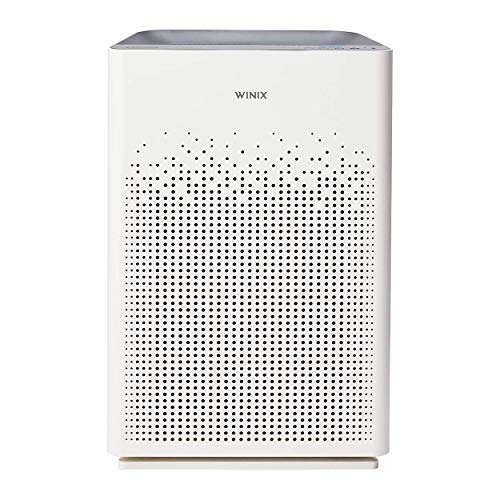
Winix comes close to Philips on stated airflow at 410m³/h and uses four stages: a washable mesh pre-filter, activated carbon, HEPA filtration and optional PlasmaWave. A sensor supports automatic mode, while sleep mode dims the lights and runs at a stated 27dB. The current listing also includes Wi-Fi app and voice control.
The unusual issue is PlasmaWave. Winix describes it as part of the purification system, but people who specifically want particle and carbon filtration without an ionisation stage should switch it off and confirm the model’s behaviour after power cycles. The listing states only 14W on high, which is strikingly low for the airflow claim; treat power figures as manufacturer data and check the rating plate supplied with the exact unit.
- Buy it if: high CADR per pound matters and you want washable pre-filtration.
- Skip it if: you dislike optional ionising technology or want the quietest low-speed figure.
- Main compromise: excellent value with one extra technology decision to make.
3. Levoit Core 300S — Best Smart Mid-Range
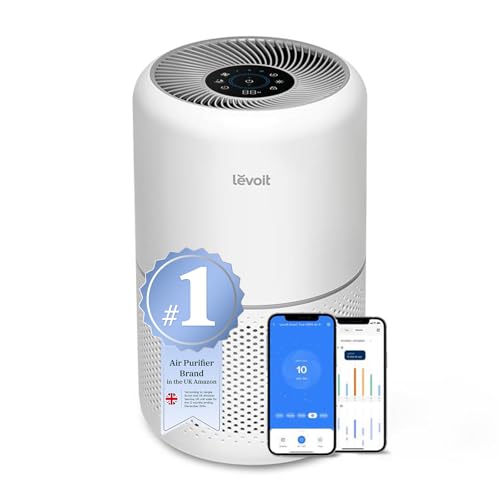
The Core 300S is easier to place than the two larger-airflow leaders and makes sense in a bedroom, study or medium sitting room. Levoit states 258m³/h CADR, a PM2.5 laser sensor, automatic fan adjustment and VeSync app controls. Its 360-degree intake reduces the need to aim one specific side at the room, although it still needs clearance from walls and curtains.
The claimed 108m² coverage refers to one air change per hour. At two changes the stated room drops to 54m², and allergy-focused use may justify a smaller target again. That is not a fault in the machine; it is why coverage figures must be read with their time basis. Optional genuine filters target pets, toxins or mould, but no filter removes the moisture source that caused mould growth.
- Buy it if: you want good app control, PM2.5 sensing and a compact mid-range machine.
- Skip it if: one unit must clean a large open-plan ground floor quickly.
- Main compromise: polished controls with less airflow reserve than Philips or Winix.
4. Blueair Blue Max 3250i — Best Quiet Bedroom Purifier

Blueair is the bedroom pick because its stated minimum is 18dB and the fabric pre-filter makes the cylindrical body less clinical beside furniture. The app adds schedules, geofencing, particle readings and filter-life estimates. Blueair describes treatment of 20m² in 12.5 minutes or 48m² in 30 minutes on high; those are two different cleaning intensities, so use the smaller figure for a demanding room.
HEPASilent combines mechanical media with electrostatic charging. That helps Blueair move air with lower resistance, but it is not the same construction as a purely mechanical HEPA system. The carbon layer is designed for light household odours rather than heavy smoke or a major VOC source. If sleep is the priority, confirm the fan speed that delivers acceptable cleaning without becoming audible to you.
- Buy it if: low-speed noise and bedroom-friendly design come first.
- Skip it if: you need maximum large-room airflow or insist on mechanical-only filtration.
- Main compromise: excellent bedroom usability with less performance headroom.
5. Coway Airmega 150 — Best No-App Option

Coway provides a useful middle ground: 281m³/h stated CADR, automatic particle sensing, a 20dB sleep mode and no need for Wi-Fi or an account. The top-loading washable pre-filter is unusually accessible, so hair and coarse dust can be removed without dragging the whole machine apart. Coway states that the filtration system uses no UV-C or ioniser.
The Airmega 150 suits someone who wants the purifier to manage itself without another phone notification. It has less airflow than Philips and Winix but more than the two Levoit bedroom models. The stated filter life is up to 12 months; vacuuming or washing only the parts the manual identifies as cleanable helps protect airflow without damaging the main media.
- Buy it if: you want automatic control, quiet sleep use and no app dependency.
- Skip it if: remote scheduling and detailed phone-based trends matter to you.
- Main compromise: simple, strong hardware with fewer connected features.
6. Levoit Core 200S — Best Budget Smart Purifier
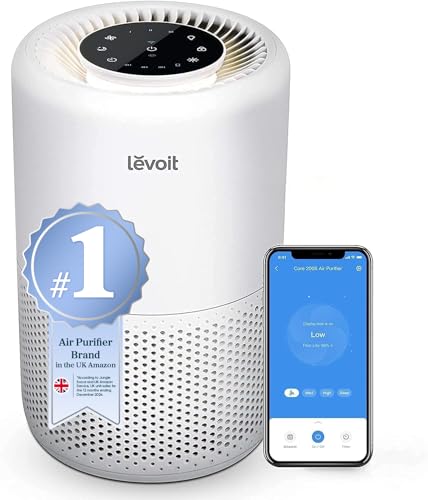
The Core 200S is the budget choice for a small bedroom or nursery-sized room. It offers VeSync scheduling, Alexa and Google Assistant support, three-stage filtration, a night light and a stated 24dB sleep mode. Genuine replacement filters are widely available, which matters more than an obscure machine that becomes useless when its original filter is exhausted.
This model does not have the stronger PM2.5 sensor and automatic response of the Core 300S, so the app is mainly a remote control and scheduler rather than a complete air-quality system. The 64m² headline is a low-turnover coverage figure. Buy it for a modest closed room, not because the largest number on the box appears to match a living floor.
- Buy it if: you want low-cost app control in a small bedroom.
- Skip it if: you need automatic particle sensing or fast cleaning in a medium-to-large room.
- Main compromise: convenient smart control without the sensor and airflow of the 300S.
How to Choose an Air Purifier
Start With the Room, Not the Brand
Measure length, width and ceiling height to estimate room volume. An open staircase, high ceiling or permanently open doorway increases the air being treated. Our guide to choosing an air purifier for a large room explains why floor area alone can flatter an undersized machine.
Prioritise Particle Airflow
For pollen, pet dander, dust fragments and smoke particles, look for a sealed particle-filtration path and credible CADR. Do not compare only the microscopic particle size printed in advertising. A superb filter with weak airflow may clean a room more slowly than a less dramatic-sounding machine with a better complete-unit delivery rate.
Choose the Control Style You Will Use
Automatic mode is valuable when the sensor is competent because the fan can respond to a cooking spike or open window. App schedules help if the purifier should start before bedtime. Simple physical controls are better when the user does not want accounts, updates or cloud dependency. A purifier left switched off because the controls annoy you has a CADR of zero.
Check the Replacement Filter Before Buying
Confirm the genuine filter code, current availability and the cost of at least two replacements. A washable pre-filter is useful for hair and coarse dust, but the main HEPA-style media is not washable unless the manufacturer explicitly says otherwise. Wetting fibre media can damage it and encourage microbial growth.
CADR, Room Size and Filter Types Explained
CADR Is the Clean-Air Output
CADR describes the volume of filtered air delivered over time. It is more useful than fan airflow because it accounts for both movement and particle removal. Our CADR guide shows how to compare m³/h figures and calculate approximate air changes.
HEPA and Carbon Do Different Jobs
Particle media captures pollen, dust, dander and fine smoke particles. Activated carbon adsorbs some gases and odours, but thin carbon sheets saturate quickly under heavy pollution. Read our HEPA versus activated-carbon comparison before buying a purifier mainly for smells or VOCs.
Avoid Coverage-Number Shopping
A brand can claim a very large room if it assumes one complete clean per hour. For ongoing particle reduction, many buyers need more turnover. Compare models at the same air-change target and remember that furniture, leaks and imperfect mixing reduce theoretical performance. The largest advertised area is not automatically dishonest, but it rarely tells the whole story.
Using an Air Purifier for Allergies and Asthma
An air purifier can lower the concentration of airborne particles that pass through it. That may reduce exposure to pollen, pet dander, dust-mite debris and fine smoke, but individual symptoms vary. Settled allergens remain on bedding, carpets and upholstery, while dust mites depend on humidity and habitat rather than simply floating in room air.
Asthma triggers are personal. A purifier is an environmental control, not an inhaler or medical treatment. Keep following the plan agreed with a healthcare professional and seek medical advice if symptoms are worsening. NHS asthma guidance explains symptoms, treatment and when urgent help is needed.
Pair filtration with source control: ventilate appropriately, use extraction while cooking, avoid indoor smoking, repair damp causes, wash allergy bedding as advised and vacuum with suitable filtration. Our guide to improving indoor air quality covers the whole-home approach. A purifier cannot create oxygen, remove carbon dioxide or detect carbon monoxide.
Filters, Placement, Noise and Running Costs
Place It Where Air Can Move
Keep the intake clear of curtains, furniture and walls, and avoid blowing directly into a corner. Bedroom placement should balance airflow with comfort: near the breathing zone is useful, but a high-speed outlet pointed at the bed can feel draughty. Our placement guide shows practical layouts.
Judge Noise at the Speed You Need
A 13dB or 18dB minimum sounds impressive, but the lowest setting also delivers the least clean air. Compare the speed needed for the actual room, then use a quieter maintenance speed after an initial high-speed run. The night-mode guide explains why one decibel number cannot describe the whole machine.
Budget for Filters and Electricity
Filter cost often exceeds electricity over the life of an efficient purifier. Heavy pollution, pets, smoke and continuous high-speed use may shorten service life. Replace media when the model-specific indicator and condition call for it; do not reset a warning indefinitely. Our UK running-cost guide shows how to calculate electricity from wattage and tariff.
Keep the Pre-Filter Clean
A loaded pre-filter restricts airflow and makes the fan work harder. Vacuum or wash it only as the manual directs, let washable parts dry fully, and never vacuum fragile HEPA media unless the manufacturer permits it. Mark maintenance dates so a quiet decline in airflow does not go unnoticed.
Which Air Purifier Should You Buy?
Buy the Philips 2200 Series for the best overall balance. Its 420m³/h CADR, automatic sensing and low stated minimum noise make it the strongest one-machine answer for many UK homes. Choose the Winix Zero-S when you want nearly the same airflow at a sharper price and are comfortable deciding whether to use PlasmaWave.
For bedrooms, the Blueair 3250i is the easiest recommendation when silence and app control matter. The Coway Airmega 150 is better if you want automatic control without Wi-Fi. Choose the Core 300S for a compact smart mid-range system, and the Core 200S only for a smaller room where budget and scheduling matter more than sensors or high airflow.
The biggest buying mistake is selecting by filter percentage or maximum room area alone. Match CADR to room volume, check the genuine replacement-filter price and decide which fan speed can run for long periods without bothering you. Consistent use of the right-sized machine beats occasional use of an oversized feature list.
Frequently Asked Questions
What is the best air purifier for allergies in the UK?
The Philips 2200 Series is our best overall choice because its 420m³/h stated CADR gives useful particle-cleaning headroom. Room size, noise tolerance and filter availability can make another model a better fit.
Can an air purifier help asthma?
It may reduce exposure to some airborne particle triggers, but it does not treat asthma or replace prescribed medication and medical advice. Trigger response varies between people.
What CADR do I need for a bedroom?
Calculate room volume and choose a purifier that provides several air changes per hour at a tolerable fan speed. A larger or high-ceiling bedroom needs more CADR than a small closed room.
Do I need activated carbon as well as HEPA filtration?
Particle media is the priority for pollen, dust and dander. Carbon adds some capacity for gases and odours, but thin carbon layers cannot replace ventilation or source removal.
Should an air purifier run all day?
Continuous lower-speed operation often maintains cleaner air better than short bursts, provided noise and running cost are acceptable. Use automatic mode or schedules when they suit your routine.
Can one air purifier clean the whole house?
Usually not through closed doors. Put it in the room where exposure matters most, or use separate appropriately sized units for bedrooms and the main living space.