An air purifier night mode dB rating tells you how quiet the machine can be, not whether it is cleaning your bedroom properly. That is the catch. A purifier can claim 19 dB in night mode and still be the wrong choice if that setting barely moves air across the room.
In This Article
- What Night Mode Actually Changes
- What the dB Rating Means at Bedside Distance
- Quiet Mode vs Clean Air: The CADR Trade-Off
- Product Examples: Quiet Claims Worth Checking
- Bedroom Setup That Keeps It Quiet
- What to Buy If Night Mode Matters
- Frequently Asked Questions
What Night Mode Actually Changes
Night mode is usually a bundle of small changes rather than a separate filtration system. It lowers the fan speed, dims or turns off the display, and may stop the purifier from ramping up automatically when the sensor spots a rise in particles.
That sounds simple, but the details matter. A good night mode keeps the room calmer without making the purifier decorative. A weak one just turns the lights off and drops the fan so low that the clean air delivery rate falls through the floor.
Fan speed is the main change
Most air purifiers make noise because of moving air, not because the filter is doing anything dramatic. Lower the fan and the dB number drops. The problem is that clean air output drops too.
That is why the lowest quoted dB figure is not always the useful one. If a small purifier is whisper-quiet on speed 1 but needs speed 3 to deal with a 14m² UK bedroom, the speed 1 figure is marketing comfort rather than buying evidence.
Display lights matter more than people expect
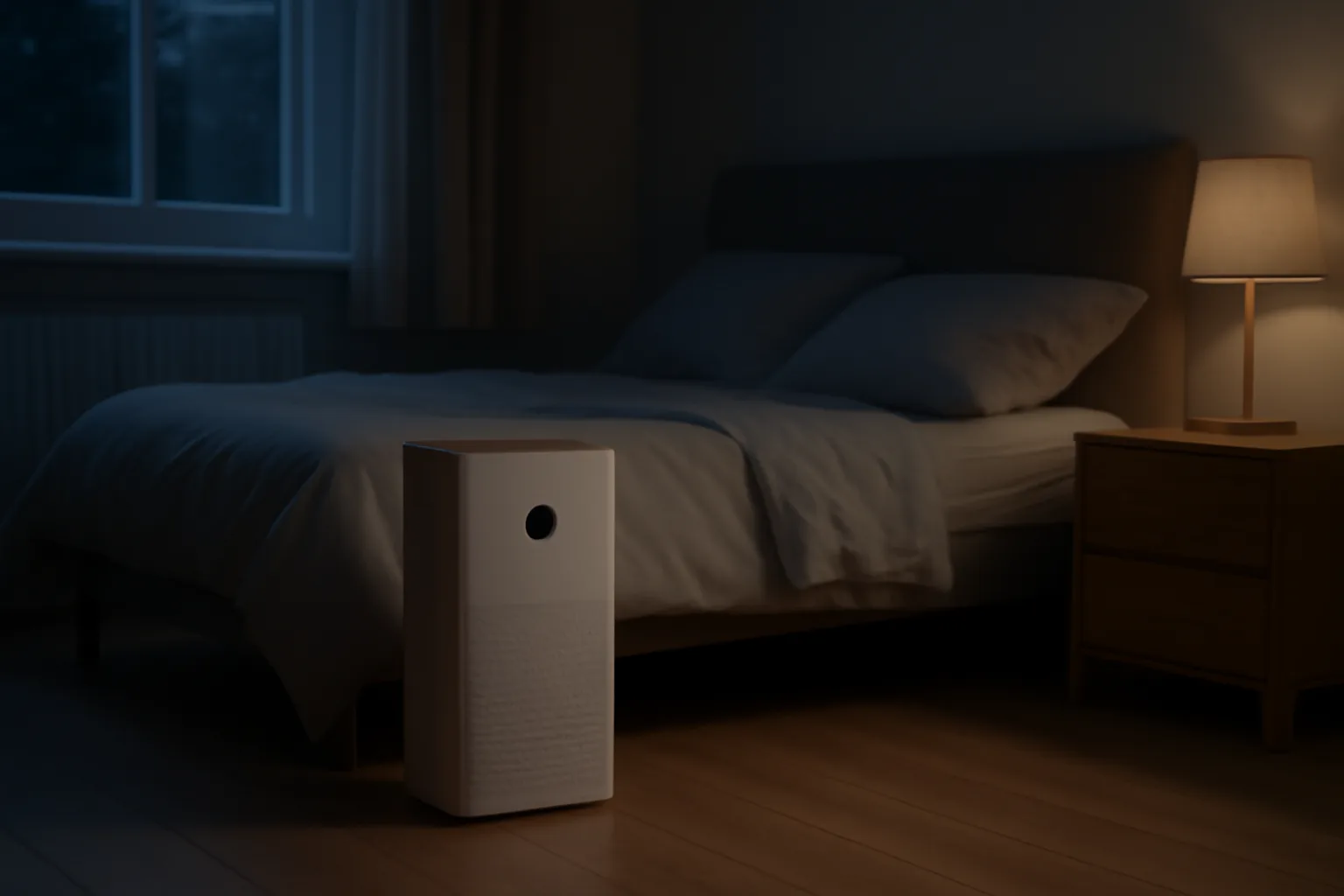
Bedroom purifiers often fail the partner test because of the lights, not the sound. A bright blue air-quality ring, Wi-Fi icon or filter warning can bounce off white walls and make the room feel less dark.
Better night modes shut the display off properly. Dimmed is not always enough. If you are light-sensitive, check product photos, user reviews and the app controls before buying.
Auto mode can be annoying overnight
Auto mode is useful in a kitchen or living room. In a bedroom, it can be irritating because sudden fan changes are more noticeable than a steady hum. You might sleep through a constant 27 dB airflow but wake when the purifier jumps from quiet to medium at 3am.
My preference for bedrooms is a fixed quiet speed overnight, then a stronger clean before bed. Run the purifier hard for 30-60 minutes while you are brushing teeth, reading or getting the room ready, then switch to night mode for sleep.
What the dB Rating Means at Bedside Distance
The air purifier night mode dB rating is usually measured in controlled conditions. Your bedroom has wardrobes, curtains, hard floors, bedside tables and corners that change how sound behaves.
The number still helps, but it is not a complete answer.
The useful range for sleep
As a practical buying guide:
- Under 20 dB: barely audible in many bedrooms, but often linked to very low airflow.
- 20-25 dB: excellent for light sleepers if the purifier still suits the room size.
- 26-30 dB: acceptable for most bedrooms, especially if the sound is smooth airflow.
- 31-35 dB: still workable, but sensitive sleepers may notice it.
- Above 35 dB: better for pre-cleaning before bed than all-night use.
The existing BreatheCleanUK guide to air purifier noise levels and sleep quality covers the wider dB scale. Here, the key question is narrower: does night mode give you enough cleaning at a sound level you will actually tolerate?
Distance changes the experience
A purifier at 24 dB on the other side of the room can be fine. The same unit 40cm from your head may feel irritating because you hear airflow texture, motor tone and small rattles more clearly.
Avoid putting it on a bedside table unless the room is tiny. A purifier on a chest of drawers, low shelf or floor position about 1-2m from the bed is usually easier to live with. Keep it away from loose cables, laundry baskets and anything that can vibrate.
Tone matters as much as volume
Two purifiers can both claim 24 dB and feel different. One may produce a soft whoosh that fades into the room. Another may have a faint motor whine or bearing noise that catches your ear.
This is why I do not buy bedroom purifiers on dB rating alone. I look for user reviews mentioning whine, rattles, clicking relays, app beeps and display lights. Those are the details that make people switch a purifier off.
Quiet Mode vs Clean Air: The CADR Trade-Off
Night mode is only useful if it still cleans enough air. Clean Air Delivery Rate, or CADR, tells you how much filtered air the purifier can move in a given time. Unfortunately, the CADR on the box is usually the maximum-speed figure, not the night-mode figure.
Why the quietest speed can be too weak
Take a typical UK double bedroom: 4m by 3.5m with a 2.4m ceiling. That is about 34m³ of air. For meaningful overnight cleaning, you want several air changes during the night, not one gentle pass before breakfast.
A purifier with 250m³/h maximum CADR may look powerful, but if night mode only moves a fraction of that, it may suit a small bedroom rather than a large loft room. Manufacturers rarely publish the low-speed CADR, so you have to infer from room-size claims, fan speeds and independent reviews. If the CADR figure itself is the confusing part, our CADR ratings explainer is the better starting point.
Pre-cleaning is the practical compromise
The easiest workaround is to use two stages:
- Pre-clean on medium or high: run the purifier for 30-60 minutes before sleep, especially during hay fever season or after opening windows.
- Switch to night mode: keep particles from building back up while you sleep.
- Clean the pre-filter regularly: a clogged pre-filter makes the fan work harder and can add noise.
This approach works better than expecting a tiny purifier to clean a dusty room silently from cold. If allergies are the reason you are buying, the NHS allergy guidance is useful background, and our hay fever air purifier guide covers purifier-specific choices rather than relying on night mode alone.
Bigger can be quieter
Counter-intuitive but true: a larger purifier can be quieter in a bedroom because it can run at a lower speed while still moving enough air. A small £60 unit may need medium speed to cope; a better £140-£220 unit may do the same job on low.
That is why I would rather buy a slightly oversized purifier with a good night mode than a tiny unit working hard all night. The bigger machine costs more upfront, but it is more likely to stay switched on.
Product Examples: Quiet Claims Worth Checking
Prices move weekly, but these examples show how the spec sheet should be read. Treat the numbers as buying context, then check the current retailer page before ordering.
Blueair Blue Pure 511i Max
Blueair says the Blue Pure 511i Max runs as low as 19 dB and no louder than 42 dB on high. That is a strong noise range for a small bedroom purifier, and the current UK Amazon price is often about £79-£100.
The appeal is obvious: low night-mode noise, simple controls and a compact footprint. The caution is room size. It is best for a small bedroom, nursery or home office, not a big open-plan room. If you put it in a large bedroom and expect the 19 dB setting to do all the work, you may be disappointed.
Levoit Core 300S
The Levoit Core 300S is advertised with sleep mode as quiet as 22 dB. Levoit UK pricing is commonly around £139.99, with bundles and discounts changing through the year.
This is the better all-rounder for many UK bedrooms because it has more headroom than the smallest purifiers. The app controls are useful if you want schedules, and replacement filters are usually about £25-£35 depending on the filter type and retailer.
My only warning is that app-connected purifiers can introduce their own irritations: indicator lights, Wi-Fi status lights or automatic routines that do more than you wanted. Set it up in the daytime and test the lights before trusting it overnight.
Philips 600i and 800 Series models
Philips lists the 600i Series at 19 dB in sleep mode on a current product page, while UK 800 Series models are commonly sold around £150-£180 depending on the retailer. Philips replacement filters for the 800 Series are listed on Philips UK at £38.99 when available.
The Philips pitch is neat: compact size, low sleep-mode figure, and an app on some models. The caution is the same as with any small purifier. Check the room size and CADR, not just the quietest dB number.
For a box room or child’s bedroom, the low sleep-mode figure is attractive. For a larger main bedroom with pets, pollen and open windows, I would look carefully at whether it can clean enough air quietly.
Coway Airmega 150
Coway’s Airmega 150 often sells around £160-£190 in the UK, with Amazon listings highlighting a 20 dB sleep mode. It is a stronger, more appliance-like choice than many budget cylinders, with washable pre-filter access that makes maintenance less fiddly.
I like this type of machine for allergy households because the pre-filter is easy to clean. Dust and hair on the pre-filter can make a purifier noisier over time, so maintenance is not just about filtration; it affects bedroom comfort too.
Dyson Purifier models
Dyson’s night mode is more about the whole bedroom experience than a single dB boast. Dyson support describes night mode as quieter operation with a dimmed display while the machine continues monitoring air quality. New Dyson purifier models often sit around £399-£599, so they are premium buys rather than value picks.
The reason to pay Dyson money is not silence alone. It is the fan function, app, sensor display and design. If your only requirement is quiet HEPA filtration beside a bed, cheaper units from Blueair, Levoit, Philips or Coway usually make more sense.
Bedroom Setup That Keeps It Quiet
The right setup can make a normal purifier feel much quieter. The wrong setup can make a good purifier annoying.
Put it where air can move
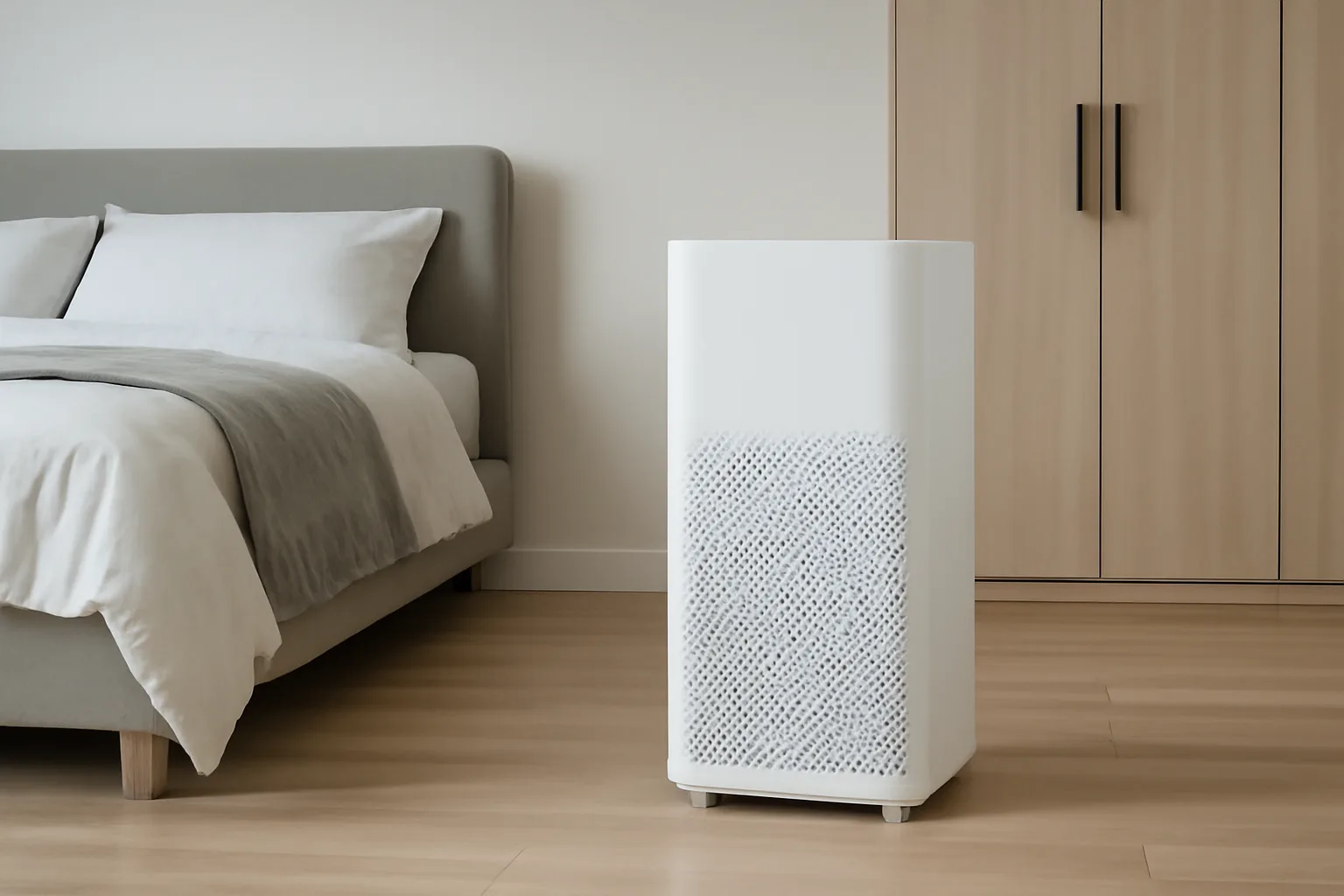
Do not wedge the purifier between a wardrobe and a curtain. It needs intake and output space. Check the manual, but as a rule keep at least 20-30cm clear around the intake and avoid pushing it tight into a corner.
A central-ish position is better than hiding it behind furniture. If you have to choose, prioritise clear airflow over symmetry. Clean air matters more than a tidy Instagram bedroom.
Stop vibration at the source
If the purifier hums through a wooden floor or bedside table, put it on a thin rubber mat. A £5-£12 anti-vibration mat from Amazon UK, Screwfix or B&Q can make a surprising difference. Do not block air intakes with a towel, though. Soft isolation is fine; suffocation is not.
Also check the cable. A cable touching a skirting board or radiator pipe can transmit a faint buzz that sounds like the machine is faulty.
Use schedules sensibly
If your purifier has an app, schedule a stronger clean before bed and a fixed night mode afterwards. Avoid automatic high-speed boosts while you sleep unless you know they do not wake you.
For allergy season, I would run a bedroom purifier:
- Early evening: medium or high for 45 minutes with the bedroom door shut.
- Bedtime: fixed night mode, display fully off.
- Morning: short boost while bedding is disturbed and windows are opened.
If damp or mould is also part of the problem, do not expect a purifier to solve it. Our damp and mould guide is the more useful read because filtration cannot remove the source of moisture.
What to Buy If Night Mode Matters
If night use is a priority, I would rank the buying criteria differently from a living-room purifier.
Specs worth paying for
Look for:
- Night-mode noise under 25 dB: ideal for light sleepers if room size still works.
- Enough CADR for the bedroom: do not buy a tiny purifier for a large room just because it is quiet.
- Fully dark display: not just dimmed.
- Fixed-speed option: so auto mode does not ramp up overnight.
- Easy pre-filter cleaning: cleaner filters usually mean less fan strain and less noise.
- Affordable replacement filters: budget £25-£40 for many compact models, more for premium units.
My practical picks
For a small bedroom, I would start with the Blueair Blue Pure 511i Max at about £79-£100 if the room is modest and you want the lowest sound. For a typical double bedroom, the Levoit Core 300S at about £139.99 is the safer all-rounder. For allergy households that clean filters properly, the Coway Airmega 150 at about £160-£190 is worth the extra money. For model shortlists beyond night mode, compare that against our quiet bedroom air purifier guide.
I would not buy a purifier purely because it says 19 dB. I would buy the one that can clean my actual room on a quiet setting I can live with. That is what the air purifier night mode dB rating is really trying to tell you, once you read past the headline number.
Frequently Asked Questions
What is a good air purifier night mode dB rating? Under 25 dB is excellent for light sleepers, 26-30 dB is fine for most bedrooms, and anything above 35 dB is usually better for pre-cleaning before bed than overnight use.
Does night mode still clean the air properly? It depends on the purifier and room size. Night mode lowers fan speed, so CADR drops. A larger purifier may clean better on quiet mode than a small purifier running at its lowest setting.
Is 19 dB better than 24 dB for an air purifier? It is quieter, but not automatically better. If the 19 dB setting moves too little air for your room, a 24 dB purifier with stronger low-speed airflow can be the better bedroom choice.
Should I use auto mode overnight? Usually not if you are noise-sensitive. Auto mode can ramp the fan up suddenly. A fixed quiet speed is more predictable for sleep.
Where should I put an air purifier in a bedroom? Place it 1-2m from the bed if possible, with clear space around the intake and outlet. Avoid bedside tables if motor tone or airflow texture bothers you.
How much should I spend on a quiet bedroom air purifier? Budget about £80-£140 for a good small or mid-sized bedroom model, and £160-£220 if you want more airflow headroom, easier maintenance or stronger allergy performance.