Smoke is one of the harder things to ask an air purifier to deal with because it is both tiny particles and stubborn smell. A good purifier can reduce the visible haze, some fine particles and part of the odour, but it will not make indoor smoking harmless or remove residue from carpets, curtains and walls.
In This Article
- What Smoke Leaves in a Room
- Can an Air Purifier Remove Smoke?
- Filters That Matter for Smoke
- How Big and Powerful the Purifier Needs to Be
- Where to Place It and How to Run It
- Costs, Maintenance and What to Buy
- What an Air Purifier Cannot Fix
- Frequently Asked Questions
What Smoke Leaves in a Room
Smoke is not one single problem. That is why a cheap purifier with a basic dust filter often disappoints people who buy it for tobacco, vape residue, candles, wood burners or smoke drifting in from outside.
Fine particles
The visible part of smoke is made up of fine particles, including PM2.5. These are small enough to hang in the air rather than dropping quickly onto the floor. If you can see a grey haze in a room after someone has smoked, cooked heavily or burned a candle for hours, the purifier needs a proper particle filter and enough airflow to cycle the room air several times.
The UK Government’s public health guidance on air pollution and health treats fine particulate matter as a key health concern. That does not mean a domestic purifier makes a smoky room healthy, but it does explain why particle filtration matters rather than just masking the smell.
Gases and odour
The stale smell is a different job. Odour comes from gases and volatile compounds, not just visible particles. A HEPA-style filter catches particles; it does very little for smell unless the purifier also has a decent amount of activated carbon.
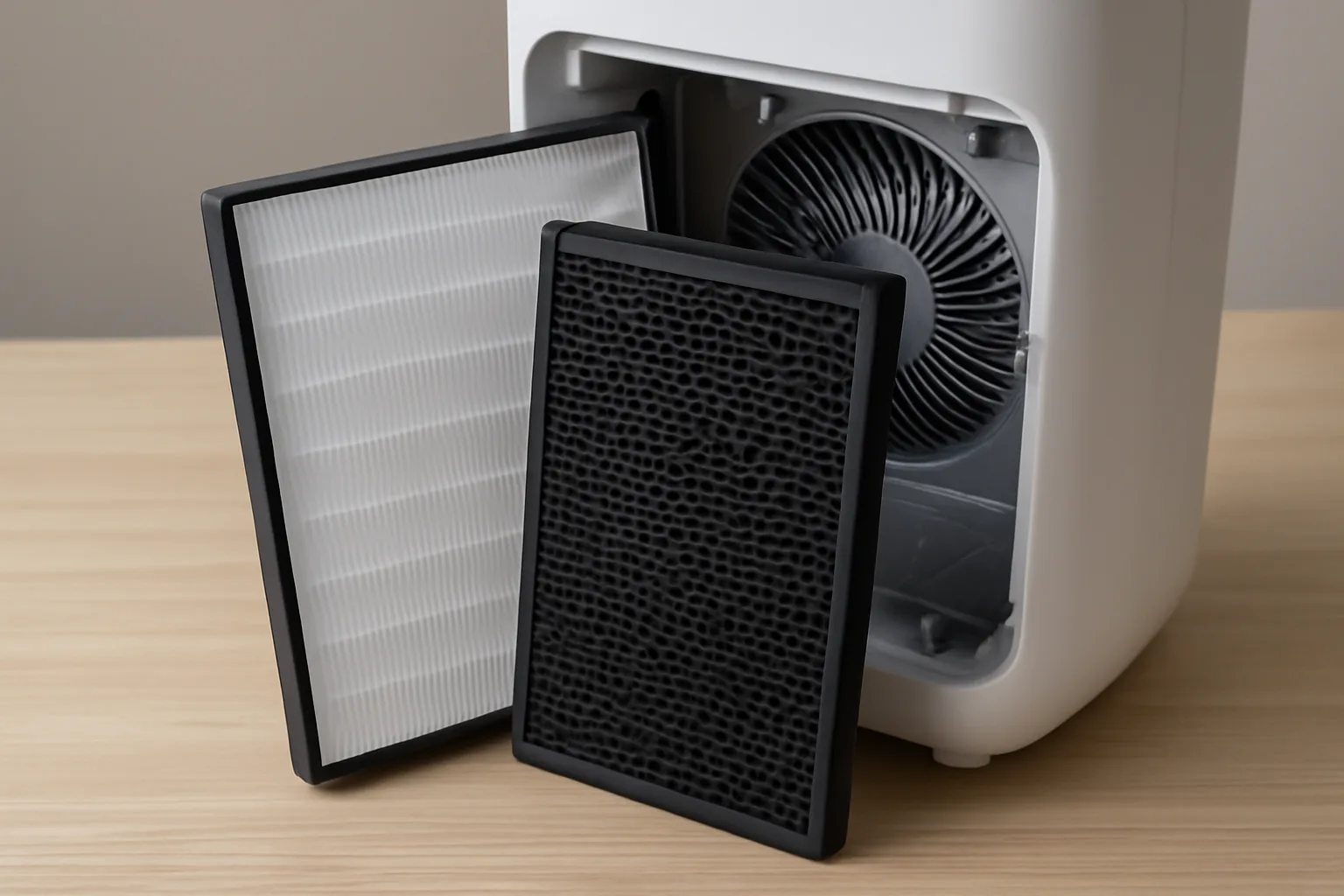
This is where many budget models fall down. A thin black foam sheet described as a carbon filter is better than nothing, but it has very little carbon mass. In a smoky room, it saturates quickly. Owners often report that the purifier still moves air and collects dust, but the smoke smell comes back within minutes of switching it off.
Residue on surfaces
Smoke also sticks. Curtains, sofas, rugs, lampshades, painted walls and wardrobes can all hold residue. An air purifier only treats air passing through it. It will not clean yellowing paint, remove odour from fabric or undo years of indoor smoking.
That distinction matters because it stops you overspending on the wrong promise. Buy an air purifier to reduce airborne particles and some odour. Do not buy one expecting it to reset a room that needs washing, airing and soft-furnishing cleaning.
Can an Air Purifier Remove Smoke?
An air purifier can remove smoke from the air while it is running, but only within limits. The more accurate answer is: it can reduce smoke particles well, reduce smell partly, and do very little about smoke being produced faster than the machine can filter it.
Best case
The best case is occasional smoke entering a room: a neighbour’s garden fire drifting through an open window, a smoky cooking incident, a candle-heavy evening, or someone smoking near but not inside the room. In those situations, a strong purifier with HEPA filtration and proper carbon can make the room feel clearer within 20-60 minutes, depending on room size.
If the focus is tobacco smoke from active indoor smoking, expectations need to be lower. The NHS is clear that passive smoking is harmful, especially for children and people with respiratory conditions. A purifier is a backup measure, not a licence to smoke indoors.
What the air purifier remove smoke claim really means
The phrase air purifier remove smoke gets used too loosely in product listings. A purifier does not make smoke vanish at the source. It pulls smoky air through filters, traps some particles, adsorbs some odour compounds in carbon, and pushes cleaner air back out.
That process depends on:
- Airflow: the machine has to move enough air for the room, not just hum quietly in the corner.
- Filter type: particle filtration and activated carbon need to work together.
- Source control: the less smoke entering the room, the better the purifier performs.
- Runtime: short bursts are weaker than running the unit before, during and after the smoke event.
The practical verdict
For occasional smoke, yes, a good air purifier helps. For regular indoor smoking, it reduces some airborne pollution but does not make the room safe or fresh. For stale smoke smell in fabrics, it is only one small part of the fix.
That sounds less exciting than the marketing, but it is the honest buying position.
Filters That Matter for Smoke
Smoke needs two types of filtration. If a purifier lacks either one, it may still be useful for dust or pollen, but it will be weaker for smoke.
HEPA or HEPA-grade particle filtration
For smoke particles, look for a true HEPA filter or a clearly stated high-efficiency particle filter. The wording varies because some brands avoid the formal HEPA claim, but the spec should make clear that fine particles are the target. If you want the filter standard broken down in more detail, our HEPA filters explained guide covers the basics without the product-listing fog.
For a smoky room, a washable pre-filter on its own is not enough. Washable mesh catches larger dust, fluff and pet hair. It will not handle fine smoke particles properly.
Useful signs:
- HEPA H13 or equivalent: common on better domestic purifiers.
- CADR rating: a clean air delivery rate gives a better clue than vague room-size claims.
- Replacement filter availability: check Amazon UK, Argos, Currys or the brand site before buying.
- Filter price: if replacements cost half the price of the purifier, factor that into the first year.
Activated carbon for smell
Activated carbon is the part that tackles odour and some gases. More carbon mass is usually better. A proper carbon pellet bed is stronger than a thin carbon-coated sheet, though it also costs more. For the difference between particle filters and carbon filters, the separate carbon filters guide is worth reading before you pay extra for a smoke-focused model.
This is why a £60 mini purifier can look tempting but underperform in a smoker’s room. It may have a HEPA-style cylinder filter, yet the carbon layer is small. It catches some particles, then leaves the sour smell hanging around.
Ionisers and ozone
Be careful with ionisers, plasma modes and ozone-style marketing. Some machines include an ioniser mode that can be switched off; others make it part of the cleaning claim. For smoke, I would buy a purifier for mechanical filtration and carbon, not for ionisation.
If the spec talks loudly about “fresh ions” but quietly about filter replacement, that is the wrong emphasis.
How Big and Powerful the Purifier Needs to Be
Most disappointing air purifier purchases are not because the purifier is useless. They are because it is too small for the room or too quiet to move enough air.
Ignore optimistic room-size claims
Room-size claims are often based on ideal lab conditions or one air change per hour. Smoke needs more aggressive cleaning than that. For a living room, aim for several air changes per hour rather than a bare minimum. CADR is the better number to compare, and our CADR ratings explainer shows why a small quiet unit can be outmatched in a smoky lounge.
As a rough UK home guide:
- Small bedroom, 10-12m2: compact purifier with about 150-250m3/h CADR.
- Medium bedroom or office, 12-20m2: around 250-350m3/h CADR.
- Living room, 20-35m2: around 350-500m3/h CADR, especially for smoke.
- Open-plan space: either a larger unit or two smaller units placed apart.
These are not exact rules, but they stop you putting a bedside purifier in a family room and wondering why nothing changes.
Noise matters because smoke needs runtime
A purifier that is too loud on the setting you need will get switched off. For smoke, the low sleep mode is usually not enough unless the room is small and the source is minor. Check noise levels for the middle setting, not just the headline “quiet mode”.
Owners consistently report the same pattern: they run the machine high for 20 minutes after smoke enters the room, then drop to medium for another hour. That is a sensible routine. Running on whisper mode all day may look calm, but it often lacks the airflow needed for smoke.
Sensors help, but do not trust them blindly
Particle sensors are useful when a room goes smoky after cooking or outdoor smoke enters through a window. The display rising from green to amber gives you a cue to turn the fan up.
Odour is harder. Many domestic sensors are better at particles than gases. A room can smell stale even when the PM reading looks better. That is not always sensor failure; it is the carbon side of the job lagging behind the particle side.
Where to Place It and How to Run It
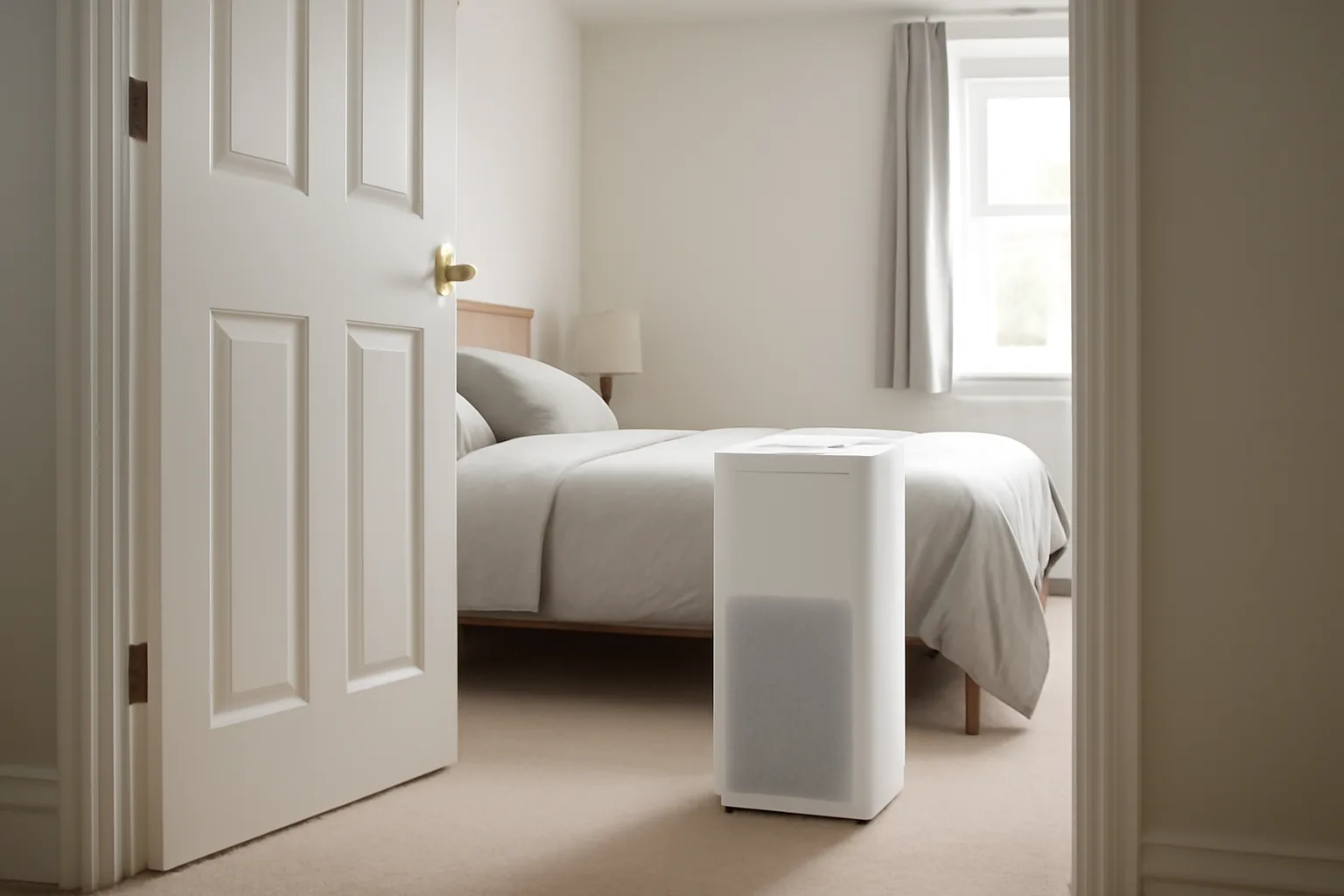
Placement makes a bigger difference than people expect. A powerful purifier behind a sofa is worse than a smaller unit with clear airflow.
Put it near the source, not in a dead corner
Place the purifier where smoky air can reach it. For tobacco smoke, that means near the area where smoke enters or is produced, while keeping the purifier at least 20-30cm from walls and furniture. For outdoor smoke drifting in, position it between the window and the main sitting area if the cable run is safe. The same airflow logic applies in our guide to placing an air purifier for best results.
Do not tuck it behind curtains. Do not put it under a desk. Do not aim the outlet straight into a wall.
Use doors and windows with a bit of thought
Ventilation and purification are not enemies. If someone has just burned toast or smoke has entered from outside, a short blast of ventilation can clear the worst of it, then the purifier can deal with what remains.
The exception is outdoor smoke. If a neighbour is burning damp garden waste or there is heavy road pollution outside, closing the window and running the purifier makes more sense until the air clears.
Run it before the room smells bad
With smoke, waiting until the smell is baked into the room is the slow route. If you know smoke is likely, switch the purifier on early and let it run afterwards.
A practical routine:
- Before: run on medium for 15-20 minutes if smoke is expected.
- During: use high if smoke is visible or the sensor spikes.
- After: keep it on medium for at least an hour, longer in a large room.
- Next day: air the room briefly if outdoor conditions are better.
That routine is not glamorous, but it is how these machines work best.
Costs, Maintenance and What to Buy
For smoke, the cheapest purifier is rarely the cheapest over a year. Filters clog faster, carbon saturates faster and underpowered units need longer runtime.
UK running costs
A typical domestic air purifier uses about 5-60W depending on fan speed. At a rough UK electricity price of 24-28p/kWh, that works out at pennies per day on low or medium, and more like £3-8 per month if a larger unit runs hard for several hours daily. The bigger cost is usually filters, not electricity, which is why the separate air purifier running costs guide is useful before buying a large model.
Filter replacement costs
For smoke use, assume filters may need changing sooner than the app says. A filter used in a clean bedroom might last 9-12 months. A filter dealing with tobacco smoke, candle smoke or frequent cooking smoke may smell tired in 3-6 months.
Typical UK replacement filter costs:
- Budget cylinder filters: about £20-35 each on Amazon UK.
- Mid-range HEPA/carbon filters: about £35-60 from Currys, Argos or the brand site.
- Premium filters: about £60-90+, especially on larger Dyson, Blueair or Philips units.
If replacement filters are hard to find, skip the purifier. A good deal on the machine is useless if you cannot buy filters next winter.
Models I would shortlist
For a small bedroom, a Levoit Core 300S-type unit at about £130-170 is a sensible entry point, but I would not expect miracles with heavy smoke. It is better for occasional smoke and general air cleaning.
For a living room, the Philips 2000i/3000i range, often around £250-450 depending on sales, is a stronger bet because airflow is higher and filters are widely available. Blueair’s larger HealthProtect or DustMagnet models can also work well, usually from about £300-600, though filter costs are not gentle.
Dyson purifiers are polished and easy to live with, but smoke buyers should check the exact CADR-style performance and filter price rather than buying on brand alone. At £400-700, I would want a clear reason to choose one over a simpler high-airflow Philips or Blueair.
My default pick for smoke would be a high-CADR Philips or Blueair with a proper combined HEPA and carbon filter. The cheaper Levoit makes sense for a bedroom or backup room, not as the main answer to regular smoke.
What an Air Purifier Cannot Fix
This is the section that saves people money. Air purifiers help, but smoke is not just an air problem.
It cannot make indoor smoking safe
If someone smokes indoors regularly, the purifier is reducing part of the problem after it has already entered the room. It is not source control. Smoking outside, closing internal doors, washing fabrics and ventilating at the right times all matter more. That is the same reality check behind our wider air purifier myths guide: filtration helps, but it has limits.
For homes with children, asthma, COPD or pregnancy, I would not treat a purifier as the answer. It is support, not protection.
It cannot remove old stale smell on its own
If a room already smells of smoke before anyone lights up, you are dealing with surfaces. Wash curtains, clean hard surfaces, shampoo carpets if needed, and consider repainting with a stain-blocking primer if the room has years of residue.
The purifier can help stop the air becoming as stale again, but it will not pull odour out of fabric overnight.
It cannot replace carbon forever
Carbon gets used up. Once saturated, it stops doing much for smell even if the particle filter still looks fine. If the purifier starts blowing clean but smoky-smelling air, the carbon is probably done.
That is why smoke use should push you towards models with affordable, easy-to-buy filters. The machine is only as good as the filter you are willing to replace.
Frequently Asked Questions
Can an air purifier remove cigarette smoke completely? No. It can reduce airborne smoke particles and some odour, but it cannot make indoor smoking safe or remove residue from fabrics, walls and furniture.
What type of air purifier is best for smoke? Choose a purifier with strong particle filtration, a proper activated carbon filter and enough CADR for the room. For UK living rooms, that often means a mid-range or larger unit, not a small bedside model.
Do HEPA filters remove smoke smell? HEPA filters catch fine particles, but smell needs activated carbon. A purifier without enough carbon may clear haze while leaving a stale tobacco smell behind.
How long should I run an air purifier after smoke? Run it on high while smoke is visible, then medium for at least an hour afterwards. Large rooms, heavy smoke and poor ventilation may need longer.
Are cheap air purifiers good for smokers? They can help in small rooms with occasional smoke, but they usually have weaker airflow and less carbon. For regular smoke, filter cost and CADR matter more than the lowest upfront price.
Where should I put an air purifier for smoke? Put it near the smoke source or where smoke enters the room, with clear space around the intake and outlet. Avoid corners, curtains and spots hidden behind furniture.