You cook dinner, the kitchen smells fine after ten minutes, and then a little screen on the shelf tells you the air is still a mess. That is the useful bit of the best air quality monitor UK buyers can choose in 2026: it turns vague “stuffy room” guesses into numbers you can act on.
In This Article
- Quick Verdict: Which Air Quality Monitor Should You Buy?
- What an Air Quality Monitor Actually Measures
- Best Air Quality Monitors UK Shortlist
- Best Budget PM2.5 Pick: IKEA VINDSTYRKA
- Best All-Rounder: Qingping Air Monitor Lite
- Best Premium Pick: Airthings View Plus
- Best Cheap Smart Route: Sonoff AirGuard
- PM2.5, VOC, CO2 and Humidity: What Matters?
- Where to Place an Air Quality Monitor
- How to Use the Readings Without Overreacting
- Frequently Asked Questions
Quick Verdict: Which Air Quality Monitor Should You Buy?
For most UK homes, I would buy the Qingping Air Monitor Lite if you want one device that covers PM2.5, PM10, CO2, temperature and humidity without paying premium money. It gives you the two readings I care about most day to day: fine particles from cooking, candles and outdoor pollution, and CO2 as a clue that a room needs ventilation.
If you already use IKEA smart home kit, the IKEA VINDSTYRKA is a neat budget choice for PM2.5, humidity, temperature and tVOC. The missing CO2 sensor is the catch. It tells you about particles and chemical-style VOC trends, but not whether a closed bedroom or office is getting stale.
If you want the full picture, including radon, the Airthings View Plus is the premium pick. It costs far more, but it tracks radon, PM2.5, CO2, VOCs, humidity, temperature and air pressure. That makes sense for older homes, basements, home offices and anyone who wants long-term trends rather than a cheap warning light.
The cheap smart route is Sonoff AirGuard, but you need to choose the right version. One model focuses on PM2.5 and PM10; another focuses on CO2. That is useful for smart-home automation, less useful if you want one screen showing everything.
What an Air Quality Monitor Actually Measures
Most home monitors combine several small sensors in one box. They are not laboratory instruments, but the better ones are useful for spotting patterns.
The main readings are:
- PM2.5: fine particles from cooking, candles, smoke, traffic and dust
- PM10: larger airborne particles
- CO2: a ventilation clue, especially in bedrooms, offices and classrooms
- VOC or tVOC: a broad index for airborne chemicals from cleaning products, paint, furniture and fragrances
- Temperature: useful for comfort and mould risk
- Relative humidity: important for damp, dust mites, mould and dry-air irritation
- Radon: a long-term gas risk in some UK homes, only found on specific monitors
Do not buy a monitor expecting it to diagnose every pollutant. Consumer VOC sensors are trend indicators, not a precise chemical analysis. CO2 sensors are useful, but they tell you about ventilation rather than whether an air purifier is removing particles.
The HSE explains that CO2 monitors can help identify poorly ventilated spaces, but also notes that air cleaning units do not remove CO2. That distinction matters: an air purifier can reduce particles while CO2 stays high because the room still needs fresh air. See the HSE guidance on using CO2 monitors for the workplace version of the same principle.
The best air quality monitor UK buyers can choose is therefore not always the one with the most sensors. It is the one that matches the room question. A kitchen needs PM2.5 visibility. A home office needs CO2. A damp bedroom needs humidity. A recently decorated room may need VOC trend data. Buying the wrong sensor gives you numbers, but not much useful action.
Best Air Quality Monitors UK Shortlist
Here is the shortlist I would start with in 2026.
I would avoid ultra-cheap USB gadgets with no clear sensor list, no calibration information and no history view. A single colour light can be useful as a warning, but it is not enough if you want to understand why a room changes through the day.
Best Budget PM2.5 Pick: IKEA VINDSTYRKA
The IKEA VINDSTYRKA is the easiest budget recommendation if you mainly care about particles, humidity and smart-home integration. IKEA says it monitors PM2.5, temperature, relative humidity and total volatile organic compounds.
It is especially sensible if you already use IKEA DIRIGERA or Home Assistant. You can place the sensor near the kitchen, bedroom or work desk and use it to trigger habits: open the window, run the extractor, switch on an air purifier, or stop burning candles in a closed room.
The limitation is CO2. VINDSTYRKA does not give you a direct carbon dioxide reading, so it is weaker for judging whether a closed bedroom, study or classroom-style space needs more ventilation. If stale air is your main concern, buy a monitor with NDIR CO2 instead.
Use VINDSTYRKA if you want:
- Simple PM2.5 visibility
- Humidity and temperature checks
- IKEA smart-home compatibility
- A clean display
- A lower price than premium monitors
It is also a good choice if you plan to pair it with an existing purifier. PM2.5 is the number that should fall when a particle filter is doing useful work. If the reading barely moves after an hour of purifier use, the room may be too large, the filter may be tired, or the purifier may be in the wrong place.
Best All-Rounder: Qingping Air Monitor Lite
The Qingping Air Monitor Lite is the better all-rounder because it covers PM2.5, PM10, CO2, temperature and humidity in one small device. That mix suits UK homes well.
PM readings show what happens after frying, lighting candles, opening windows near traffic, vacuuming, or running a wood burner nearby. CO2 shows whether the room is under-ventilated when people are inside. Humidity helps with the damp-versus-dry-air problem that runs through so many UK houses.
I would choose it for:
- Bedrooms shared by two people
- Home offices
- Open-plan kitchen/living spaces
- Homes near busy roads
- Anyone deciding when to run an air purifier
The trade-off is VOC tracking. The Lite version is not the best choice if VOCs are your main concern after decorating, new furniture, flooring or heavy cleaning products. For that, look at a fuller monitor such as Airthings View Plus or a dedicated VOC-capable model.
The other trade-off is that an all-rounder can make you chase every number. Try to pick one goal for each room. In a bedroom, I would watch overnight CO2 and humidity. In a kitchen, I would watch PM2.5 recovery after cooking. In a home office, I would watch CO2 during long calls. That keeps the monitor useful rather than distracting.
Best Premium Pick: Airthings View Plus
The Airthings View Plus is expensive, but it is the most complete option here. Airthings lists sensors for radon, PM2.5, CO2, VOCs, humidity, temperature and air pressure. That makes it more than a quick “is the kitchen smoky?” device.
The radon sensor is the main reason to spend this much. Radon risk varies by location and building type, and it is a long-term measurement rather than something you understand from one afternoon of data. If you live in a radon-affected area, have a basement office, or want long-term indoor-air history, the premium route makes more sense.
It is also useful if you want to compare interventions:
- Baseline the room for a week.
- Add ventilation habits.
- Add a purifier.
- Check whether PM2.5 falls while CO2 stays acceptable.
- Watch VOC trends after decorating, cleaning or new furniture.
If you just want to know whether frying bacon spikes PM2.5, it is overkill. If you want a serious home-air dashboard, it is the one I would shortlist.
Best Cheap Smart Route: Sonoff AirGuard
Sonoff AirGuard is interesting because it splits the problem into cheaper smart sensors. The PM2.5/PM10 version tracks fine particles, larger particles, temperature and humidity. The CO2 version tracks carbon dioxide, temperature and humidity.
That can work well if you are already building a smart home. Put the PM sensor near the kitchen or purifier, and the CO2 sensor in a bedroom or study. Use automations to switch on fans, send alerts, or remind you to ventilate.
It is less elegant if you want one screen with everything. Two cheaper devices can solve more of the house, but they are not as tidy as one all-in-one monitor.
This route makes most sense if you are comfortable with smart-home setup already. If the words Zigbee, Matter, scenes and automations make you tired, choose a standalone monitor with a clear screen instead. The data is only valuable if you will actually look at it or let it trigger something useful.
PM2.5, VOC, CO2 and Humidity: What Matters?
The right sensor depends on the problem you are trying to solve.
PM2.5
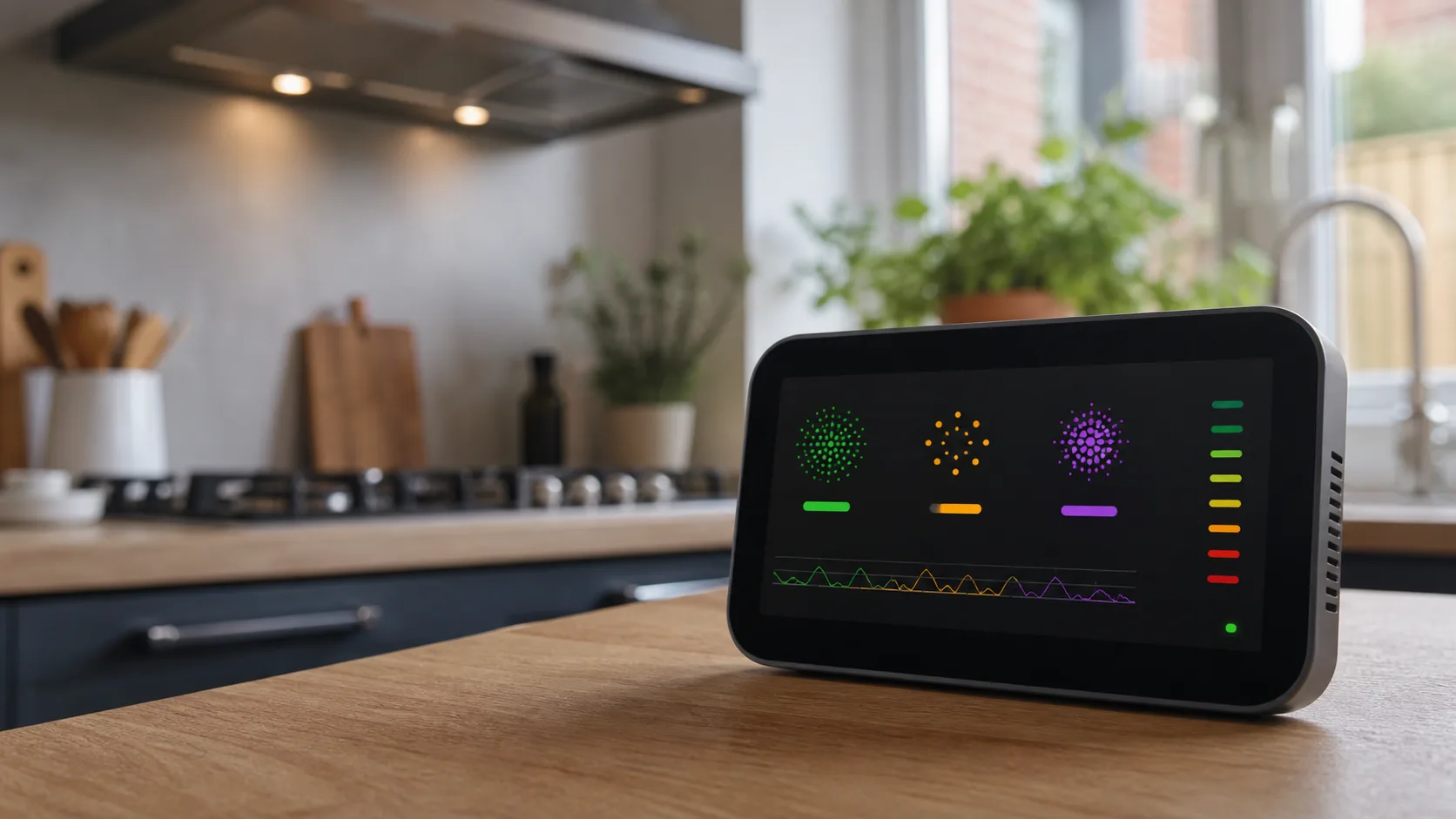
PM2.5 is the reading most people notice first. It can spike from frying, grilling, candles, incense, smoke, traffic pollution and sometimes vacuuming. If you buy one monitor because you want to see whether an air purifier is doing anything, PM2.5 is the key metric.
Pair it with our best air purifiers UK guide if your readings stay high.
VOCs
VOC readings are useful as trend data. If the monitor jumps after using a spray cleaner, painting a room or unpacking new flat-pack furniture, that tells you to ventilate. What it does not tell you is the exact chemical mix or health impact.
Treat VOC sensors as a warning nudge, not a lab result.
CO2
CO2 matters in closed rooms with people in them. Bedrooms, home offices and classrooms can climb quickly when windows and doors are shut. A high CO2 reading usually means stale air and poor ventilation, not that you need a stronger purifier.
This is where people get caught. A purifier can make PM2.5 better while CO2 stays high. Fresh air solves CO2; filters solve particles.
If CO2 rises every afternoon in a home office, try opening a window for short bursts, opening the door, or using trickle vents before spending more money. If the room is noisy or cold, short ventilation bursts may be more realistic than leaving a window open all day.
Humidity
Humidity is the quiet reading that explains a lot. Too high and you raise mould and dust-mite risk. Too low and rooms can feel dry, especially in winter with heating on.
For UK homes, I would watch humidity alongside our guides to reducing damp and mould and measuring humidity at home.
The useful pattern is time-based. A bathroom humidity spike after a shower is normal if it falls back down. A bedroom sitting high all night and still high at lunchtime is a different problem. That points to ventilation, heating, damp sources or drying clothes indoors.
Where to Place an Air Quality Monitor
If the readings show persistent problems, use them alongside our complete indoor air quality guide and our practical advice on how to test indoor air quality at home. For VOC context, GOV.UK publishes UK indoor air quality guidance for volatile organic compounds, which is useful background when a monitor keeps flagging chemical sources.
Placement can make the difference between useful data and nonsense.
Put the monitor:
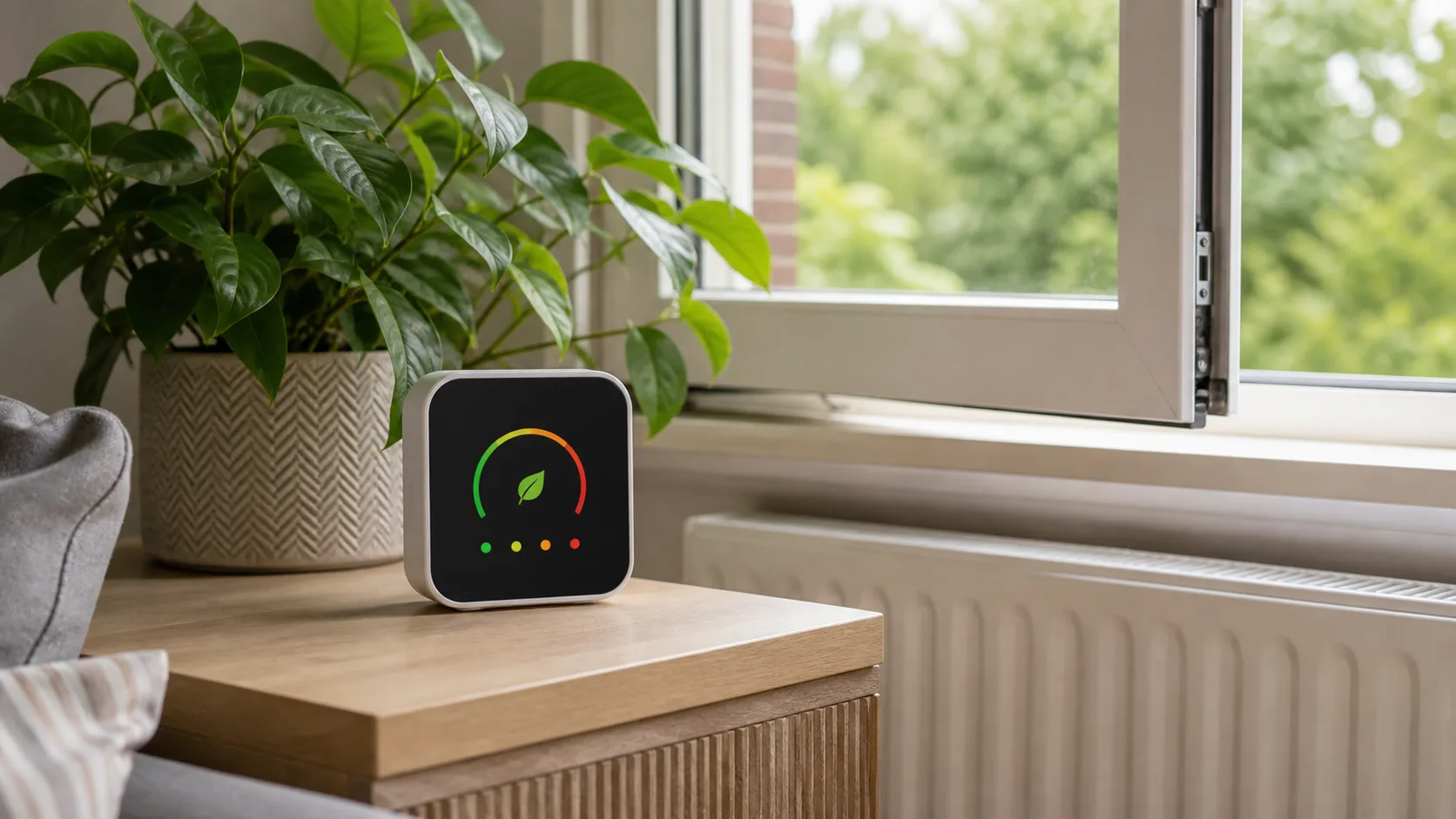
- At breathing height, roughly table or shelf level
- Away from direct window draughts
- Away from extractor fans
- Not right beside the purifier outlet
- Not on top of a radiator
- In the room you actually care about
For a kitchen/living space, start on a shelf or worktop away from the hob but still in the room. For a bedroom, put it on a chest of drawers rather than the floor. For a home office, keep it near your desk but not directly beside a laptop vent or open window.
If you want to test a purifier, do not place the monitor directly in the purified air stream. Put it across the room and watch whether the whole-room reading improves.
For a first week, move the monitor between rooms rather than buying three devices immediately. Try the kitchen during cooking, the bedroom overnight, and the office during a normal workday. You will quickly learn which room deserves a permanent monitor.
How to Use the Readings Without Overreacting
The first week with an air quality monitor can make you a little too interested in every spike. Do not panic because the PM2.5 reading jumps during cooking. That is normal. The useful question is how high it goes, how long it stays high, and what brings it down.
A practical routine:
- Baseline for a week without changing much.
- Note obvious events such as frying, cleaning, candles, visitors or closed-window nights.
- Try one change at a time, such as extractor fan use or a purifier.
- Watch recovery time, not just the peak number.
- Use trends, not single readings, for buying decisions.
If the kitchen PM2.5 spikes but clears in 20 minutes with the extractor and a cracked window, you have a behaviour fix. If it stays high for hours, a purifier may help. If CO2 is high every morning, the answer is ventilation, not a bigger HEPA filter.
The monitor should make the home easier to manage, not turn it into a control room. The best one is the device that changes habits: opening a window at the right time, running the extractor longer, replacing a purifier filter, or spotting humidity before mould appears.
Frequently Asked Questions
What is the best air quality monitor UK homes should buy?
For most homes, Qingping Air Monitor Lite is the best all-round pick because it covers PM2.5, PM10, CO2, temperature and humidity. IKEA VINDSTYRKA is better value for PM2.5 and humidity if you do not need CO2.
Do I need PM2.5, VOC and CO2 sensors?
Not always. PM2.5 is best for cooking, candles, smoke and purifier performance. CO2 is best for ventilation. VOC is useful after cleaning, decorating or new furniture, but consumer VOC readings are broad trend indicators.
Are cheap air quality monitors accurate?
They are useful for trends and spikes, but not lab-grade measurements. A good cheap monitor can show when cooking raises PM2.5 or when a bedroom needs ventilation. Do not treat every number as exact.
Where should I put an air quality monitor?
Put it at breathing height, away from direct draughts, radiators, extractor fans and purifier outlets. Place it in the room where you want to change behaviour, such as the bedroom, kitchen or home office.
Can an air purifier fix high CO2?
No. Air purifiers remove particles and some odours depending on the filter, but they do not remove CO2. High CO2 usually means the room needs more fresh air.