The VonHaus 12L dehumidifier review below is based on three hands-on tests in real UK rooms, including two demanding laundry sessions. Our clearest finding was that it cut the drying time for two full loads from the usual 8–10 hours to four or five hours. It also lowered the humidity created by a running shower, although that test took longer than we expected.
Product disclosure: VonHaus supplied this dehumidifier to Breathe Clean UK free of charge and allowed us to keep it. No payment was made. VonHaus had no editorial control, did not approve this article and had no influence over our verdict. The photographs were supplied by VonHaus.
In This Article
- Our VonHaus 12L dehumidifier review verdict
- How we tested the VonHaus 12L dehumidifier
- Laundry drying performance
- Humidity control after a shower
- Controls, tank and everyday use
- Noise and build quality
- What could be better
- Who should buy the VonHaus 12L dehumidifier?
- Frequently Asked Questions
Our VonHaus 12L dehumidifier review verdict
The VonHaus 12L is an easy dehumidifier to recommend if your main priorities are drying washing indoors and managing everyday condensation. It produced the strongest results in Laundry mode: two full loads on two airers were completely dry after five hours in a 35m² kitchen and after four hours in a 40m² bedroom. Comparable loads usually need around 8–10 hours without a dehumidifier.
That is a useful result, particularly because both laundry rooms were larger than the manufacturer’s stated 20m² coverage. We would still treat 20m² as the sensible guide for normal use, rather than assuming our short tests prove that the unit is designed for every 35–40m² space. Room shape, airflow, temperature and the amount of moisture present all affect what a dehumidifier can do.
What we liked
- Excellent laundry performance: it dried two full washing-machine loads completely in four to five hours during both trials.
- Simple controls: Lucy, our tester, found the panel easy to understand without repeatedly consulting the manual.
- Easy tank handling: removing, carrying and emptying the two-litre tank was uncomplicated.
- Useful automatic control: the humidistat responded as expected when a target level was selected.
- Solid construction: the 10kg body feels substantial and well made, with wheels to help once it is on the floor.
- Unobtrusive sound: we heard a low, steady hum rather than rattling or an irritating change in pitch.
The short version
At about £105 from VonHaus when checked on 9 September 2026, it offers good value for households that regularly dry clothes indoors. We were less impressed by its speed during the shower test, but it still reduced the reading from 69% to 50% while moisture was actively being generated. It is not the lightest machine to carry upstairs, and we cannot judge its electricity consumption, Sleep mode or continuous drainage because we did not test those areas.
How we tested the VonHaus 12L dehumidifier
Lucy, a member of the Breathe Clean UK team, tested the unit between 7 and 9 September 2026. Each trial took place at approximately 22°C, and the unit’s display was used to record the starting and finishing relative humidity.
We used three different setups rather than repeating one easy test:
- Kitchen laundry test: two full loads, straight from the washing machine and spread across two airers, in a 35m² kitchen. Laundry mode ran for five hours.
- Bedroom and en-suite test: a hot shower ran in the en-suite while the unit operated in normal Dehumidifier mode in the adjoining 20m² bedroom. The test lasted two hours.
- Bedroom laundry test: two full loads on two airers in a 40m² bedroom. Laundry mode ran for four hours.
For each session we recorded elapsed time, starting and finishing humidity, and the approximate quantity of water in the tank. For the two laundry tests, we also checked whether the clothing was fully dry rather than merely feeling less damp.
| Test | Room | Mode and time | Humidity | Water | Outcome |
|---|---|---|---|---|---|
| Two laundry loads | 35m² kitchen | Laundry, 5 hours | 65% to 55% | 1 litre | Completely dry |
| Hot shower running | 20m² bedroom/en-suite | Dehumidifier, 2 hours | 69% to 50% | 0.5 litres | Target reached |
| Two laundry loads | 40m² bedroom | Laundry, 4 hours | 66% to 50% | 1 litre | Completely dry |
Important limits to our evidence
This was practical household testing, not a controlled laboratory comparison. We did not use a plug-in electricity meter or separate calibrated hygrometer, and we did not run a simultaneous control load in an identical room. The normal 8–10-hour drying time is the household baseline for comparable laundry, not a laboratory benchmark.
We also did not test Sleep mode or the continuous drainage hose. Where we mention the claimed extraction rate, power, room coverage or noise level, those are VonHaus specifications, not measurements made by our team.
Laundry drying performance
Laundry is where this model made its strongest case. In the kitchen, two full loads placed on two airers were completely dry after five hours. The humidity fell from 65% to 55%, and the tank contained about one litre of water. In the bedroom trial, the same quantity of washing was dry after four hours; humidity moved from 66% to 50%, with another litre collected.
The difference against the usual 8–10-hour drying time was obvious enough to matter in daily life. It means a load put out after lunch could be folded that evening, rather than leaving airers blocking a bedroom or kitchen overnight. Our results also fit the underlying purpose of a compressor dehumidifier: it removes water from the surrounding air, allowing more moisture to evaporate from wet fabric.
Why the result was better than the humidity figures alone suggest
The kitchen reading only dropped by ten percentage points, which might look modest beside the bedroom result. That number does not tell the whole story. Wet washing was continually releasing moisture into the air while the machine was removing it, and the tank still captured approximately one litre. The decisive outcome was that both loads became completely dry.
The 40m² bedroom result was stronger on both measures. It reached 50% relative humidity in four hours and dried the clothing in less than half the upper end of the usual time. We would not promise every household the same saving: a cooler room, tightly packed airer, heavier towels or closed-off airflow may extend the process.
How we would set it up for laundry
Our experience supports a few practical choices:
- Keep the room contained: close the door so the appliance is working on one defined air volume rather than the whole home.
- Leave gaps between garments: crowded fabric slows evaporation, however capable the dehumidifier is.
- Place the unit clear of the airer: follow the manual’s clearance guidance and do not drape anything over the machine.
- Use Laundry mode: it runs continuously, which suited these high-moisture tests better than waiting for automatic cycling.
- Check the tank: one litre was collected in each session, so the two-litre capacity was ample for our tests but should not be ignored.
For more general setup advice, see our guide to using a dehumidifier effectively and our comparison of the best dehumidifiers for drying clothes.
Humidity control after a shower
Our shower trial was deliberately more challenging than switching the unit on after the bathroom had cleared. The hot shower was running in the en-suite, so new water vapour was entering the adjoining bedroom while the dehumidifier operated. The starting reading was 69%; after two hours, it had reached 50%, and roughly half a litre of water had collected in the tank.
Lucy expected the room to reach the target in 30–60 minutes, so the two-hour result felt slow. That expectation was probably ambitious while the shower continued adding moisture. Even so, this is the one area where the product did not feel as quick as its laundry performance led us to expect.
What the result does and does not prove
It proves that, in this 20m² bedroom and en-suite setup at about 22°C, the machine reduced the displayed relative humidity by 19 percentage points over two hours despite an active moisture source. It does not prove that every bathroom will clear in two hours, or that a dehumidifier should replace a working extractor fan.
Current UK government guidance on damp and mould identifies showering, laundry and cooking as common moisture sources and stresses the importance of dealing with underlying causes and ventilation. A portable dehumidifier can help manage airborne moisture, but it cannot repair a leak, defective insulation or inadequate fixed ventilation.
If bathroom moisture is your main concern, our dehumidifiers for bathrooms guide explains the electrical-safety and placement considerations. The VonHaus unit belongs in a safe, dry position outside splash zones, with doors arranged so moist air can reach it.
Controls, tank and everyday use
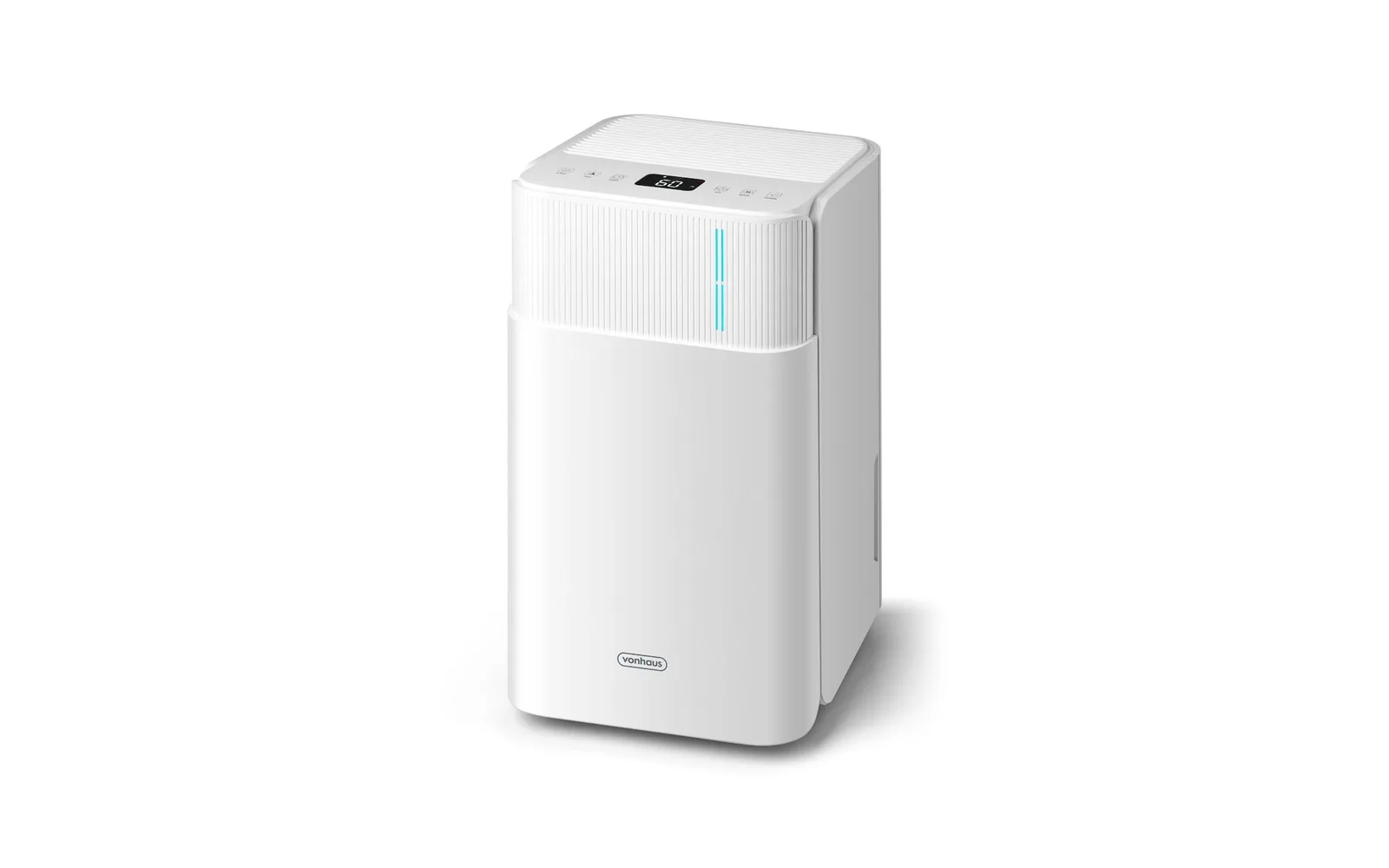
There is very little learning curve. The LED panel gives access to Auto, Laundry and Sleep modes, while the colour indicator provides a quick view of the humidity band. During our sessions, setting the mode and timer was easy, and the child lock engaged and released without fuss.
Automatic humidity control
We found the automatic control worked well. Once a target was selected, the unit responded to the displayed room humidity instead of requiring constant intervention. That is the mode we would use for routine management after laundry is dry or after a short moisture spike has passed.
Remember that a built-in sensor sits close to the machine. Its reading may not exactly match a hygrometer on the opposite side of a large room. If you want to understand differences between devices or choose a sensible measuring position, our guide explains how to measure humidity in your home.
Tank emptying and drainage
The two-litre tank slides out cleanly and was simple to empty. It held the one litre produced during each laundry session with plenty of room remaining. VonHaus states that the unit stops automatically when the tank is full, but we did not reach that point during testing.
A hose connection is provided for continuous drainage. We did not test it because none of the sessions required unattended operation or produced enough water to make manual emptying inconvenient. Buyers planning to run it in a utility room for long periods should check that they have a suitable low drain and can route the hose without kinks.
Moving and storing it
At 10kg, this is not a machine we would describe as light. The weight contributes to the sturdy feel, and the wheels make movement across one level easy. Carrying it between floors is a different matter: anyone with limited grip or mobility may prefer a lighter model or one unit per problem area.
The body is relatively compact at a claimed 45.9cm high, 25.5cm wide and 22.3cm deep. VonHaus also provides a 1.5m cable and storage space for the lead in the empty tank when the unit is not being used. Do not store the cable there while the tank is wet.
Noise and build quality
The sound during our tests was a low, consistent hum, similar to a small air conditioner running quietly. We found it unobtrusive in the kitchen and bedroom while awake. There were no obvious rattles, sharp fan notes or loose-panel noises from the tested unit.
That is a subjective judgement. We did not measure sound with a decibel meter, so the manufacturer’s 39dB figure should be treated as a claimed specification rather than our result. We also did not test Sleep mode overnight, which means we cannot say whether a light sleeper would be comfortable with it beside the bed.
Does it feel well made?
Yes. The casing, tank fit and controls all felt reassuringly solid during repeated movement and emptying. Its unexpected heft reinforced that impression, although weight alone is not evidence of durability. A longer ownership period would be needed to judge fan wear, sensor drift and how the tank mechanism holds up after months of use.
The model includes a washable filter behind the air intake. VonHaus describes this as helping to reduce dust and allergens, but this is primarily a dehumidifier, not a substitute for a dedicated HEPA air purifier. We have not independently tested particle removal, so we would buy it for moisture control rather than air cleaning.
What could be better
No serious fault emerged in our three sessions, but there are clear limitations to weigh up.
It is heavy on stairs
Ten kilograms is manageable for many adults, yet it is enough to discourage frequent carrying between floors. The wheels solve movement across hard floors, not a trip from a downstairs kitchen to an upstairs bedroom. A more pronounced top handle would also make that transfer feel easier.
The shower test took longer than expected
Reaching 50% from 69% in two hours was still a useful result, especially with the shower running. It simply did not feel as quick as we anticipated after seeing the laundry results. Buyers hoping to clear a very steamy en-suite in 30 minutes should temper that expectation and use the extractor fan as the first line of control.
Some features remain untested
We cannot give a responsible verdict on:
- Electricity use: no plug-in energy meter was used, so we will not present an estimated cost as a tested finding.
- Sleep mode: we did not run the appliance overnight or compare the display and fan behaviour in a sleeping environment.
- Continuous drainage: the hose setup was unnecessary for our short tests and was not assessed.
- Long-term reliability: three days of testing can reveal usability and short-term performance, not durability over several winters.
The rated input is 200W, but actual consumption can change as the compressor cycles. Our dehumidifier running-cost guide explains why a measured kWh figure and your current tariff give a better answer than a fixed pence-per-hour claim.
Who should buy the VonHaus 12L dehumidifier?
This model makes most sense for a household that dries washing indoors several times a week and wants a machine that is simple rather than app-heavy. Its two-litre tank, Laundry mode and automatic humidity setting cover the jobs most people will use regularly, while the tested drying times were the standout reason to buy.
It is a good fit if you:
- dry one or two loads on airers in a closed room;
- want to reduce everyday condensation from laundry or showers;
- prefer clear physical controls to Wi-Fi and an app;
- can leave the unit mainly on one floor or are comfortable carrying 10kg;
- want a mid-sized compressor model at around the £100 mark.
Consider something else if you:
- need to treat a consistently damp open-plan area well beyond the claimed 20m² coverage;
- want verified overnight quietness from our testing;
- need a very light unit for frequent stair use;
- require proven continuous drainage or measured electricity consumption;
- have penetrating damp, rising damp or a leak that needs diagnosis and repair rather than moisture management alone.
For a broader view of capacity and dehumidifier types, compare it with our best dehumidifiers in the UK. If the problem is persistent mould rather than an occasional moisture spike, start with the underlying causes in our guide to reducing damp and mould in UK homes.
Final recommendation
The VonHaus 12L earned our recommendation for laundry drying. Cutting two full loads from roughly 8–10 hours to four or five hours in our home tests is a practical improvement, not a marginal change. The controls and tank are easy to live with, automatic humidity management behaved well, and the build feels more substantial than the price suggests.
The reservation is not that it failed the shower test—it reached 50% while moisture was still being produced—but that it needed two hours rather than the 30–60 minutes our tester expected. Buy it chiefly as a capable laundry and everyday-condensation machine, and treat the 20m² manufacturer coverage as the sensible planning figure even though our laundry trials succeeded in larger rooms.
Frequently Asked Questions
How quickly did the VonHaus 12L dry clothes? In our two tests, two full washing-machine loads on two airers were completely dry in four hours in a 40m² bedroom and five hours in a 35m² kitchen. Comparable loads usually took around 8–10 hours without the dehumidifier.
How much water did it collect? It collected approximately one litre during each laundry test and 0.5 litres during the two-hour bedroom and en-suite shower test. The built-in tank holds a claimed two litres.
Is the VonHaus 12L dehumidifier noisy? We heard a low, steady hum similar to a quiet air conditioner and found it unobtrusive while awake. We did not measure decibels or test Sleep mode overnight, so we cannot judge it for very light sleepers.
Can it be used for bathroom moisture? It reduced the displayed humidity from 69% to 50% in two hours while a hot shower ran in the en-suite. Keep any portable mains appliance safely outside splash zones and continue to use suitable bathroom ventilation.
Is it easy to move? Wheels make it easy to reposition on one level, but the claimed 10kg weight is noticeable when carrying it upstairs. We would not choose it for someone who needs an especially light portable machine.
How much does the VonHaus 12L cost to run? We did not measure electricity consumption, so we cannot present a tested running cost. VonHaus rates it at 200W, but real consumption depends on compressor cycling, room conditions, use time and your electricity tariff.