The best window vacuum for condensation depends on how much wet glass you clear and the size of its panes. I would choose the Kärcher WV 6 Plus for several large windows: its 150 ml tank reduces stops to empty it, and Kärcher quotes up to 100 minutes of runtime. The Beldray Cordless Window Vacuum Plus suits a smaller job and tighter budget. Each machine collects water already on the glass; recurring condensation also calls for attention to the room’s moisture and ventilation.
Quick decision: Choose the WV 6 Plus for many large panes, the Bosch GlassVAC set for divided windows, the WV 2 Plus for a shorter Kärcher routine, or the Beldray for occasional use. A cloth may be enough for light misting. Where glass is wet every morning, clear the water and look into the moisture source too.
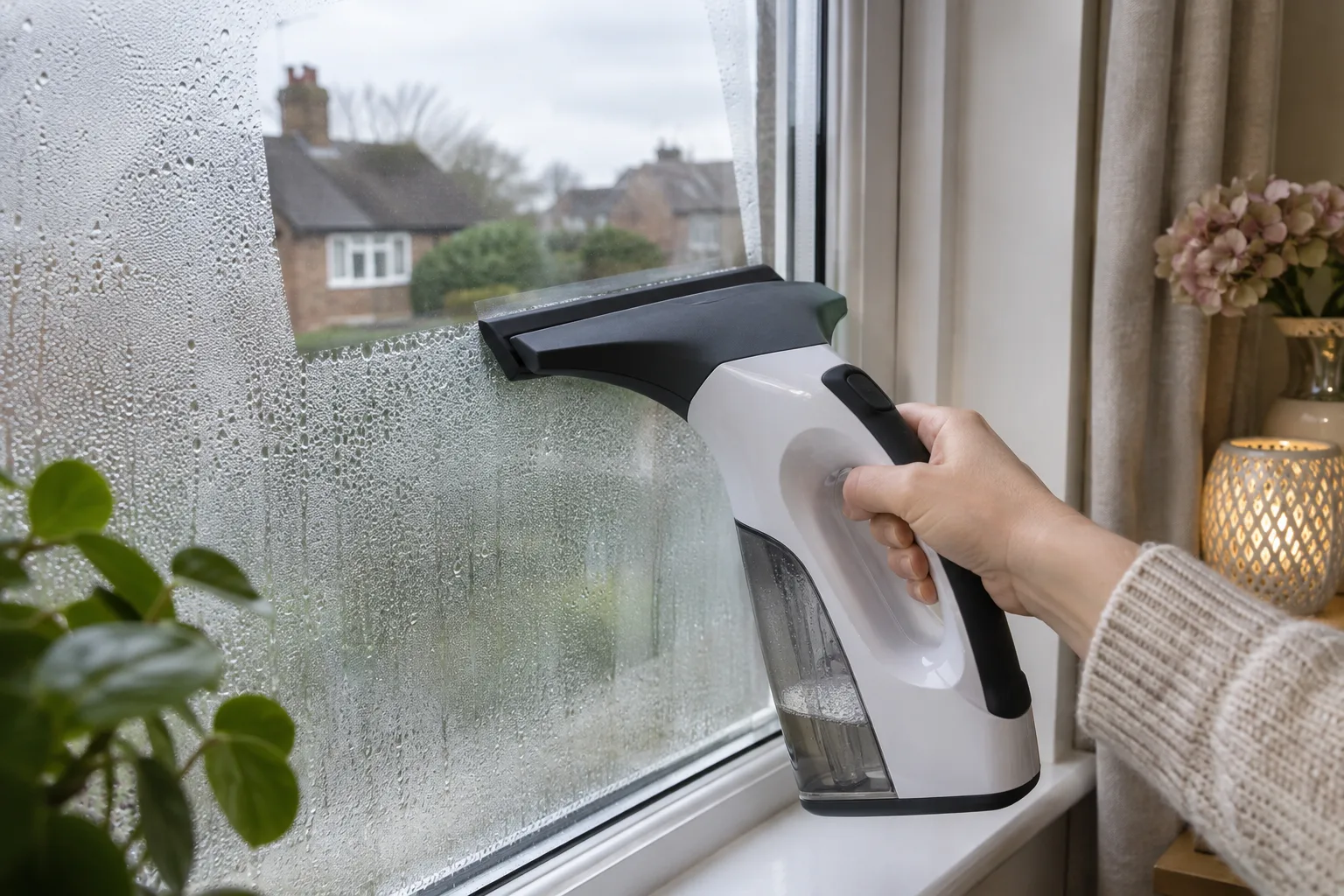
Our top 4 picks

Kärcher WV 6 Plus
Best overall
Larger tank and long quoted runtime suit several broad, wet windows.

Beldray Cordless Window Vacuum Plus
Best budget
A lower-cost way to collect water from one or two damp windows.

Kärcher WV 2 Plus
Best simple Kärcher
A simple wide-head choice for a few full-size panes.

Bosch GlassVAC set 06008B7070
Best for divided panes
Two included suction heads help with wide and narrow glass.
In This Article
- Comparison at a glance
- The four best window vacuums for condensation
- What a window vac can and cannot do
- The features that matter on a wet window
- How to clear condensation with a window vacuum
- Choosing for small panes, large glazing and shower screens
- Window vac, cloth, squeegee or dehumidifier?
- When a window vac is not enough
- Which window vac should you buy?
- Frequently Asked Questions
Comparison at a glance
These four models cover large panes, divided glazing, a short daily routine and occasional use. Runtime figures come from the manufacturers and will vary in practice. Compare the exact kit contents and current retailer offer before ordering; the similarly named narrow-nozzle bundles are different products.
| Model | Best fit | Quoted runtime | Water tank | Main compromise |
|---|---|---|---|---|
| Kärcher WV 6 Plus | Several large windows | 100 minutes | 150 ml | Narrow head sold separately |
| Beldray Cordless Window Vacuum Plus BEL01985 | Budget, occasional use | Up to 30 minutes | 100 ml | Smaller buyer-feedback sample |
| Kärcher WV 2 Plus | Simple daily routine | 35 minutes | 100 ml | Smaller tank and shorter runtime than WV 6 |
| Bosch GlassVAC set 06008B7070 | Mixed pane sizes | 30 minutes | 100 ml | 30-minute quoted runtime and 100 ml tank |
The four best window vacuums for condensation
Best overall: Kärcher WV 6 Plus
The WV 6 Plus is my first choice if condensation covers several bedroom windows or a broad patio door each morning. Kärcher quotes a 100-minute battery runtime and a 150 ml dirty-water container. The wide 280 mm head is suited to unobstructed glass, and a display shows remaining battery minutes. Its longer runtime is more than most quick morning sessions need; the larger tank is the more practical reason to choose it over the WV 2 Plus when there is a lot of water to collect.
The important kit distinction is WV 6 Plus versus WV 6 Plus N. Kärcher’s Plus N includes an extra narrow nozzle; the ordinary Plus has the standard wide head. For many slim panes, add the compatible nozzle or consider the Bosch set below. The Kärcher WV 6 Plus specification confirms the runtime, tank and standard-head figures. Check that the offered kit is the ordinary WV 6 Plus if that is the model you want.
Its extra capacity may be unnecessary for a single damp bathroom pane. The 280 mm blade also leaves edges and sills for a cloth. For broad, routinely wet glazing, I would take its larger tank over a smaller machine that needs more emptying.
Best budget: Beldray Cordless Window Vacuum Plus BEL01985
The Beldray Plus is a sensible low-cost entry point when you want to stop a morning puddle without spending Kärcher money. Model BEL01985 has a removable 100 ml tank and a spray bottle with wipe pad. Beldray’s own product page confirms the kit and quotes up to 30 minutes of use from a full charge. Those accessories are useful if you also plan to wash glass, but they are not needed simply to collect clean condensation.
The Beldray is the budget choice for a small flat or one or two affected windows. Its 100 ml tank and up-to-30-minute quoted runtime fit that modest job. Buyer feedback is thinner than for the other three models, so I would weigh the lower cost against the more established alternatives rather than assume equal long-term durability.
Choose it for a modest job and a firm budget. A houseful of wet windows makes the WV 6 Plus’s larger tank more useful. Before ordering, compare the supplied charger and accessories on the BEL01985 product page; Beldray sells other window-vac bundles with similar names.
Best simple Kärcher: WV 2 Plus
The WV 2 Plus gives you the familiar Kärcher format without paying for the WV 6’s long runtime. The UK WV 2 Plus specification lists a 35-minute runtime, 100 ml tank and 280 mm standard suction nozzle. The kit includes a spray bottle, microfibre cloth and small cleaner sachet. Again, the cleaning extras do not make it better at vacuuming plain condensation; they widen its use as a window-cleaning kit.
It is a reasonable pick for a few full-size panes that you clear often. The standard WV 2 Plus has one 280 mm head; the WV 2 Plus N is a different two-nozzle bundle. A separately purchased narrow nozzle changes the value calculation if most of your panes are divided.
Compare its live price with the WV 6 Plus before choosing. When the gap is small, I would take the WV 6 Plus for its larger tank and longer quoted runtime. The WV 2 Plus earns its place when the saving matters and your daily run is short.
Best for mixed pane sizes: Bosch GlassVAC set 06008B7070
Bosch’s GlassVAC set 06008B7070 is the most useful alternative for mixed pane sizes. Its box includes both large and small suction heads, a spray applicator and microfibre cloths. Bosch’s product information lists this set with a 30-minute runtime and 100 ml tank. The small head is its advantage on divided glazing.
Match the Bosch model number when buying. A newer GlassVAC has different battery and tank figures, so those specifications do not describe set 06008B7070. The older set’s two heads reduce the amount of hand wiping around divided panes; corners and seals still need a cloth.
I would choose Bosch where the included narrow head solves a real window-layout problem. For wide modern glazing, the WV 6 offers more tank capacity and runtime. Compare current prices and confirm that the offered Bosch box includes both heads.
What a window vac can and cannot do
It takes water off the surface
A window vacuum combines a rubber blade with suction. You draw it across wet glass, and it collects the water in a small tank instead of leaving most of it in a cloth or running down the sill. That is useful when a cold window is dripping on winter mornings, or a shower screen is still wet after use. It can also make the task quicker and tidier than wringing out a cloth after every pane.
The appliance works after condensation has formed. Warm, moist indoor air can meet cold glass again tomorrow. The UK government’s home-ventilation guidance explains how trapped moisture contributes to condensation and mould. Working extractor fans, suitable ventilation, adequate heating and repairs address causes that a glass-cleaning tool cannot. Our guide to stopping condensation on windows covers those measures.
Decide whether it is worth buying
A vac earns its place when wet glass soaks several cloths or leaves puddles on the frame. A dry cloth clears faint mist on one pane just as easily. I would buy for the water it collects, rather than a promise of perfectly streak-free glass: blade condition and the state of the glass still affect the finish.
Look at the task you actually have:
- Count the panes: a whole house of wet glass makes a tank and charger more relevant than one bathroom window.
- Check their shape: large sheets suit a wide blade; divided panes make an included narrow head more useful.
- Find the water: droplets on glass can be vacuumed, but frames, seals and sills still need a cloth.
A wide head clears patio doors quickly, while Georgian bars, handles and narrow sidelights favour a smaller nozzle. Keep a dry cloth for corners, seals and sills. If wet walls or mould keep returning, prioritise the moisture source alongside daily clean-up.
The features that matter on a wet window
Blade width and the edge of the pane
The standard Kärcher heads here are 280 mm wide. That is handy for an uninterrupted patio door but awkward on a divided sash or beside a handle. Measure the usable strip of glass, not just the entire window frame. A narrow head can be more valuable than another hour of claimed runtime when you spend every morning working around small panes. Bosch’s set earns its place on that point; the ordinary WV 6 Plus and WV 2 Plus kits should not be credited with an included narrow nozzle.
Blade condition matters too. A worn or dirty rubber edge can leave water behind, and trying to press harder is not a substitute for cleaning or replacing it. Check whether the manufacturer sells a replacement blade for the exact model. A window vac is a small appliance with a consumable edge, not a once-for-life solution.
Tank size, charging and handling
Runtime and tank capacity answer different questions: battery time tells you how long the motor can run, while tank size determines when to empty it. A “windows per charge” claim also depends on pane size and how wet the glass is.
Consider where you will keep and charge it. A machine tucked in a cupboard without a charge is no use on a cold morning. Look at the charging lead supplied with the exact kit and whether its tank can be emptied without splashing. I give less weight to bundled detergent and spray bottles for a condensation-only purchase, because the glass is already wet. They are worthwhile only if you will use the vac to clean windows and shower screens as well.
How to clear condensation with a window vacuum
A quick, tidy morning routine
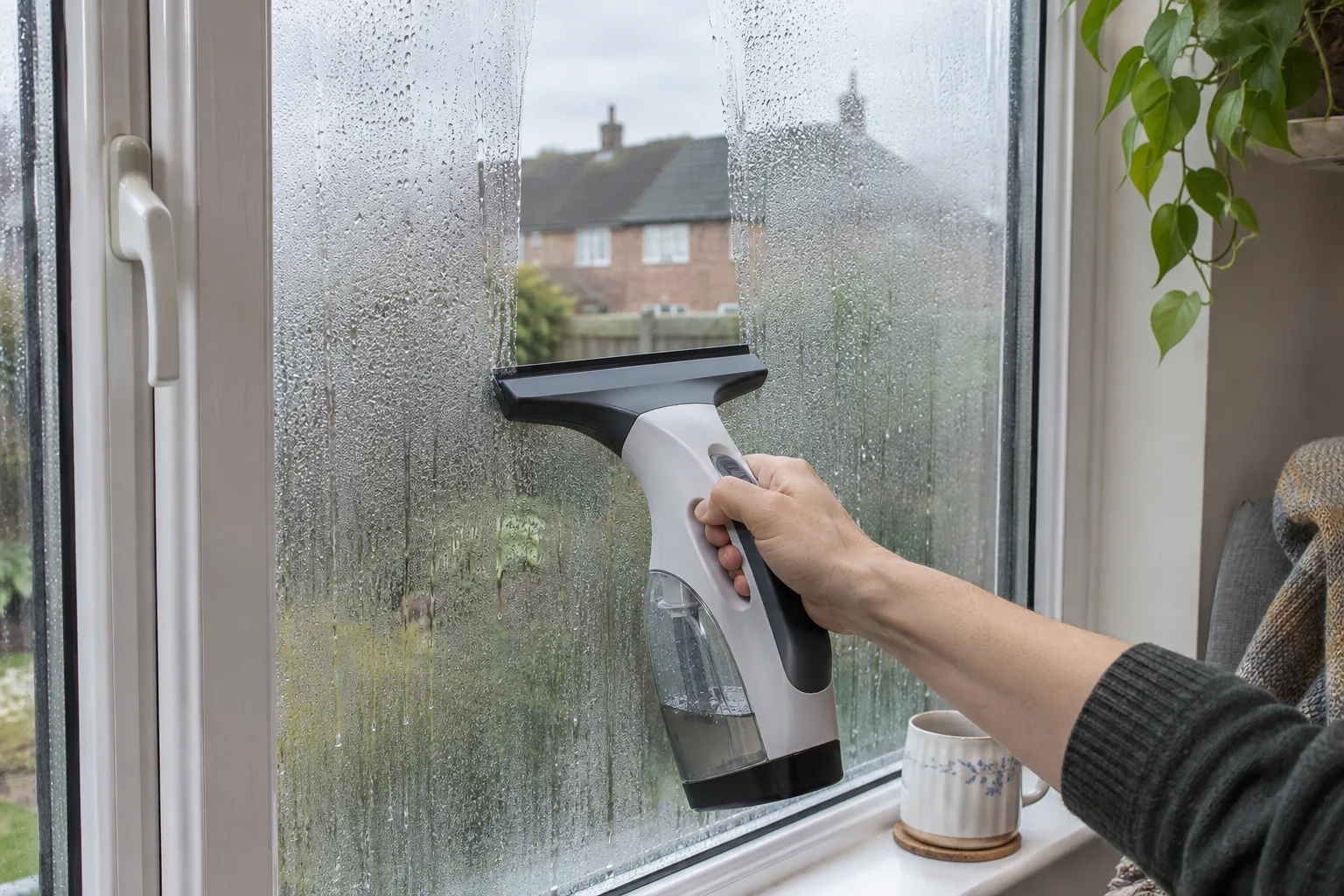
Start with the appliance charged and its tank empty. Follow the exact model’s operating instructions, including how it should be held; a window vac is designed for water on smooth surfaces, not for dry dust, debris or a large spill. You do not need to spray cleaning solution onto glass that is already covered in plain condensation.
- Clear the glass from top to bottom. Move the suction blade steadily over the wet pane, with enough contact to collect water but no need to grind it into the glass.
- Finish the edges. Use a dry cloth around the frame, seals, corners and sill, where a wide blade cannot reach. Do not leave collected water sitting against timber or plaster.
- Empty the tank. Pour the collected water away according to the manual. Do not let the tank sit full for days, and keep the motor body out of water while cleaning it.
- Check the room. If the same window is wet every morning, look at ventilation and moisture sources rather than treating the vac as the entire fix.
For ordinary condensation, a dry sill matters more than a showroom finish. If the blade leaves lines, clean and reseat it, then check for dirt or dry patches on the glass. Wipe the final strip at the bottom instead of drawing the machine over the frame.
Keep the unit hygienic and ready
Rinse or clean only the parts the manufacturer allows you to remove, and let them dry before storage. A damp cloth or tank shut in a cupboard may smell unpleasant. Keep chargers away from the wet work area and use the charger specified for the appliance. Never use a window vac as a substitute for cleaning visible mould; investigate and address the moisture source, and follow appropriate safety guidance for mould rather than vacuuming it with a glass-cleaning tool.
Choosing for small panes, large glazing and shower screens
Match the head to the surface
- Broad glazing: a standard wide head makes fewer passes, and the WV 6’s larger tank matters if several windows are wet.
- Divided windows: the Bosch set’s included narrow head avoids working around every bar with a cloth.
- Shower screens: all four can be considered for smooth glass, provided the exact model instructions allow that surface.
A full-height door and a small casement are different jobs, even if a manufacturer counts each as one window. Light mist and heavy droplets also fill a tank at different rates. If you are unsure what capacity you need, clear the wettest room with a cloth once and see how much water it collects.
Look beyond the centre of the glass
Condensation often gathers at the cold lower edge, on seals and along a sill. A wide vacuum head may remove the visible sheet of water yet leave the spots that cause the most mess. Plan on a small dry cloth for those areas whichever model you choose. If water appears between panes of double glazing, rather than on the room-facing surface, a window vac cannot reach it. That may indicate a glazing-unit fault worth discussing with a competent installer or landlord, not a reason to buy a more powerful vac.
Window vac, cloth, squeegee or dehumidifier?
Buy only for the work it saves
If one pane has light misting, a washable cloth is cheap, silent and ready immediately. A manual squeegee moves water quickly on large glass, but you still need to catch the run-off at the bottom. A window vac makes most sense when you want that water collected instead of moving across the sill or into several wet cloths. The Beldray is the low-cost way to try the routine; a larger tank and durable blade support are reasons to spend more, not proof that a dearer vac will stop condensation forming.
A dehumidifier removes moisture from room air and may reduce future condensation in suitable conditions. A window vac collects droplets after they appear. Our dehumidifier-versus-opening-windows comparison explains where moisture control and fresh air help. Measure indoor humidity if the cause is unclear.

When a window vac is not enough
Investigate repeated or spreading damp
A wet pane on a cold morning may be ordinary surface condensation. Wet walls, peeling finishes, persistent mould or water appearing after rain deserve investigation. Oxford City Council’s condensation guidance advises removing surface moisture and improving ventilation. Our damp and mould guide helps separate moisture habits from defects needing repair.
In a bathroom, check that extraction is working and used long enough after showers; our humidity-sensing extractor-fan guide covers the buying decision if a suitable fan is needed. In a rented home, report persistent damp or suspected defects to the landlord rather than accepting daily vacuuming as the only answer. Do not block vents to keep a room warm and then assume the vacuumed water has fixed the air problem.
Which window vac should you buy?
The short answer
For several large, regularly wet windows, I would buy the Kärcher WV 6 Plus; its 150 ml tank is the practical upgrade. Choose the Bosch GlassVAC 06008B7070 set where divided panes make its included narrow head worthwhile. The WV 2 Plus suits a short routine when its live price is meaningfully lower than the WV 6. For occasional surface water on a tight budget, choose the Beldray BEL01985, bearing in mind its smaller buyer-feedback sample.
Clear the glass, dry the frame and sill, and investigate persistent moisture. That combination keeps daily clean-up useful without losing sight of the cause.
Frequently Asked Questions
Will a window vacuum stop condensation coming back? No. It collects water that has already formed on the glass. Reducing recurring condensation may also require ventilation, moisture control, more consistent heating or repair of a defect, depending on the home.
Do I need to spray cleaner before vacuuming condensation? No. If the glass is already wet with plain condensation, you can collect that water directly. Use a cleaning solution only when cleaning dirty glass and follow the appliance instructions.
Is a narrow nozzle worth having? It is valuable for divided or slim panes where a 280 mm standard head cannot sit flat. Check whether the exact kit includes one; the Kärcher WV 6 Plus N is a different bundle from the ordinary WV 6 Plus.
Can I use a window vac on a shower screen? Most window-vac makers list smooth surfaces such as shower screens as suitable, but follow the instructions for your exact model and keep the electrical and charging parts away from water.
Is a window vacuum better than a dehumidifier? They solve different parts of the problem. A window vac removes droplets on glass; a dehumidifier removes moisture from room air. Repeated condensation may need air or building changes as well as surface clean-up.
What if water is inside double glazing? A window vac only reaches the exposed glass surface. Moisture between sealed panes may indicate a failed glazing unit; ask a competent installer or your landlord to assess it rather than buying a stronger vac.