The MeacoDry Arete Two 20L is the best dehumidifier for drying clothes in most heated UK homes. It has the extraction headroom for regular family washing, a dedicated laundry setting and automatic humidity control. The Pro Breeze OmniDry WiFi 20L is worth comparing if you want 20L-class capacity at a lower current price, while the EcoAir DD1 Simple makes more sense in a cold utility room or garage.
Our top 5 picks

Best for family laundry — MeacoDry Arete Two 20L
20L-class compressor, laundry mode and a five-year warranty.

Best-value 20L — Pro Breeze OmniDry WiFi 20L
20L-class extraction and a 4L tank; app control is a convenience, not faster drying.
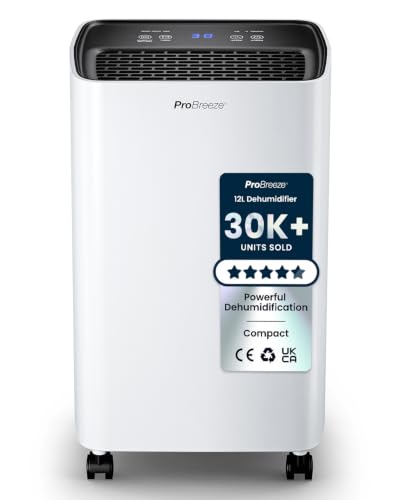
Best for lighter loads — Pro Breeze 12L
A smaller 12L compressor and 2L tank for a heated compact room.

Best compact premium — MeacoDry Arete One 12L
Laundry and night modes plus a five-year warranty in a 12L machine.

Best for a cold room — EcoAir DD1 Simple MK3
Desiccant operation for a cold utility room, with higher typical power use.
For a broader choice beyond laundry-focused models, see our guide to the best dehumidifiers in the UK.
In this guide
- Comparison at a glance
- The five best dehumidifiers for drying clothes
- Head-to-head recommendation
- How to dry laundry faster
- Choosing the right size and type
- Running costs
- How we chose
- The bottom line
- Frequently asked questions
Comparison at a glance
| Dehumidifier | Our verdict | Type | Best for | Main compromise |
|---|---|---|---|---|
| MeacoDry Arete Two 20L | Best overall | 20L compressor | Regular family laundry in heated rooms | Premium price and larger footprint |
| Pro Breeze OmniDry WiFi 20L | Best-value smart 20L | 20L compressor | Frequent laundry with app control | App convenience does not shorten drying by itself |
| Pro Breeze 12L | Best budget | 12L compressor | Smaller rooms and lighter wash loads | Smaller tank and less headroom for family laundry |
| MeacoDry Arete One 12L | Best compact premium | 12L compressor | Night mode and everyday humidity control plus laundry | Check the current gap against the budget 12L option |
| EcoAir DD1 Simple | Best for cold rooms | 7.5L desiccant | Unheated utility rooms, garages and conservatories | Usually higher power use in a warm room |
Prices and stock change frequently, so the table concentrates on the differences that should decide the purchase. Check current dimensions, warranty terms and drainage accessories before ordering.
The five best dehumidifiers for drying clothes
1. MeacoDry Arete Two 20L: best overall
The Arete Two 20L is our first choice for repeated family washing in a heated bedroom, utility room or spare room. Its 20L compressor class gives it more headroom than a compact 12L model when several wet garments release moisture at once. Laundry mode prioritises sustained extraction, while the humidistat can stop wasteful running once the target is reached. The combined HEPA air-purifier function is useful between wash days, although it should not be confused with the moisture-removal system. It costs more than the Pro Breeze alternatives, but the controls and five-year warranty make sense for a machine used throughout the year.
- Buy it if: several loads a week dry indoors and the room is normally heated.
- Skip it if: you only dry occasional small loads or the room stays cold in winter.
- Main compromise: premium pricing and a larger body than a 12L model.
2. Pro Breeze OmniDry WiFi 20L: best-value smart 20L
The OmniDry WiFi is the value alternative when you want 20L-class capacity without paying Arete Two money. Automatic humidity sensing, a timer, continuous drainage and a 4L tank cover the practical requirements. App control is convenient for checking the room without opening the door, but it does not increase extraction; room setup and airflow still matter more. Its quiet-mode claims are attractive for a spare room, though laundry mode and higher fan settings will be more audible.
- Buy it if: you want family-laundry capacity, remote control and a lower current purchase price.
- Skip it if: you prefer physical controls only or value Meaco’s five-year warranty and physical controls more.
- Main compromise: smart features add convenience rather than faster drying.
3. Pro Breeze 12L: best budget
The Pro Breeze 12L is the sensible budget choice for one person, smaller wash loads or a compact drying room. It includes automatic humidity control, continuous mode, a timer, wheels and a drainage option. The 2L tank is smaller than those on the 20L machines, so it may need emptying during a damp day unless a hose can be used safely. A 12L compressor model can still help considerably in a closed heated room; it simply has less reserve for a crowded family airer.
- Buy it if: purchase cost, storage and lighter laundry loads matter most.
- Skip it if: you regularly dry bedding, towels or several loads together.
- Main compromise: lower extraction headroom and a smaller tank than the 20L options.
4. MeacoDry Arete One 12L: best compact premium
The Arete One 12L suits a smaller home where the machine will manage everyday humidity as well as laundry. It combines a 12L compressor with a laundry mode, humidistat, night mode and HEPA filtration. Choose it for its night mode, laundry mode and five-year warranty rather than expecting greater headline extraction than another 12L machine. For a modest airer in a heated bedroom or flat, that trade can be worthwhile. For frequent family loads, the similarly priced 20L competition delivers more moisture-removal capacity, so choose this for the controls and compactness rather than raw output.
- Buy it if: you want a compact all-year machine with night mode for a smaller home.
- Skip it if: maximum laundry capacity per pound is the priority.
- Main compromise: premium 12L pricing overlaps with larger 20L competitors.
5. EcoAir DD1 Simple: best for cold rooms
The EcoAir DD1 Simple is the specialist choice for an unheated utility room, conservatory, garage or other winter space. Desiccant machines are less dependent on warm air than compressor models and release some warmth while running. EcoAir specifies extraction at temperatures down to 1°C, a laundry mode, adjustable louvre and a light 6kg body. Its simple rotary control is easy to understand. The trade-off is power consumption: in a normal heated room, a compressor model will usually be the more economical default. Clean the filter regularly because restricted airflow can cause overheating and poor performance.
- Buy it if: the drying room remains cold and a compressor struggles in winter.
- Skip it if: laundry dries in a normally heated living space.
- Main compromise: desiccant heat and fan operation normally use more electricity.
Head-to-head: which dehumidifier should you buy?
Buy the MeacoDry Arete Two 20L if indoor laundry is a regular household routine. It offers the best balance of extraction headroom, automatic control and all-year usefulness. The Pro Breeze OmniDry WiFi 20L is the stronger value choice when you want 20L-class capacity and app access at a lower current price.
Pick the Pro Breeze 12L for occasional loads in a small heated room, or the Arete One 12L when night controls and the five-year warranty matter more than capacity per pound. The EcoAir DD1 Simple wins only in a cold, unheated space. The biggest mistake is buying by the litres-per-day headline without considering temperature and room setup.
How to dry laundry faster with a dehumidifier
Use a small, closed room
Put the airer and dehumidifier in the smallest practical room, close the door and keep windows shut while the machine runs. This concentrates the moisture instead of asking one unit to treat the whole house. Do not block the appliance intake or outlet, and follow its required wall clearances.
Leave space around the clothes
Overlapping sleeves and packed rails trap damp air. Shake garments out, leave gaps and turn thick items partway through. Aim the dehumidifier outlet or a separate low-power fan across the airer rather than placing the machine underneath dripping clothes. Air movement often improves drying more than selecting an unnecessarily low humidity target.
Set a sensible humidity target
A target around 50–55% relative humidity is a useful starting point for many homes. Setting 30% does not guarantee faster drying and can keep the compressor running after the useful work is done. Check humidity with the built-in sensor or a separate meter; our guide to measuring humidity at home explains where to place it.
Manage the tank and drainage
A full tank stops most machines. Empty it before starting a large load or use continuous drainage where the manual permits and the hose can fall safely to a drain. Never create a trip hazard across a doorway. Our guide to using a dehumidifier properly covers placement, targets and maintenance.
Choosing the right size and type
12L or 20L compressor?
Choose 12L for a small heated room, lighter loads and easier storage. A 20L machine is better for family washing, towels, bedding and repeated winter use. The rating does not mean the tank holds that amount or that the machine will collect it every day; it is a laboratory extraction class. Compare tank size separately.
Compressor or desiccant?
A compressor is the default for a normally heated home because it generally uses less power. A desiccant model keeps working more consistently as temperatures fall and produces warmer outlet air, making it useful in an unheated outbuilding. Our dehumidifier versus opening-windows guide explains when ventilation helps and when outdoor air can bring more moisture in.
Noise and location
Published dB figures may refer to the quietest setting, while laundry mode often runs the fan harder. If the unit is in a bedroom, compare night controls and whether indicator lights can be dimmed. For a utility room, tank access, wheels and the direction of the air outlet matter more than a small difference in sound rating.
Running costs
Calculate cost from the power draw on the selected setting: divide watts by 1,000, multiply by hours used, then multiply by your electricity price per kWh. A 250W machine running for six hours uses 1.5kWh before any humidistat cycling is considered. Real use varies because compressors switch off after reaching the target.
Desiccant units commonly draw more power but can finish the job more reliably in a cold room. A heat-pump tumble dryer may also narrow the cost difference. Avoid universal pence-per-load claims; measure your own cycle with a plug-in energy monitor. Our detailed guide to dehumidifier running costs shows the calculation.
How we chose
We compared machines that can remove enough moisture to make a meaningful difference around an indoor airer. The main criteria were extraction class, compressor or desiccant technology, laundry setting, humidistat control, tank size, continuous drainage, fan airflow, noise, portability and suitability for typical UK room temperatures.
This is a specification-led buying guide, not a claim that we laboratory-tested every machine. Manufacturer data is useful for comparing features, but headline litres-per-day figures are measured under controlled conditions and will not equal the amount collected in every home. Room temperature, starting humidity, load size and airer spacing all change the result. Government guidance on damp and mould in homes also makes clear that moisture sources and ventilation need addressing rather than relying on one appliance alone.
The bottom line
The MeacoDry Arete Two 20L is the best dehumidifier for drying clothes in most heated UK homes. Choose the Pro Breeze OmniDry WiFi 20L if its current price is lower, the Pro Breeze 12L for lighter loads or the EcoAir DD1 Simple for a cold room. Room size, temperature and airflow matter as much as the model name, so set up the drying space properly before chasing a larger headline capacity.
Frequently asked questions
What size dehumidifier is best for drying clothes?
A 20L compressor model suits regular family laundry in a heated room. A 12L model is usually enough for lighter loads and compact spaces.
How long does a dehumidifier take to dry clothes?
There is no fixed time. Load size, fabric, room temperature, starting humidity, airflow and garment spacing all affect the result.
Should I close the door and windows?
Yes. A closed drying room lets the machine concentrate on moisture from the washing rather than treating air from the rest of the home.
What humidity should I use for laundry?
Around 50–55% relative humidity is a sensible starting target. Laundry mode may control the fan and humidistat automatically.
Is a dehumidifier cheaper than a tumble dryer?
It can use less electricity than some conventional tumble dryers, but tariffs, runtime and appliance efficiency vary. Compare measured kWh per load.
Can a dehumidifier prevent mould when drying clothes indoors?
It can reduce excess humidity, but mould prevention also requires ventilation, warmth where practical and action on leaks or persistent damp sources.