The best grow light for most UK houseplants is the SANSI 12W Gooseneck Desk Grow Light. It is compact, directional, dimmable and has a repeating timer, so it solves the usual winter-light problem without turning a living room into a propagation unit. Choose Barrina T5 bars for shelving, the Barrina T10 for a tall specimen, or the Spider Farmer SF-300 when several plants need stronger overhead coverage.
In This Article
- Grow lights compared
- Six grow-light reviews
- How to choose
- Position and timing
- Running costs and safety
- Common mistakes
- Final verdict
- Frequently Asked Questions
Best Grow Lights at a Glance
Match the fixture to the shape of the planting area before comparing headline wattage. A bulb creates a cone, bars spread light along a shelf, a panel covers a rectangle from above, and a vertical lamp lights foliage from the side.
| Product | Best for | Format | Coverage role |
|---|---|---|---|
| SANSI 10W E27 Grow Light Bulb | Best budget bulb | E27 bulb | One small plant or an existing lamp |
| SANSI 12W Gooseneck Desk Grow Light | Best compact lamp | Desk lamp | Desk, shelf or single medium plant |
| Barrina T5 2ft Grow Light Bars | Best for shelving | Four light bars | Propagation shelf or plant cabinet |
| Barrina T10 Vertical Grow Light | Best for tall plants | 120cm vertical lamp | Monstera, ficus and tall foliage |
| Spider Farmer SF-300 Grow Light | Best hanging panel | Hanging panel | Dense shelf or grouped plants |
| OUTON 60W Standing Grow Light | Best floor-standing setup | Adjustable floor lamp | Large mixed plant corner |
None of these products replaces sensible placement. Light intensity drops quickly as distance increases, while a powerful lamp placed too close can bleach or stress leaves. Start with the maker’s distance guidance, then watch new growth and adjust one variable at a time.
The Six Best Grow Lights for UK Houseplants
1. SANSI 10W E27 Grow Light Bulb — Best Budget Bulb

This is the simplest way to add useful plant light when you already own a suitable open E27 lamp. SANSI describes a 4000K full spectrum, 60-degree beam and 10W actual draw. The narrow beam suits one small plant or a tight cluster better than a wide shelf.
The bulb needs an open fitting so heat can escape; the listing explicitly warns against enclosed shades. There is no built-in timer, so pair it with a plug-in timer or smart plug.
- Buy it if: you want a low-cost bulb for one plant.
- Skip it if: you need broad coverage or an all-in-one fixture.
2. SANSI 12W Gooseneck Desk Grow Light — Best Overall

The 12W desk lamp is the easiest all-round choice for a windowsill, side table or plant shelf. Four dimming levels and a flexible neck make it easier to control distance than a fixed bulb. Its 3, 6 and 12-hour repeating timer removes the need to switch it manually every day.
It remains a compact lamp, so it is better for one medium plant or several small pots than a broad collection. Use the lowest useful brightness first in a living space; glare matters to people even when the plant is happy.
- Buy it if: you want a tidy, timer-equipped light for everyday houseplants.
- Skip it if: you need to illuminate a long shelf or tall plant from top to bottom.
3. Barrina T5 2ft Grow Light Bars — Best for Shelving

This four-bar, 40W set is shaped for propagation racks, cabinets and long shelves. Each 60cm bar has its own switch, and the set can be linked, allowing one or more bars per shelf rather than forcing every tier to receive the same output.
The “yellow” full-spectrum appearance is easier to live with than purple light, but four exposed bars still look functional. The supplied adhesive is not suitable for every surface, so use proper clips or screws where falling onto wet compost would be a risk.
- Buy it if: you have several plants arranged in rows.
- Skip it if: you need a decorative lamp for one pot.
4. Barrina T10 Vertical Grow Light — Best for Tall Plants

A vertical light makes sense for monstera, ficus and other tall foliage because it directs light across the plant’s side rather than only at the uppermost leaves. This model uses a 120cm, 42W light body on a small tripod and includes a foot switch.
It has no integrated repeating timer, and a side light can pull growth towards one direction. Rotate the plant periodically or combine it with daylight from the opposite side. Check the tripod footprint before placing it in a busy walkway.
- Buy it if: a tall specimen has dark lower foliage.
- Skip it if: you need overhead light for seedlings or a timer built into the lamp.
5. Spider Farmer SF-300 Grow Light — Best Hanging Panel
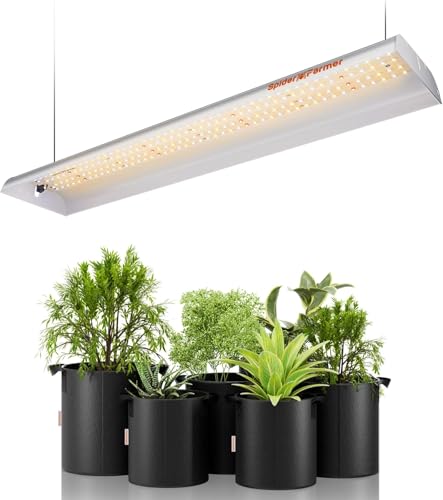
The slim SF-300 is the strongest choice here for a dense group of plants. Spider Farmer specifies 32W draw, a broad 120-degree beam and a long linear panel, which suits a deeper shelf or compact propagation zone better than a clip lamp. Hanging wires allow height adjustment as plants grow.
It is designed to hang rather than blend into a table lamp, and the listing does not present an integrated timer or dimmer. That makes installation and distance more deliberate, but it also avoids weak clamp arms over a valuable plant collection.
- Buy it if: you want serious overhead coverage for grouped plants.
- Skip it if: you cannot suspend a fixture securely.
6. OUTON 60W Standing Grow Light — Best Floor-Standing Setup

The OUTON combines a tripod, adjustable height, three light modes, ten brightness levels and a repeating 4, 8 or 12-hour timer. Its vertical arrangement is useful beside a large mixed plant corner where a small bulb would leave lower leaves in shade.
The large stand occupies floor space and its very broad feature list comes from the manufacturer rather than independent output testing. Treat modes and dimming as placement tools, not proof that every setting suits every species.
- Buy it if: you need adjustable side coverage for a large indoor display.
- Skip it if: floor space is tight or you want an unobtrusive fitting.
How to Choose a Grow Light
Choose Coverage Before Power
Measure the lit area, not the room. A 60cm shelf wants a bar; a round pot beneath a lamp suits a bulb; several plants on a table usually need a panel. Manufacturer wattage-equivalent claims are poor comparison tools because beam angle, distance and fixture shape decide how much light reaches each leaf.
Full Spectrum Is the Easiest Living-Space Choice
White full-spectrum LEDs are easier on the eyes and preserve natural leaf colours. Red-and-blue modes can be useful in dedicated growing spaces, but purple light is intrusive in a bedroom or lounge. Spectrum labels do not guarantee useful intensity, so do not buy on “full spectrum” alone.
Timers and Dimming Matter
A repeating timer keeps the schedule consistent, while dimming helps when a lamp must sit close to foliage. Check whether the timer restarts automatically after a power cut. A basic external timer often makes a good bulb or panel more practical than a weaker all-in-one lamp.
How to Position and Time a Grow Light
Begin with the maker’s suggested hanging distance and a moderate duration. Many foliage plants respond well to a consistent supplementary period during short UK winter days, but the right combination depends on daylight, species, beam and distance. More hours cannot fully compensate for a lamp that is too far away.
- Start conservatively: use a moderate brightness and check the newest leaves after several days.
- Keep the beam even: centre the plant or rotate it so growth does not lean permanently towards one side.
- Preserve darkness: plants still need a night period; avoid leaving the lamp on around the clock.
- Watch the plant: stretching and pale new growth can indicate too little useful light, while bleaching, crisp patches or curling near the lamp can indicate excessive intensity or heat.
The Royal Horticultural Society’s houseplant-lighting guidance is a useful reference for matching natural positions to plant needs. A grow light supplements that judgement; it does not make every dark corner suitable for every species.
Running Costs and Safety
Running cost follows actual wattage, hours used and your electricity tariff. Multiply watts by daily hours, divide by 1,000 to get kilowatt-hours, then multiply by the unit rate on your bill. A 10W bulb used for 12 hours consumes 0.12kWh per day; a 60W lamp on the same schedule consumes 0.72kWh.
Keep plugs, controllers and extension leads away from watering spills. Do not cover vents or put a heat-dissipating bulb in an enclosed shade when the manufacturer warns against it. Mount shelf bars and hanging panels with mechanical support suited to the surface, not hopeful adhesive above damp compost.
The UK government publishes current guidance on electrical-equipment responsibilities and product safety. Stop using any lamp with a damaged cable, loose driver, scorched fitting or flickering that persists after checking connections.
Common Grow Light Mistakes
- Buying by claimed equivalent wattage: compare actual draw, fixture shape and credible output data instead.
- Placing a weak lamp too far away: moving a suitable lamp closer often helps more than extending the timer.
- Lighting only the top leaf: use bars, a panel or vertical light when the canopy is broad or tall.
- Ignoring glare: position living-space lamps below eye level or shield the beam without trapping heat.
- Changing everything at once: adjust distance, brightness or duration separately so the plant’s response is readable.
- Running continuously: use a timer and maintain a regular dark period.
Final Verdict
The SANSI 12W Gooseneck Desk Grow Light is the best all-round choice for most homes because it combines directional light, dimming and a repeating timer in a compact fitting. The SANSI E27 bulb is the budget solution when you already have an open lamp.
Choose Barrina T5 bars for shelves, the Barrina T10 for tall plants, the Spider Farmer SF-300 for a denser overhead setup, and the OUTON when a large floor-standing fixture suits the room. The right format matters more than buying the highest claimed wattage.
Frequently Asked Questions
Do houseplants need grow lights in the UK?
Not all do, but grow lights can help plants kept away from windows or during short, overcast winter days. Match the lamp to the species and existing daylight.
How many hours should a grow light be on?
A consistent daily period with a regular dark interval is better than continuous light. Start with the maker’s guidance and adjust for natural daylight and plant response.
How close should a grow light be?
It depends on output and beam angle. Follow the manufacturer’s starting distance, then watch new leaves for stretching, bleaching or heat stress.
Is full-spectrum light better for houseplants?
It is the easiest choice for living spaces because it supports plant growth while appearing white to people. The label alone does not guarantee adequate intensity.
Can I use a normal LED bulb?
A bright white household bulb may supplement a very small plant, but a purpose-made grow bulb usually provides a more useful beam and documented plant-light spectrum.
Are grow lights expensive to run?
Small LED grow lights use modest power. Calculate cost from actual wattage, daily hours and your electricity unit rate rather than marketing equivalents.